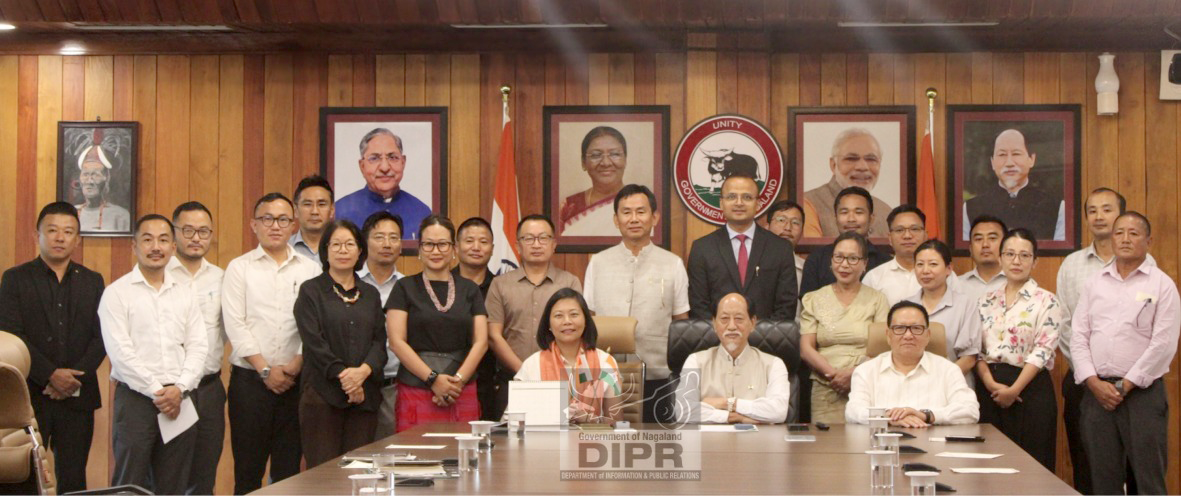
Nagaland Chief Minister, Neiphiu Rio on Friday virtually inaugurated the Chief Minister’s Yarn Bank Scheme on the occasion of the 12th National Handloom Day, describing the initiative as a landmark intervention aimed at strengthening Nagaland’s handloom sector and improving the livelihoods of thousands of weavers across the State.
The virtual inauguration was held at the Chief Minister’s Residential Complex, Kohima, while the Yarn Bank has been established at the District Industries Centre, State Industrial Park, Toluvi, Dimapur.
Addressing the programme, Rio said National Handloom Day is not merely a celebration of a traditional craft but a tribute to a living heritage that embodies the identity, culture and spirit of the Naga people. He said handloom represents the artistry, resilience and creativity of the people, with every shawl, wrap and woven motif carrying the stories, traditions and values of the various Naga tribes.
Paying tribute to the weavers of Nagaland, particularly women, the Chief Minister described them as the backbone of the State’s handloom sector and commended their dedication, perseverance and extraordinary craftsmanship in preserving the State’s rich textile heritage despite changing times.
According to a DIPR update, Rio acknowledged that the lack of affordable, quality natural yarn has remained one of the biggest challenges facing weavers in Nagaland. Many artisans, he noted, have been compelled to travel long distances to procure raw materials, resulting in high transportation costs and inflated prices that reduce productivity and earnings.
To address this issue, the Government has established the Chief Minister’s Yarn Bank, at the District Industries Centre, State Industrial Park, Toluvi, Dimapur, which would function as a centralised facility to supply high quality natural yarn to eligible weavers across the State, he said.
Under the scheme, natural yarns including cotton, eri silk, muga silk, bamboo fibre and other natural fibre blends will be made available at mill-gate prices. In addition, the State Government will provide a 15 per cent subsidy, making raw materials more affordable and accessible to eligible weavers.
The Chief Minister said the initiative is expected to benefit 5,000 to 10,000 weavers annually. Eligible weavers possessing a Yarn Pass Book would be able to procure yarn directly from the Yarn Bank through a transparent, reliable and efficient distribution system, he added.
Boosting livelihoods and preserving heritage
Rio said the Yarn Bank is far more than a raw material supply mechanism. It represents the Government’s commitment to reducing production costs, ensuring timely availability of quality yarn and creating better opportunities for artisans to improve productivity and household incomes while safeguarding Nagaland’s traditional textile heritage.
He added that the initiative aligns with the Government’s broader vision of preserving the State’s cultural heritage while creating sustainable economic opportunities. Strengthening the handloom sector, he said, would promote women’s empowerment, entrepreneurship, rural economic growth and the preservation of one of Nagaland’s most valuable cultural assets.
Download Nagaland Tribune app on Google Play


Calling upon eligible weavers across all districts to take advantage of the scheme, the Chief Minister also urged government departments, cooperative societies, self-help groups, village institutions and community leaders to work together to ensure that its benefits reach deserving artisans.
On the occasion of National Handloom Day, the Chief Minister appealed to the people of Nagaland to renew their collective commitment to protecting, promoting and celebrating the State’s handloom heritage so that the traditions passed down through generations continue to inspire future generations.
Rio expressed confidence that the Chief Minister’s Yarn Bank would become a lasting support system for the handloom community and further strengthen Nagaland’s rich weaving tradition.
Advisor highlights implementation framework
Advisor for Industries & Commerce, Hekani Jakhalu described the launch of the Yarn Bank as a major milestone in addressing one of the most persistent challenges faced by the State’s weaving community.
Expressing gratitude to Chief Minister, Jakhalu said that despite his many responsibilities, he has consistently supported the handloom and textile sector.
She noted that while the department of industries & commerce has implemented several initiatives under the textile division over the years, the establishment of a Yarn Bank had long been identified as a critical requirement. She thanked the Chief Minister for allocating funds under the CM innovative fund 2025-2026 for the project last year, making its launch possible.
The Advisor also acknowledged the immense contribution of the weavers of Nagaland, describing them as the custodians of the State’s identity, culture and heritage. She said the traditional shawls and textiles woven by generations of artisans have become symbols through which the Nagas are recognized across the world and stressed that preserving the handloom tradition means preserving the identity of the people.
Jakhalu, informed that the Chief Minister’s Yarn Bank has been established to provide affordable, high-quality natural yarn to eligible weavers with Government support. Implemented under the National Handloom Development Programme (NHDP) in accordance with the Ministry of Textiles’ Raw Material Supply Scheme (RMSS) guidelines, the initiative aims to reduce production costs and improve access to quality raw materials.
Explaining the implementation process, she said eligible weavers must possess a valid Handloom Mark (HM) Identity Card and register through the designated mobile application. Verification will be carried out using the State Handloom Database and census records. She added that the department is updating the State’s weavers’ database to ensure that benefits reach genuine artisans.
She further informed that applicants must be at least 18 years of age and active weavers. Registered cooperative societies with a minimum of ten members will also be eligible under the scheme.
To ensure transparency and accountability, Jakhalu said the department will establish a real-time digital dashboard for inventory management and subsidy tracking. Regular third-party audits, district-level monitoring committees, a toll-free helpline and a grievance redressal mechanism will also be put in place.
Describing the Yarn Bank as a transformative initiative, the Advisor expressed confidence that it would positively impact thousands of weavers across Nagaland by improving access to raw materials, enhancing productivity and strengthening livelihoods.