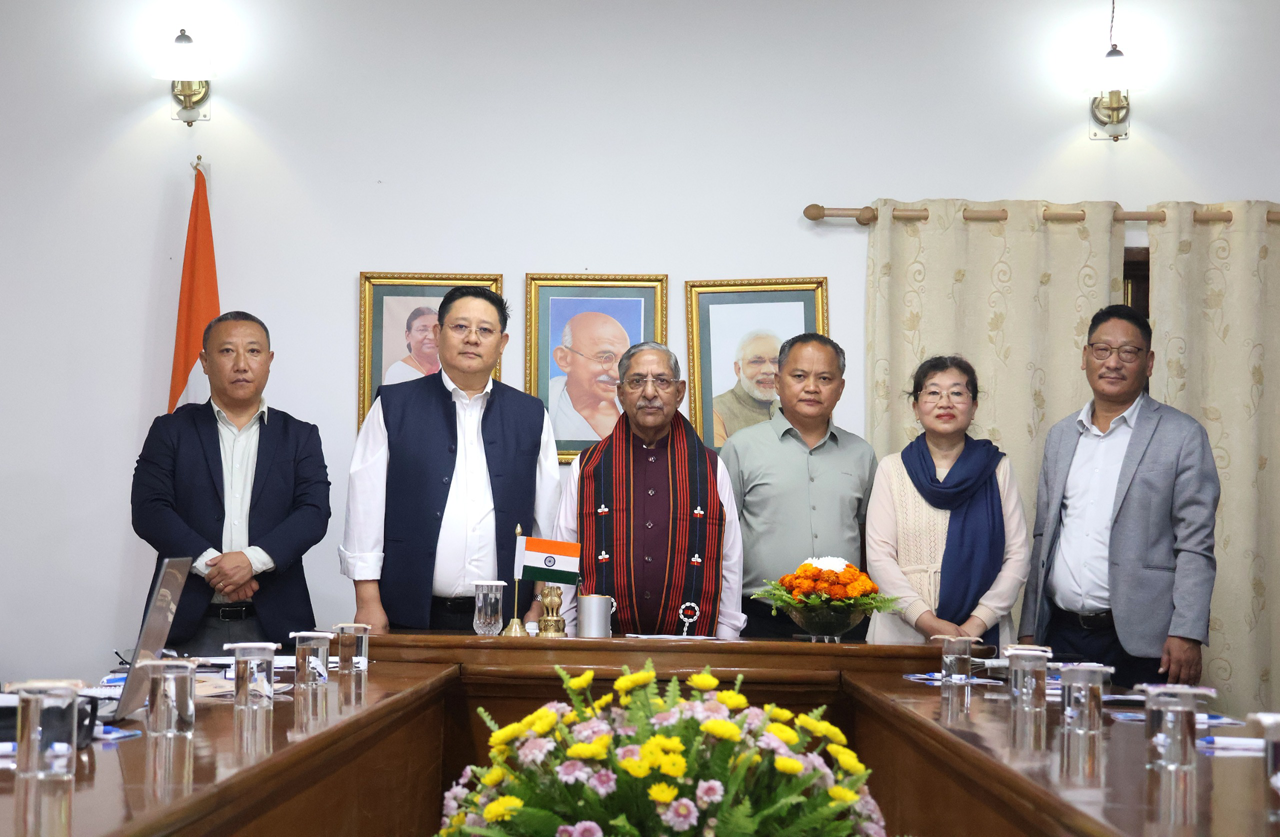
Nagaland Governor Nand Kishore Yadav on Tuesday reviewed the functioning of the Department of Excise & Prohibition, including its enforcement activities, revenue collection, infrastructure and operational challenges, and called for stronger institutional mechanisms to combat illicit liquor and drug trafficking in the State.
The Governor held the review meeting with officials of the department at Lok Bhavan, Kohima, where a detailed presentation was made on its mandate, achievements and future roadmap.
The department functions under various laws, including the Nagaland Excise Act, 1967, Nagaland Excise Rules, 1972, Nagaland Liquor Total Prohibition Act, 1989, Nagaland Liquor Total Prohibition Rules, 1990, the Narcotic Drugs and Psychotropic Substances (NDPS) Act, 1985, and the Drugs & Cosmetics Act, 1940.
During the review, the department highlighted its enforcement activities from April 2021 to March 2026, including cases registered under the Nagaland Liquor Total Prohibition (NLTP) Act and drug-related cases.
Seizures during the period included Indian Made Foreign Liquor (IMFL), country liquor, poppy straw, opium, heroin, cough syrup and other drugs in the form of capsules and tablets. The department also highlighted recent seizure operations and the destruction of confiscated liquor and narcotic substances.
On revenue generation, the department reported total excise revenue collection of ₹2,250.66 lakh (₹22.51 crore) during the five-year period from April 2021 to March 2026. Annual revenue collection increased from ₹317.36 lakh in 2021-22 to ₹591.96 lakh in 2025-26.
The meeting also reviewed infrastructure development under the Excise Housing Programme for 2025-26, including the construction of Excise Offices at Phek and Peren and an Excise Bonded Warehouse at Dimapur.
Download Nagaland Tribune app on Google Play


The department informed the Governor that it has also been undertaking drug awareness campaigns as part of its efforts to prevent substance abuse and strengthen public awareness alongside enforcement measures.
Among the major challenges highlighted were porous borders, shortage of manpower, the absence of a cadre review since the department’s inception, discontinuation of inter-district check-gates, outdated firearms, limited operational mobility and persistent demand-driven illicit liquor.
The department pointed out that its personnel-to-population ratio currently stands at 1:6,000, compared with 1:2,000 in Mizoram, underscoring the need for strengthening its human resources and operational capacity.
The department’s future roadmap focuses on strengthening enforcement, combating organised crime, protecting public health, improving governance, increasing revenue, building personnel capacity and working towards a drug-free Nagaland.
Governor Yadav stressed the need to strengthen enforcement mechanisms and institutional capacity to effectively tackle the challenges posed by illicit liquor and drug trafficking. He also emphasised the department’s wider role in protecting public health, promoting effective governance and contributing to a safer society.
The review meeting provided an opportunity to assess the department’s achievements, identify operational gaps and deliberate on measures to strengthen its enforcement and administrative capabilities.
Secretary, Excise and Prohibition, T Wati Aier, along with other officials of the department, attended the meeting.