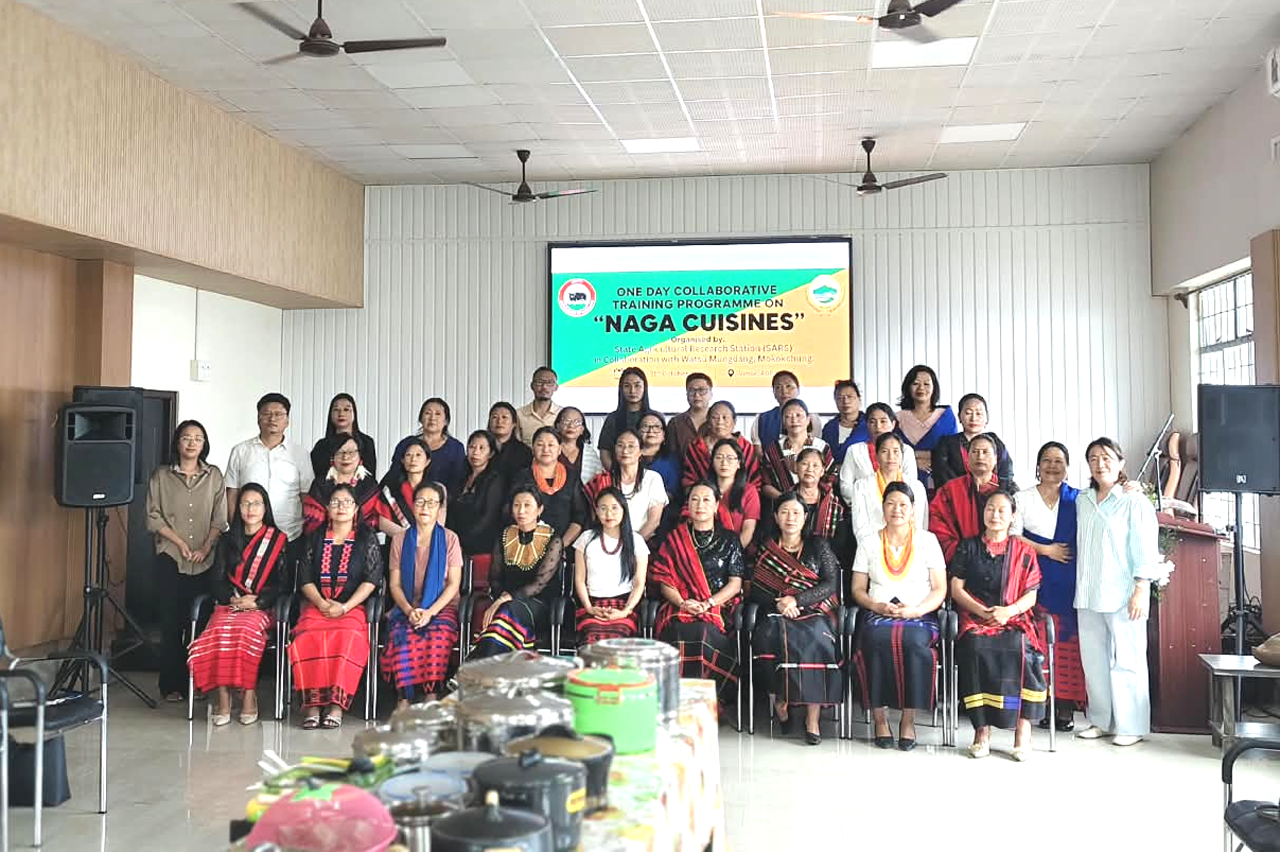
The State Agricultural Research Station (SARS), Yisemyong, in collaboration with Watsü Mungdang, organised a one-day collaborative training programme on “Naga Cuisines” at AOR Kilem, Mokokchung, on October 30, with the objective of preserving indigenous food traditions, promoting local agricultural biodiversity and exploring opportunities for food-based entrepreneurship.
Delivering the keynote address, I Lipokonen Jamir, Joint Director, SARS, Yisemyong, highlighted the close relationship between indigenous food systems, agricultural conservation and the livelihoods of farmers. He said that preserving traditional food practices would also contribute to conserving indigenous crops, as different Naga cuisines are closely connected to locally grown agricultural produce.
He explained that SARS has been working towards the preservation of indigenous crops through seed conservation, collection, cultivation and gene banking. In this regard, documenting traditional food practices and promoting Naga cuisines would indirectly contribute to the conservation of crop biodiversity while creating opportunities for farmers through increased demand for indigenous agricultural produce.
Jamir also stressed the importance of involving women in the initiative, noting that women play a central role in preserving traditional cooking practices and passing down culinary knowledge through generations.
Explaining the choice of Watsü Mungdang as the collaborating organisation, he said that although the programme could have been organised with students or other groups, women were particularly important because of their traditional role in safeguarding food culture.
He encouraged women to look beyond their traditional responsibilities in the kitchen and explore opportunities in food entrepreneurship, stating that indigenous Naga cuisine has the potential to contribute to household incomes as well as the wider state economy.
Highlighting the prospects of food tourism, Jamir observed that while Nagaland has much to offer in terms of dances and songs, its culinary heritage presents another promising avenue for attracting visitors. He said that even within a single Naga tribe, there are different dishes and tastes, and the culinary diversity among the 17 Naga tribes offers immense possibilities.
He encouraged participants to learn from one another, exchange culinary knowledge and explore ways of developing traditional dishes into viable enterprises. He further noted that indigenous Naga entrepreneurs have an advantage in taking ownership of and promoting their own culinary heritage.
Download Nagaland Tribune app on Google Play


Representatives from eight Naga tribes – Ao, Lotha, Sumi, Phom, Konyak, Chang, Sangtam, Khiamniungan and Yimkhiung , presented their traditional dishes and shared their recipes during the programme. A total of 26 recipes were collected, covering the diverse culinary traditions of the participating communities. Although each tribe had initially been requested to bring two dishes, several participants brought additional dishes, which the organisers welcomed as an encouraging response. The Tenyimi community was the only community that could not participate, and its traditional dishes could therefore not be included in the proposed compilation.
Jamir informed that the recipes presented during the programme would be documented and compiled into a recipe book, creating a written record of traditional culinary knowledge that has largely been preserved and transmitted orally. He said the initiative was intended to ensure that these food traditions are not lost over time and can be shared with future generations.
He also expressed the hope that the programme would encourage cross-learning among the different Naga communities and eventually help develop indigenous cuisines into organised food enterprises.
Earlier, N Hamche Phom, Food Technician, Food Safety Department, Health and Family Welfare, conducted a technical session on food safety standards, highlighting the importance of safe food preparation, handling, storage and distribution.
Explaining the role of the Food Safety and Standards Authority of India (FSSAI), he said that food safety regulations are intended to ensure that food products are safe for human consumption and to prevent food-borne illnesses caused by contaminated food.
The session covered FSSAI registration, food labelling and packaging requirements, product information, batch numbering, ingredient and nutritional declarations, allergy information, and the importance of maintaining proper records for traceability and food recall in the event of contamination or other safety concerns.
He also highlighted sanitation and hygiene practices, including personal cleanliness, proper handwashing, trimmed nails, the use of appropriate protective clothing and gloves, and the need to keep vegetarian and non-vegetarian food items separately to prevent cross-contamination. Participants were also sensitised to the proper storage of high-risk food items such as milk, meat and eggs, along with maintaining clean food preparation areas and suitable storage conditions.
The food safety session further emphasised that proper registration, standardised packaging and labelling, and compliance with food safety regulations are essential for anyone intending to establish a food business and market traditional food products.
In her short speech, Watsü Mungdang president Tianaro highlighted the significance of traditional cuisine as an expression of cultural identity and belongingness. She emphasised the need to recognise the value of indigenous food practices and preserve the rich culinary diversity of the Naga people.
The programme was chaired by Asungla, executive member of Watsü Mungdang, while C. Amei Phom, SMS, SARS, Yisemyong, delivered the vote of thanks. The programme concluded with a community lunch.