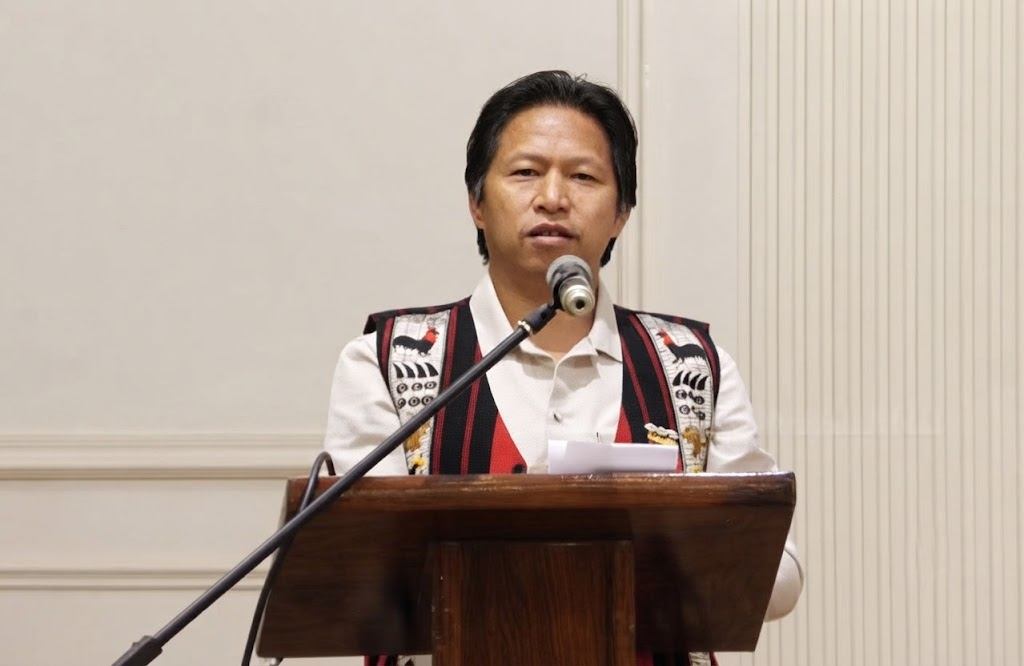
NPF Secretary General and MLA, Achumbemo Kikon on Thursday launched a sharp political attack on former Chief Minister Dr SC Jamir and former minister, K Therie, questioning their past and present positions on the Naga political issue and accusing them of creating confusion among the younger generation.
Speaking at the commemoration of Prime Minister Narendra Modi’s 76th birthday at Niathu Resort, Kikon said political discourse on the Naga issue must be based on historical records and documentary evidence rather than allegations.
Referring to a reported 1963 communication from Jamir to then Chief Executive Councillor P Shilu Ao, Kikon claimed the letter reflected opposition to Prime Minister Jawaharlal Nehru’s proposed meeting with Naga leader AZ Phizo.
Kikon read excerpts from the document and argued that Jamir’s position at that time was relevant to the present political debate over the Naga issue.
He also questioned the contention that the creation of Nagaland State through the 16-Point Agreement represented the final political settlement for the Nagas.
“If statehood is the solution, do you think Government of India will sign another ceasefire with effect from 6th September, 1964 with the NNC/FGN at that point of time?” he asked.
Kikon referred to the 1964 ceasefire and subsequent political negotiations involving representatives of the Naga underground movement and the Government of India, including talks at the Prime Ministerial level.
He said the NPF continued to stand for an “honourable, inclusive and acceptable” solution to the Naga political issue.
“We are not saying that statehood is non-existent. It is the process,” Kikon said, while arguing that sections involved in the Naga political movement had been left out of the statehood process.
Equi-distance versus equi-closeness
Kikon also criticised what he described as the “equi-distance” policy followed during Jamir’s tenure as Chief Minister.
He said the NPF-led government that came to power in 2003 changed the approach to “equi-closeness”, maintaining that all Nagas should be treated as members of one family irrespective of their political background.
“Naga people are all equal, one family,” he said, adding that differences should be addressed collectively rather than by keeping sections of society apart.
Kikon also criticised suggestions of imposing President’s Rule in Nagaland, describing such remarks as unbecoming of a senior political leader.
He said elected representatives were mandated by the people through the democratic process to provide governance and maintained that political leaders should exercise caution in their public statements.
Download Nagaland Tribune app on Google Play


Cites 2002 Therie statement
Kikon also took aim at K Therie, referring to a June 10, 2002 report in which Therie, then a former Nagaland Power Minister, had described Jamir as the “main obstacle” in the Naga peace process.
The contemporary report by a journalist’s record Therie as accusing Jamir of obstructing the peace process and criticising the then Chief Minister’s position on Naga sovereignty and the publication Bed Rock of Naga Society.
Kikon said Therie’s earlier position and his current statements should be viewed in the context of consistency in political positions.
“I think we also have to be consistent in our stand, especially on this Naga political issue. Let us not confuse our young generation,” he said.
He further appealed to senior political leaders to exercise restraint and responsibility in their statements on the Naga issue.
‘Generation Z’ and Naga history
Kikon said many members of the younger generation, particularly those born after the 1997 ceasefire, had not personally experienced the hardships and violence associated with the earlier period of Naga political conflict.
He therefore stressed the importance of presenting historical developments accurately to younger Nagas.
“Many of our people today, young generation, Generation Z, born after ’97 only… do not know the hardship, the horrible situation that our people have gone through,” he said.
Kikon maintained that political narratives surrounding the Naga issue should not be altered in a manner that could confuse younger generations.
The NPF Secretary General said his remarks were relevant to the occasion because the programme was a political gathering and the party wanted to clarify its position on the Naga political issue.
He reiterated that the NPF continued to support an honourable and inclusive political settlement and said the party would remain committed to the interests and aspirations of the Naga people.