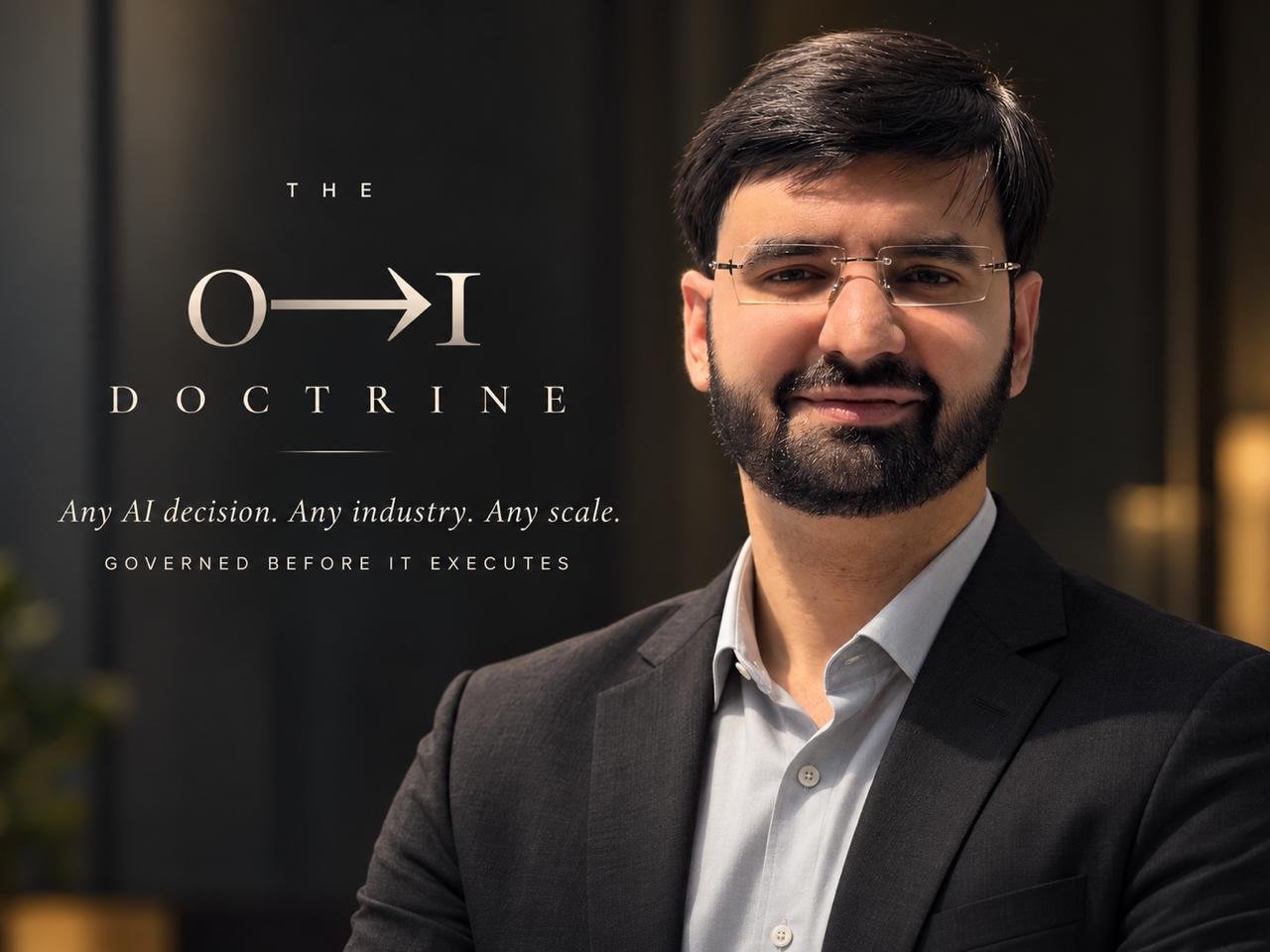
As global leaderships confront a shared, unresolved question about AI oversight, inventor Vatsal Soin’s 0→1 Doctrine offers a mathematical answer: consequential actions, from routine AI agents to systems approaching AGI, superintelligence, or the Singularity, can be represented on a zero-to-one scale, tested against an authorized boundary, and sealed before execution — with his new invention, filed on 23 September 2026, extending that governance grammar to dormant data.
Live: www.0to1doctrine.com
THE DORMANT DATA PROBLEM
AI is generating more capability, while organizations already hold years of dormant records whose value, cost, privacy exposure, and future usefulness may be unclear. The new invention addresses this neglected layer: deciding what should remain, what should be removed, what may support a derived signal, and what evidence should accompany each decision — potentially reducing storage waste and governance costs while creating opportunities to monetize permitted, governed data value.
BBAT STARTS WITHOUT OPENING THE FILE
Band-Based Archive Triage, or BBAT, applies the principle to dormant archives. The first triage boundary is metadata-only, using attributes such as age, category and jurisdiction. The disclosed final dispositions are RETAIN, PURGE and PROMOTE.
That separation matters. Initial classification does not require the archive content, only its declared metadata — sorting toward retention, deletion, or promotion without a human reading a single file.
DELETE-BEFORE-SHARE CHANGES THE SEQUENCE
Delete-Before-Share, or DBS, changes the order: the source is processed inside a Trusted Execution Environment (TEE), the required conditions are verified, and the source records are destroyed before the normalized band is transmitted.
The original records therefore do not become the outward-facing object. A Hardware Attestation Certificate (HAC) provides evidence associated with the protected execution and deletion commitment. The Actuation Compliance Receipt (ACR) records the governance conditions and evidence associated with the controlled operation, while the transmission interface remains subject to the disclosed verification and authorization conditions.
THE BAND BECOMES THE NEW OBJECT
There is another feature here as well. The band is not a substitute for the record — it is a governed representation that stands in for it once the original is destroyed. The resulting dark-data band is a normalized interval with lower and upper bounds, required before release. Where a derived band is narrower than the disclosed minimum width, the Band Width Enforcer can adjust it symmetrically, reducing the risk of pointing to one record.
FROM DORMANT DATA TO GOVERNED VALUE
The Dark Data Monetisation Engine, or DDME, takes promoted dormant data into a controlled derivation process, where the original records can remain protected while a normalized band becomes the usable output. That changes the economic question: instead of storing every record indefinitely, an organization can reduce unnecessary data burden and, where permissions and market conditions allow, potentially monetize a governed derived signal.
TRAINING CAN USE SIGNALS INSTEAD OF FILES
The Band-Derived Training Signal, or BDTS, provides a population-level route toward AI training using derived signals rather than individual raw records. It can draw on centuries-old mathematics and science models used across statistics, research, engineering, and scientific analysis. The approach does not remove every training or privacy challenge. Each signal still requires appropriate testing, provenance, population safeguards, and sector-specific rules before use.
WHY THIS MATTERS AS AI BECOMES MORE CAPABLE
A mathematical boundary cannot solve every governance problem. It can, however, make one part of the problem explicit: measure a defined state, compare it with a defined boundary, record the outcome and require another path when the conditions are not satisfied.
HEALTH, SCIENCE AND NATURE SHOW THE NON-MONETARY VALUE
A hospital archive illustrates the potential. Years of outcomes may contain patterns useful for research, but consent, privacy, provenance and statistical validity cannot be treated as optional. A governed population-level signal could be useful without requiring broad movement of raw records.
Similar logic could be explored in laboratory research, manufacturing, energy systems, biodiversity, environmental observations, maintenance histories and supply chains.
MONEY SAVED, MONEY EARNED — AND VALUE PRESERVED
The economic case has two sides. Lawful deletion can reduce unnecessary retention and administration. Governed derivation can potentially create a saleable signal where permissions, quality and a legitimate market exist.
A better research signal, earlier detection of a pattern, or preserved scientific insight all carry value that never shows up on a balance sheet, yet matters just as much.
THE HUMAN BOUNDARY REMAINS CENTRAL
The architecture should not be described as making AI harmless or guaranteeing human control. Its narrower proposition is that defined governance conditions can be placed around defined operations, with escalation and human review where the disclosed rules require them.
DETECTION IS NOT AUTHORIZATION
Cross-Agent Aggregation and Deconfliction or CAAD is similarly an analytical layer for AI-agent swarms, not an automatic grant of authority. It uses weighted components declared by a sector governance authority to detect patterns across agents. Detection stays distinct from authorization.
A MATHEMATICAL REMEDY TO A DATA WALL
The broader significance is a change in what counts as the usable object. Instead of raw records, governed bands and signals become the thing an organization can safely retain, share, or monetize.
THE QUESTIONS THAT MATTER
What is the core mathematical idea behind BBAT?
BBAT puts relevant parameters onto a common 0–1 scale so different governance factors can be considered together. At the archive stage, these normalized parameters support retention decisions; downstream, promoted data can produce a normalized band derived from dormant data.
What is the key difference between a band and an index?
A normalized band represents a range of possible values, while an index is a single calculated result used to support an analytical or governance decision. They serve different purposes and should not be treated as the same type of output.
Does more data automatically make a result private or safe?
No. Population size can help, but the filing also addresses band width, auxiliary-data risk, repeated releases and other conditions. More records alone do not establish privacy or permission.
Can a derived signal be reused or monetized indefinitely?
No. Derivation does not create unlimited rights. Reuse or monetisation remains subject to permissions, privacy controls, freshness or re-evaluation requirements, and governance conditions.
Are BBAT, DDME, BDTS and CAAD one operation?
No. BBAT handles archive triage; DDME provides protected derivation; BDTS provides a separate population-level training-signal pathway; and CAAD detects patterns across agents or receipts. Detection, derivation, training and authorization remain distinct.
CLOSING NOTE
“A data wall is not solved by generating more numbers. It’s solved by governing the numbers already sitting there, unused, for years. This filing does the second one.”
Live: www.0to1doctrine.com
This can be tested, live, via API, governed against ungoverned, side by side.
THE INVENTOR
Vatsal Soin is a serial inventor and entrepreneur whose 0→1 Doctrine now spans AI decision governance, biometric authorization, financial transaction control, and dormant data governance at global scale. His patent filings span six continents, with grants already secured in the US, India, Japan, and South Africa. He is a SIM–RMIT alumnus and an alumnus of Nanyang Technological University, Singapore.
SELECTED REFERENCES
Granted: US Patent 12,446,652 B2 · Japan Patent 7560909 · India Patents 454081 and 599317. Filed: PCT/IN2025/051943 · US 19/489,595 · India 202511115781 · Australia AU2022450649 · India 202611113867 (23 September 2026).
DISCLAIMER
Informational only. Not certified. No endorsement implied. Not investment advice. Examples are illustrative, not field results. Vatsal Soin · © 2026 All Rights Rese