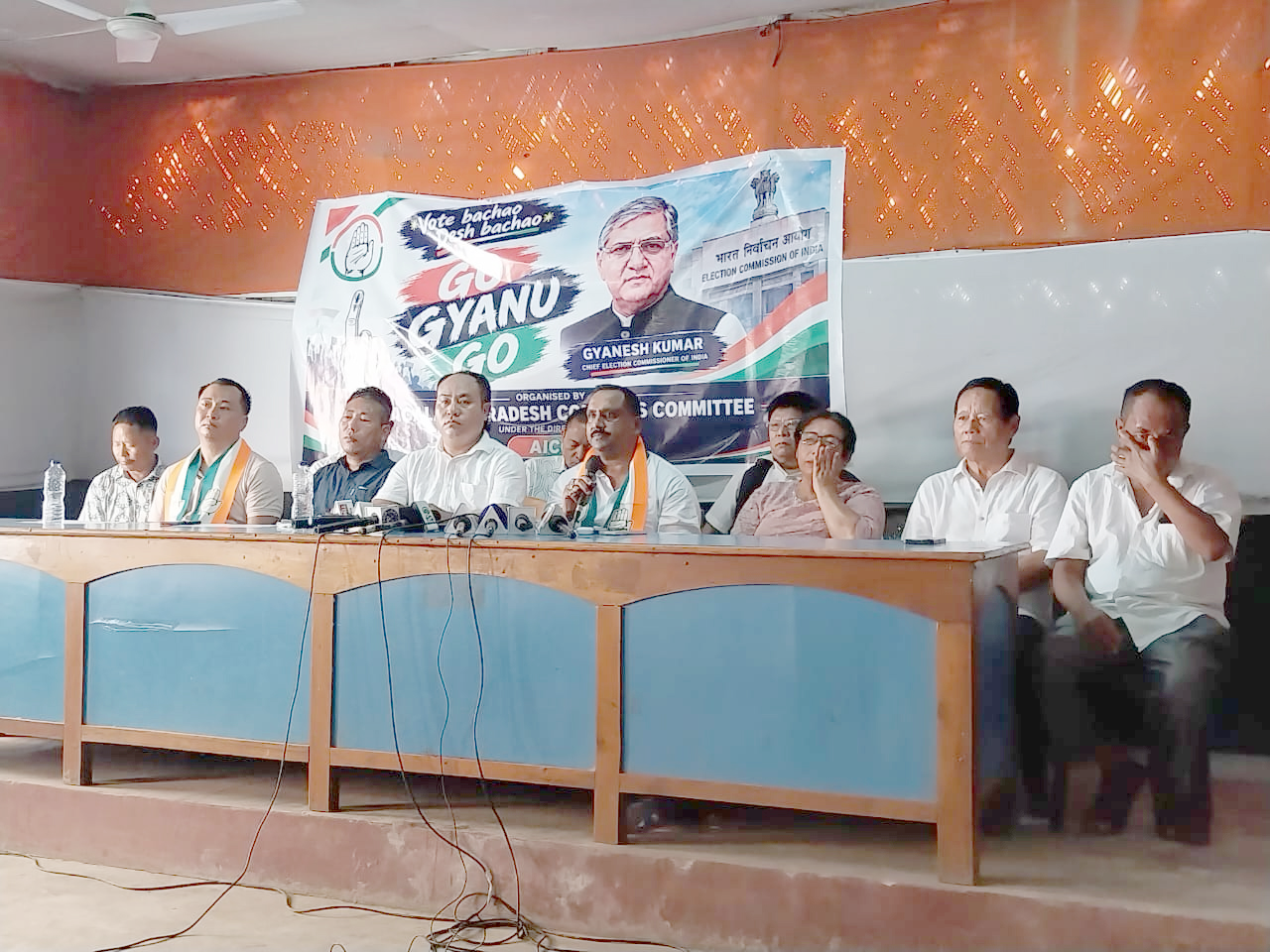
All India Congress Committee (AICC) Observer Banna Gupta on Friday alleged large-scale irregularities in the Special Intensive Revision (SIR) of electoral rolls, claiming that genuine voters were being deleted and urging people in Nagaland to remain vigilant and safeguard their voting rights.
Addressing a press conference at Congress Bhavan, Dimapur, Gupta said the AICC had constituted a nationwide team of observers to examine alleged irregularities in the SIR exercise, and that he had arrived in Nagaland as part of the initiative.
He alleged that the BJP-led government at the Centre was using the revision exercise to manipulate electoral rolls for political purposes. He said the Congress, under the leadership of Rahul Gandhi and party president Mallikarjun Kharge, was fighting to protect democratic institutions and citizens’ constitutional rights.
Gupta claimed that Nagaland, which has around 13.57 lakh voters, had also witnessed the deletion of a large number of names. He maintained that while revision of electoral rolls was necessary to remove errors and ensure accuracy, it should not become a means of disenfranchising genuine voters.
He announced that the Congress would hold a major demonstration at the Red Fort in New Delhi on November 1 against what he described as the government’s attempts to undermine democracy and voting rights.
Raising broader economic issues, Gupta criticised the Centre over rising fuel prices, unemployment, public debt and the privatisation of public sector undertakings. Comparing fuel prices during the tenure of the UPA government in 2014 with current rates, he alleged that ordinary citizens had not benefited from cheaper crude oil imports from Russia. He also accused the government of favouring corporate groups while public assets were being privatised or divested.
On unemployment, Gupta claimed that joblessness among educated youth had risen substantially, while the country’s external debt had increased considerably since 2014. He cited BCCL, CCL, MTNL, BSNL, the Railways, ports, Air India and IDBI Bank as examples of public sector institutions and national assets facing privatisation or disinvestment.
Referring to the SIR exercise in West Bengal, he alleged that large numbers of voters had initially been deleted and subsequently restored after objections were raised. He also referred to instances highlighted by Rahul Gandhi involving large numbers of voters registered at single addresses and alleged irregularities in voter registrations.
Gupta appealed to the people of Nagaland to remain alert about their electoral rights and urged Booth Level Agents (BLAs) and Booth Level Officers (BLOs) not to become instruments of any political agenda. He said the Nagaland Pradesh Congress Committee (NPCC), district units and the state party organisation were united in the campaign.
Responding to a question on the Congress’s concerns over the timing and intent of the women’s reservation issue, Gupta alleged that the government had a hidden agenda. He said the Congress had supported women’s reservation and had asked the government to implement it in the existing House rather than defer it. He questioned why the government was unwilling to implement the reservation immediately if its intentions were genuine.
On being asked why voters whose names had been deleted had not come forward to establish their eligibility, Gupta questioned the level of public awareness and the grounds on which the names had been removed. He said the role of BLOs and the reasons for deletion needed to be examined, adding that political parties had appointed BLAs to assist in the process.
He maintained that genuine voters must remain on the electoral rolls, while ineligible names should be removed irrespective of which party was in power. He also referred to cases in which people reportedly declared dead had appeared before the Supreme Court, arguing that such instances warranted scrutiny.
Download Nagaland Tribune app on Google Play


Dimapur Congress cites over 65,000 deletions
Meanwhile, Dimapur District Congress Committee (DCC) president, Kutoho Chishi claimed that the SIR exercise had resulted in the deletion of 36,629 voters from Dimapur-I, II and III Assembly constituencies, and 28,628 from Ghaspani-I and II.
According to figures presented by Chishi, the combined electorate of Dimapur-I, II and III stood at 1,25,703 before the revision and declined to 89,074 after the exercise. In Ghaspani-I and II, the corresponding figures were 1,09,941 and 81,313.
Chishi said the figures indicated a total reduction of 65,257 voters across the five constituencies. He urged the people of Nagaland to ensure that genuine voters did not lose their franchise and said the situation witnessed in other states should not be allowed to affect voters in Nagaland.
He said the Congress had repeatedly held meetings with the Deputy Commissioner, election officials and representatives of other political parties to discuss concerns arising from the revision exercise. He clarified that the party’s objective was not to create confusion or unnecessary pressure but to ensure that genuine voters were not excluded.
Chishi said many people had been residing in Dimapur for around 20 to 21 years and had established their livelihoods and businesses there. He questioned the practicality of asking long-term residents to return to their ancestral villages or districts to register their names, pointing out that Dimapur had become an important commercial and economic centre for people from different parts of Nagaland.
He appealed to the Election Commission to examine cases of genuine voters placed on the anomaly list and facilitate the correction of discrepancies in their records. He said errors relating to age, names of parents and addresses could have originated in older records and should not automatically result in the exclusion of eligible voters.
Chishi also acknowledged the difficulties faced by BLOs, many of whom are government employees and teachers who have had to carry out the revision work alongside their regular duties, including during holidays. He urged village councils, colony Gaon Buras and other local authorities to assist election officials and BLAs in identifying genuine voters and resolving discrepancies, without allowing political considerations to interfere.
He said Congress BLAs were present at polling stations and appealed to voters facing difficulties over deletion or anomalies to approach the party for assistance. He also urged the Election Commission and election authorities to consider genuine corrections sympathetically.
Congress raises concern over documentary requirements
Chishi further expressed concern over the documentary requirements under the SIR process, alleging that they could indirectly affect genuine voters, particularly elderly people whose families did not maintain formal records decades ago.
Citing his own example, he said his father was born in 1942 and that the requirement to produce his father’s birth certificate had raised difficulties because such documents were not commonly maintained by many families at the time.
He said several people had approached him with similar concerns, particularly over demands for birth certificates and other records relating to parents born in earlier decades. He pointed out that many people in Nagaland, especially those from farming backgrounds, did not possess formal birth or other official documents.
While acknowledging that the younger generation could generally produce the required records, Chishi said it was difficult for elderly voters to furnish multiple documents relating to their parents. He alleged that requiring five or six documents in such cases could make it difficult for genuine voters to establish their eligibility.
Chishi appealed to the Government of India and the Election Commission of India to exercise care while implementing the process and ensure that documentary requirements did not deprive eligible citizens of their voting rights.