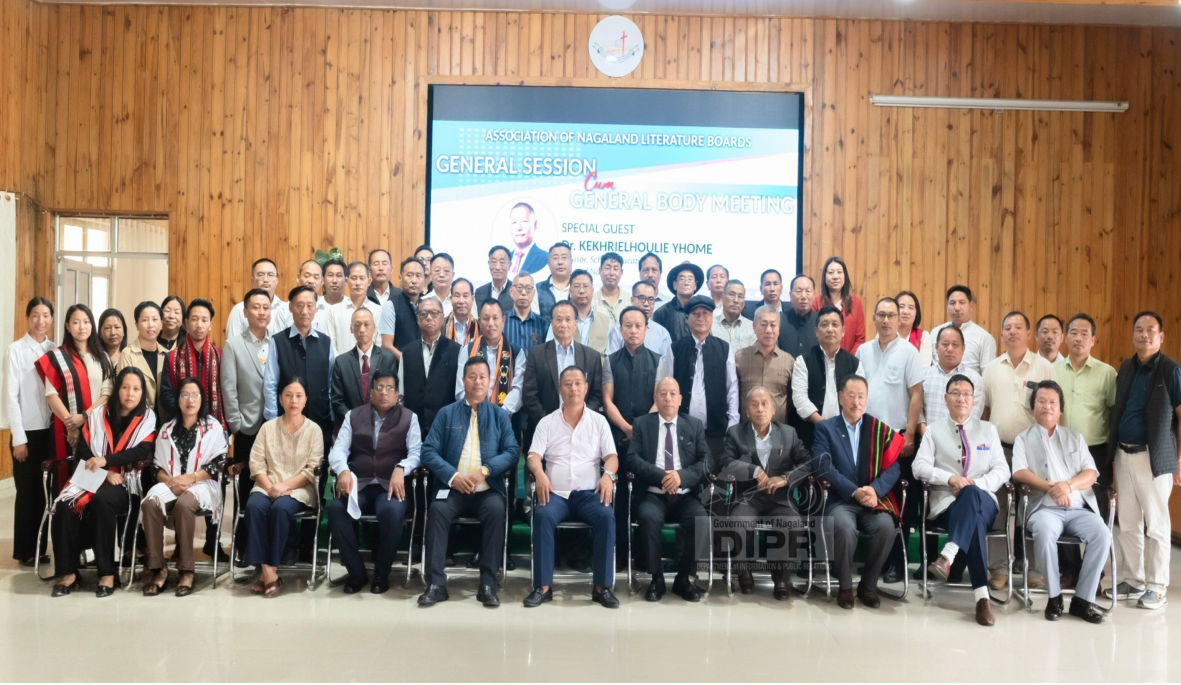
The Association of Nagaland Literature Boards (ANLB) held its General Session-cum-General Body Meeting at Platinum Hall, NBCC Complex, Bayavu Hill, Kohima on July 17.
Advisor for School Education, Dr Kekhrielhoulie Yhome addressed the gathering where he highlighted the vital role of language in shaping identity, particularly for minority communities in a diverse country like India. He stated that preserving indigenous languages is essential for safeguarding the unique cultural identity of communities.
Dr Yhome emphasized the importance of teaching indigenous languages from the foundational level. He noted challenges in implementing mother-tongue education at the primary level due to the shortage of specialized language teachers and stressed the need to retain teachers within their respective linguistic areas.
He said that language development requires the creation, legitimization, and continuous enrichment of vocabulary to remain relevant in changing times.
Highlighting the contribution of Christianity, he remarked that Bible translations and the use of indigenous languages in religious practices have played a significant role in preserving many Naga languages. He also stressed the importance of accurate and scientific translation through collaboration with linguists and scholars.
Dr Yhome advocated translating literature, developing textbooks, encouraging research, and recognizing literary contributions to promote language growth.
He further called for proper institutionalization and leadership in language development, drawing lessons from past experiences of language organizations and academies.
He maintained that language influences thought and identity. He described Nagaland’s multilingual environment as a major advantage, where children often grow up learning their mother tongue, English, Nagamese, and other tribal languages. This multilingual ability, he said, enhances cognitive skills, strengthens cultural identity, and improves opportunities for global. He added that the State Curriculum Framework seeks to promote tribal languages and stressed the need for sustained institutional support, active community participation, and an open-minded approach that recognizes language as dynamic and continuously evolving.
Additional Director, School Education, Deenabandhu Panda highlighted the importance of preserving and promoting indigenous languages in Nagaland in line with the National Education Policy (NEP). He noted that while only Tenyidie was widely taught in schools in the early years, all tribal languages have now been introduced in the education system and will be taught up to Class 9 from this academic year.
He emphasized that the NEP supports the preservation of culture and linguistic diversity, ensuring equal opportunities for all languages.
Acknowledging the collective efforts of literature boards, the School Education Department, and the public, Panda called for continued collaboration to strengthen indigenous languages. He encouraged greater use of local languages within communities. Assuring the literature boards of the department’s support, he reaffirmed its commitment to working together for the growth and promotion of all indigenous languages in the state.
Download Nagaland Tribune app on Google Play


President, ANLB, B Tingshem Konyak, delivered the welcome address and acknowledged the Advisor for School Education for his continued support towards the promotion of language and literature in Nagaland. He noted that efforts to advance indigenous languages have gained momentum since 2015 and referred to key developments such as the NLA’s 2019 resolution supporting 13 local languages, the state government’s approval of ₹2 lakh for each literature board for language development, and the introduction of locally developed textbooks in Class 9 from the current academic year.
Vice President of Ura Academy, Daso Paphino, extended greetings on behalf of the Academy and shared a brief account of the development of the Tenyidie language. He noted that American missionary Rev. Sydney W Rivenburg, who arrived in Kohima in 1887, played a pivotal role in developing the language by introducing its alphabet and promoting its use in education.
He highlighted that Tenyidie was recognized by North-Eastern Hill University (NEHU) in 1988 and introduced under Nagaland University in 1997. He informed that the department has produced 330 postgraduates and nine PhD holders, with 17 more scholars currently pursuing doctoral studies, and that the language is presently taught in 7 colleges across Nagaland.
He also highlighted the contributions of Tenyidie publications, including the monthly magazine Ura Dze, which has completed 50 years, 4 other monthly magazines and the daily newspaper CAPI.
Reaffirming Ura Academy’s commitment to preserving and promoting Tenyidie and other Naga languages, he called for continued cooperation among educational institutions, churches, writers, poets and language enthusiasts to ensure their growth in literature, education, research and everyday life.
The programme concluded with a vote of thanks proposed by General Secretary, ANLB, Chegeseng Kath. The programme was chaired by Vice President, ANLB, S. Akho Leyri.
The programme was followed by a business session during which members discussed the adoption of the ANLB Constitution, establishment of an institute/academy, language teacher appointments, strengthening of the ANLB fund, and other related issues aimed at advancing language preservation and literary development in Nagaland.
