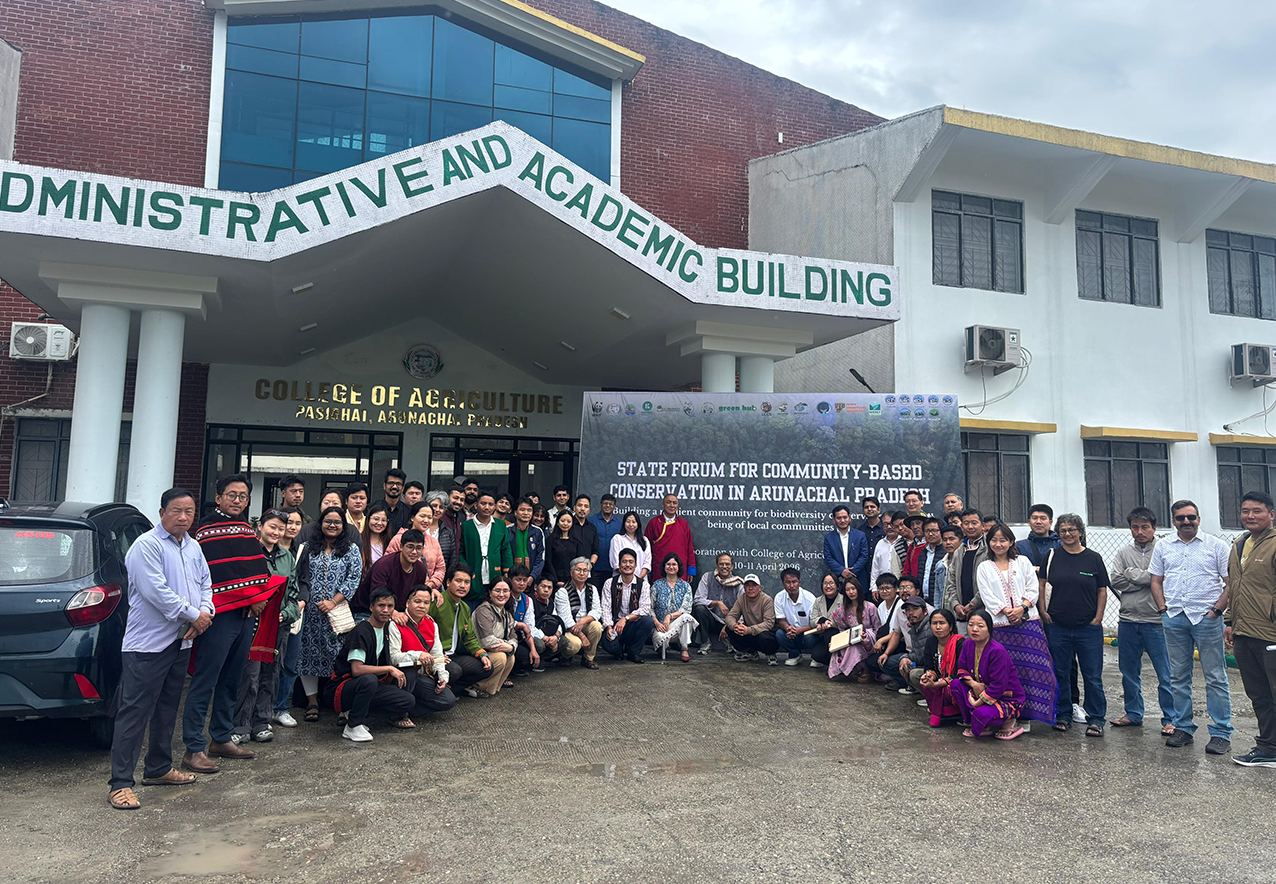
Community Leaders and Conservationists from across Arunachal Pradesh have initiated the formation of the first state-wide platform to unify community-led biodiversity protection efforts, marking a significant step in the state’s grassroots conservation movement.
The decision was taken at a two-day workshop at Central Agricultural University, Pasighat, where participants agreed on the formation of the proposed Arunachal Pradesh State Community Led Conservation Forum and appointed an interim working group to work out the modalities of the Forum over the next few months.
The proposed body seeks to bring together Community Conserved Areas (CCAs) and other community-led conservation initiatives under a common platform for advocacy, policy engagement and knowledge-sharing at the state level.
Participants said the move would transform scattered local conservation efforts into a collective force capable of influencing biodiversity policy and strengthening environmental governance in the state.
Speaking on the opening day, Elopa Etugu Community Eco-Cultural Preserve (EECEP) founder Jibi Pulu emphasized the importance of a collective approach.
He mentioned that the meeting has brought people together at a state level for the first time, indicating a positive shift in community engagement and hoped for continued gatherings under the aegis of the Forum.
WWF-India’s Head of the Himalayas Program, Dr Rishi Kumar Sharma said that this is a fantastic opportunity for communities in the state of Arunachal Pradesh to come together and work with similar forums across the region to promote community led conservation.
During the meeting, members of the Elopa Etugu Community Eco-Cultural Preserve (EECEP) highlighted the use of camera traps to monitor wildlife species which has reported around 41 species in the CCA and emphasized the importance of preserving nature and culture.
The discussion also covered research on ecology, flora and fauna and community livelihoods for long term management of conservation area.
Jambey Gyaltsen of the Thembang Bapu CCA spoke of the challenges of balancing conservation with economic needs, highlighting the use of camera trapping and the installation of low-cost electric fencing to reduce negative interaction between human and wildlife. The discussion also touched on the impact of commercial agriculture and tourism and on the need to promote eco and community based tourism, and the importance of sustainable agriculture.
Chajo Lowang of Green Tirap said that their efforts are aimed at raising awareness in New Tupi, and that plans are underway to expand the campaign to neighbouring areas. The conservation initiative is new to the community and faces some challenges, but there is hope for a positive response. The role of community leaders in facilitating the CCA was emphasized.
Download Nagaland Tribune app on Google Play

The 22-member interim working group has been given six months to draft the forum’s bylaws, governance structure and membership framework and to present it to the larger gathering for consideration and endorsement at the end of their tenure. Ranju Dodum and Dimum Pertin were appointed as Convenor and Co-convenor of the interim working group
Also embedded within the interim working group is an advisory panel comprising representatives from Kalpavriksh, WWF-India, ATREE, Nature Conservation Foundation, Green Hub and senior local conservation figures will support the process.
Speaking to the media, Hranglung Lungalang, Chairman of the Nagaland Community Conserved Areas Forum, urged Arunachal Pradesh to act before ecological degradation accelerates.
“Arunachal’s forest cover is vast, but people are not always aware that conservation is urgent. In Nagaland, we realized the need only after many areas were already depleted. By starting now, Arunachal can save what it has before it’s too late,” he said.
Participants stressed that conservation must be positioned as part of sustainable development rather than in opposition to it.
“When people hear the word conservation, they often think it means stopping development. That is not the objective. The goal is sustainable development—ensuring that infrastructure, livelihoods and ecological integrity progress together,” said interim convenor Dodum.
A digital portal documenting conservation areas, biodiversity records and project profiles is also planned as part of the initiative.
Initial support for the process of Forum building will be provided by WWF-India, ATREE, Kalpavriksh and Green Hub, while Rajiv Gandhi University has offered to host future meetings of the interim working group and later on the Forum.
Participants said the initiative could reshape biodiversity governance in the state by giving local conservation groups a unified voice in policy and environmental decision-making.

