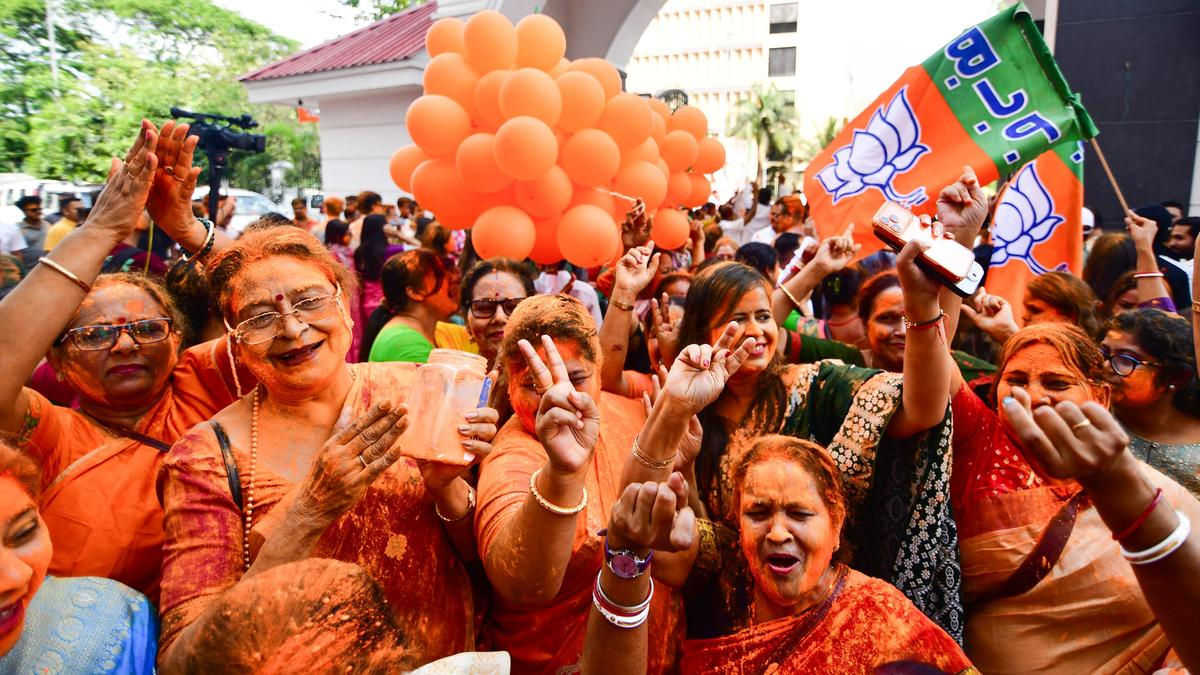
The political landscape of Assam has undergone a decisive transformation as the Bharatiya Janata Party-led National Democratic Alliance (NDA) stormed to power with a resounding mandate in the 2026 Assembly elections, securing a third consecutive term and firmly consolidating its dominance in the state.
What was once a fragmented political arena has now evolved into a sharply polarised contest, with the NDA’s sweeping victory signalling a shift toward a high-stakes, two-party political structure.
The NDA’s performance was emphatic, securing a three-fourths majority with a commanding tally of 101 seats in the 126-member Assembly. The BJP emerged as the principal force, while its allies—the Asom Gana Parishad (AGP) and Bodoland People’s Front (BPF)—contributed 10 seats each, reinforcing the alliance’s broad-based electoral strength.
At the centre of this victory stands Chief Minister Himanta Biswa Sarma, who delivered a dominant personal performance, winning his constituency by a margin exceeding 80,000 votes. In his victory remarks, Sarma credited the success to the “double-engine” governance model, highlighting the synergy between the state government and Prime Minister Narendra Modi’s leadership at the Centre.
However, the election also witnessed a major political setback for the opposition. In one of the most significant upsets, senior Congress leader Gaurav Gogoi lost the prestigious Jorhat seat to BJP’s Hitendra Nath Goswami by over 23,000 votes. The defeat is being widely viewed as a symbolic blow to the Gogoi family’s long-standing influence in Upper Assam.
Nagaland Tribune app on Google Play


The results also underscored deeper electoral trends. The BJP increased its vote share to 38.59%, up from 33.6% in 2016, reflecting consolidation of its support base. Meanwhile, the All India United Democratic Front (AIUDF), led by Badruddin Ajmal, saw its influence decline sharply, with its vote share dropping to 5.29%. Analysts attribute this decline partly to constituency delimitation, which altered traditional voter dynamics.
The Indian National Congress maintained a vote share of 29.26%, but its reduced seat tally pointed to a narrowing electoral base. Notably, a majority of its winning candidates were from minority-dominated constituencies, indicating a shift in its support structure.
The 2026 verdict marks a turning point in Assam’s political evolution. Regional and smaller parties have been significantly marginalised, and the state now appears firmly set on a bipolar trajectory dominated by the BJP and the Congress.
With this emphatic mandate, the “Sarma era” in Assam stands not only reaffirmed but strengthened, ushering in a new phase of political consolidation and ideological contestation in the state.
(with inputs from ANI)