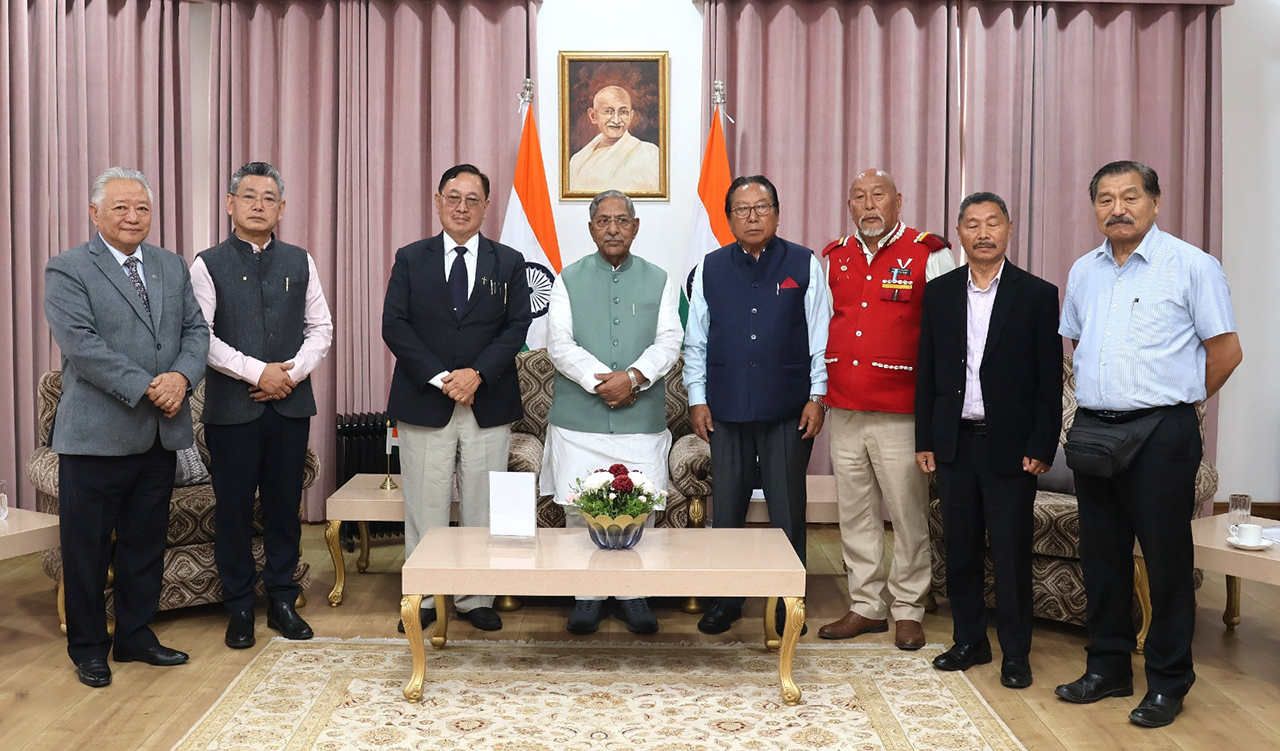
The Concerned Naga Forum of Nagaland (CNFN) has urged the Governor of Nagaland for urgent intervention to ensure implementation of the long-pending Naga political agreements and restoration of law and order in the state.
In a memorandum submitted to the Governor, the CNFN extended formal welcome to the Governor and expressed hope that his tenure would be marked by decisive leadership at
Addressing the Governor at Lok Bhavan, the Forum extended a formal welcome while expressing hope that his tenure would be marked by decisive leadership at what it termed a “crucial juncture” in Nagaland’s political history.
Recollecting that the Naga political problem has been around for about a century, beginning with a delegation of Naga elders submitting a representation to the Simon Commission, in 1929, the CNFN said over the decades, numerous efforts have been made to address the issue, including the landmark 16-Point Agreement, which led to the formation of Nagaland as a state within the Union of India.
The Forum pointed out that statehood brought rational development and progress and people found comfort under it. However, it said there has been issue of integration of the contiguous Naga inhabited areas within Nagaland state, areas in Manipur, Arunachal Pradesh, Assam and at times, even with areas of Myanmar. Though the Nagaland Legislative Assembly took ‘resolution’ for integration of the contiguous Naga inhabited areas, Manipur declared that ‘not an inch of Manipur’ would be parted with. It also said the Government of India also made it clear that, “when we talk of a solution, the boundaries of the States cannot be changed”.
The memorandum, jointly signed by CNFN Secretary, Theja Therieh and Convenor HK Khulu also highlighted the emergence of Naga movements, including the formation of the National Socialist Council of Nagaland (NSCN) in 1975 following divisions within the Naga movement, and its subsequent split into factions such as the NSCN (IM) and NSCN (K) in 1988. It highlighted the period of intense fratricidal clash between them, engulfing the law and order maintenance agency, the Indian Army and the innocent public.
It said the Government of India initiated ‘peace process’ to pave the way for solving the problem in a democratic manner through ceasefire, negotiations and dialogue, following which ceasefire with the NSCN (IM) was signed in 1997 and with NSCN (K) in 2000.
The CNFN emphasized that after prolonged negotiations spanning nearly three decades, two major agreements were signed—the Framework Agreement with NSCN (IM) in 2015 and the Agreed Position with the Working Committee of NNPGs in 2017. Both agreements, it noted, were concluded within the framework of the Constitution of India.
However, the Forum informed the Governor that despite the passage of 11 and 9 years respectively, none of these agreements have been implemented. It described this delay as “inordinate,” stressing that the number of years speaks volumes louder than words about the lack of political will and urgency.
It further recalled that former Governor, RN Ravi had officially declared in his address to the Nagaland Legislative Assembly that negotiations had been completed on October 31, 2019. The Assembly had subsequently adopted a unanimous vote of thanks, effectively acknowledging the closure of talks between Government of India and the Naga groups.
The Forum expressed surprise that after the vote of thanks to Governors’ address was passed, the state Government quickly demanded the removal of Governor RN Ravi. “However, they cannot transfer or erase the vote of thanks to his address,” it stated.
The memorandum sharply criticized recent statements by the State’s Political Affairs Committee and Chief Minister Neiphiu Rio bargaining to ‘upgrade’ the negotiations to a ‘political level’. It termed this move as “unconstitutional,” arguing “it is volte face and totally against the Assembly’s own unanimous vote.”
The memorandum alleged that asking for continuation of the talks appears to be with a pure intention to retain their precious chairs and positions in the Government with no care for the welfare of the people.
Download Nagaland Tribune app on Google Play

The memorandum also raised concerns over rapid proliferation of factions in recent years. The Forum claimed that more than 30 groups armed with sophisticated weapons, with licenses issued by the Chairman of Ceasefire Monitoring Board (CSFMB), are now operating. It said over 20 factions have Ceasefire Monitoring Offices in Dimapur and are running respective ‘self-styled’ governments..
It alleged that under the guise of the unresolved Naga political issue, these groups have engaged in recruitment, extortion, illegal taxation on supply chains, and syndicate operations.
The CNFN claimed that the organized syndicates are reported to be receiving over Rs 400 crores annually, besides extortion from all supply chains. The state government have also apparently buckled and all Departmental Drawing & Disbursement Officers and Finance department are allegedly paying systematically to all factions, it added.
The Forum stated that under the existing pseudo peace, the people of Nagaland suffer from all-pervading despair, injustices, systematic corruption and unbearable socio-economic burden, which tantamount to a total breakdown of law and order and is in short a collapse of the Constitution machinery in the State.

It also pointed out that despite claims of an “opposition-less government” formed to facilitate a political solution, there has been little tangible progress. Statements from central leaders, including the Prime Minister and Union Home Minister, were cited to suggest that the Centre is awaiting cooperation from the State Government.
Against such background, the CNFN urged the Governor to take decisive steps and direct the state Government to shoulder its Constitutional responsibility of maintaining the law & order in the State and immediately review how to curb the situation of lawlessness in the State and further curb the mushrooming of factions and various illegitimate groups.
It also urged the Governor to direct the state Government to stop speaking of fresh talks and new issues, instead review with the Government of India the talks that have already been concluded, outline the outcomes including the competencies and work out how the solution as agreed upon can be implemented.
“The people cannot be allowed to exist in such confusion and misery,” the memorandum said and urged the Governor to do the greatest justice to the people of Nagaland and bring about an immediate solution to the vexed Naga problem.
