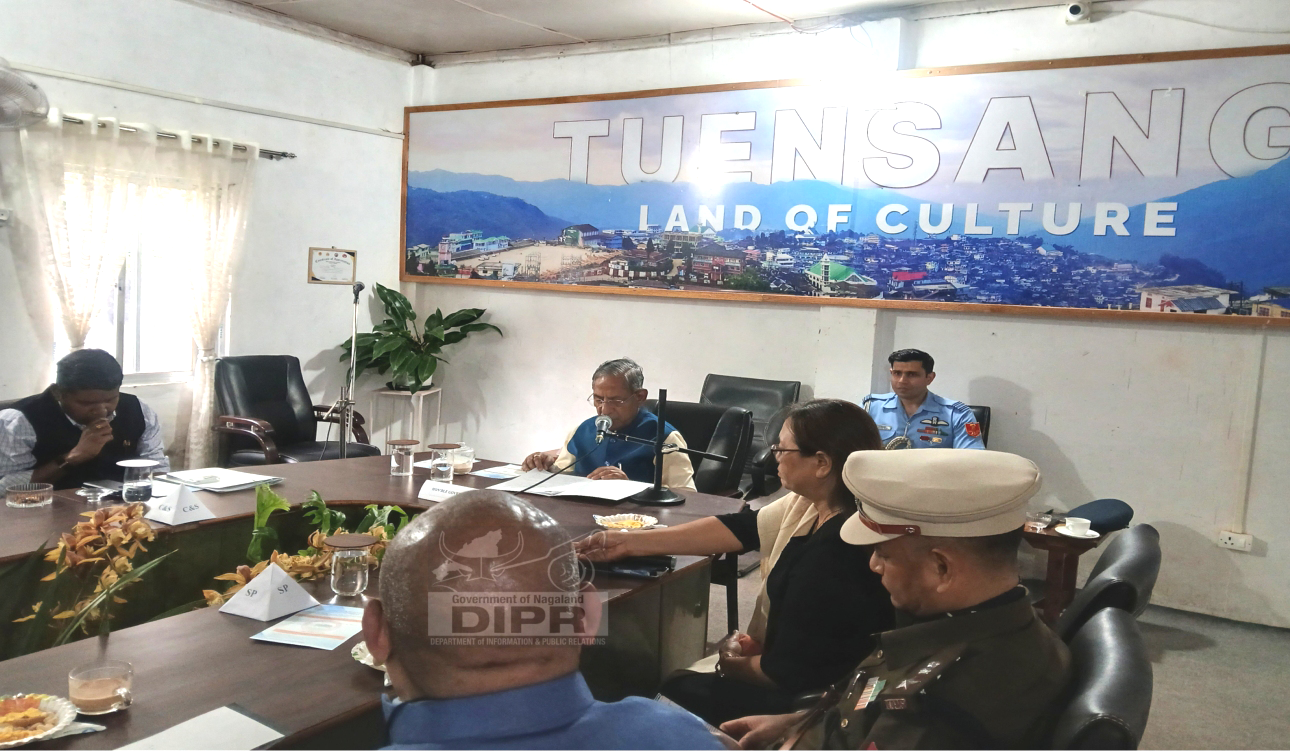
Nagaland Governor Nand Kishore Yadav has called for inclusive and community-led development across Eastern Nagaland, emphasising better infrastructure, market access, youth empowerment, sustainable livelihoods and preservation of indigenous cultural heritage during his visits to Tuensang and Longleng districts on Thursday.
As part of his district visit programme, the Governor held interactive sessions with district officials and civil society representatives in both districts, seeking to understand their developmental priorities, challenges and aspirations and stressing the need to strengthen grassroots-level governance.
According to a DIPR update, in Tuensang, Yadav expressed gratitude to the people for their hospitality and said the visit provided him an opportunity to see the district firsthand and interact with people from different sections of society.
Highlighting Tuensang’s historical significance, he said the district occupied an important place in the political and administrative evolution of Nagaland. Before the formation of the State in 1963, it formed part of the Naga Hills-Tuensang Area and was one of the early administrative centres of the Eastern Nagas.
He said Tuensang had also been an important meeting point of communities, cultures and traditions, with its rich heritage forming an integral part of Nagaland’s cultural identity. The people of the district, he added, had demonstrated courage, resilience, hard work and community spirit despite geographical and infrastructural challenges.
Referring to the agreement signed in New Delhi on February 5, 2026, between the Government of India, Government of Nagaland and Eastern Nagaland Peoples’ Organisation (ENPO) concerning the Frontier Nagaland Territorial Authority (FNTA), Yadav described it as an important milestone for Eastern Nagaland. He said the development reflected the importance of dialogue, mutual understanding and democratic engagement in addressing the aspirations and developmental needs of the people.
The Governor expressed hope that the agreement would open new avenues for inclusive development, stronger institutions, improved infrastructure and greater opportunities for the people of Eastern Nagaland, while ushering in a new era of peace, cooperation and prosperity and preserving the unity and integrity of Nagaland.
Yadav said Tuensang had considerable potential in agriculture, horticulture, handloom, handicrafts, tourism, education and entrepreneurship. With improved connectivity, infrastructure, technology and opportunities for young people, he said, the district could become an important contributor to Nagaland’s economic growth.
He stressed that youth must remain at the centre of development, saying they possessed talent, energy and creativity but needed opportunities, skills, access to technology and an enabling environment to pursue their aspirations. He encouraged young people to acquire new skills and become active partners in the development of their communities.
The Governor also stressed that development must go hand in hand with preservation of cultural heritage. Language, customs, music, traditions and community institutions, he said, were valuable assets, and modernisation should strengthen rather than weaken the region’s identity.
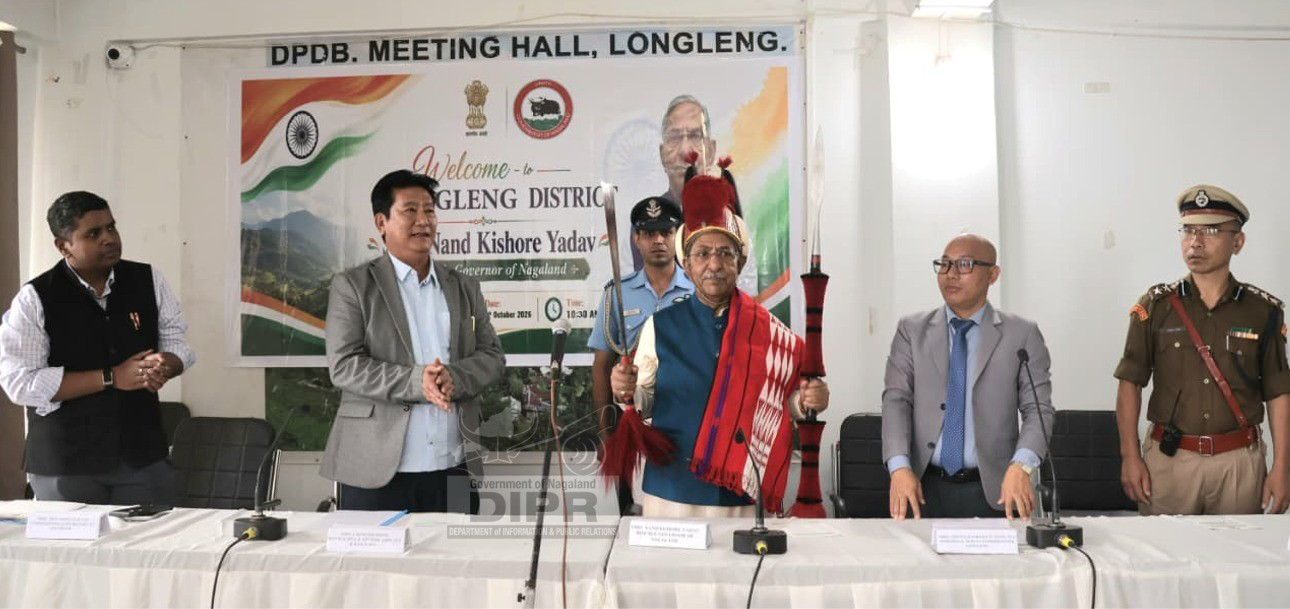
In Longleng, Yadav similarly emphasised the need for regular engagement with districts to ensure that development reached all parts of the State. Addressing district officers and civil society organisations at the DPDB Hall, he said such visits provided an opportunity to review developmental activities as well as listen directly to the people.
Describing Longleng as an important part of Eastern Nagaland and home to the Phom community, the Governor highlighted its potential in agriculture, horticulture, handloom and handicrafts, forest-based livelihoods, tourism and entrepreneurship.
Download Nagaland Tribune app on Google Play


He encouraged farmers and young entrepreneurs to look beyond traditional markets through value addition, food processing, digital marketing and modern agricultural practices so that local products could reach markets within Nagaland and beyond.
Yadav called for youth to become active participants in the district’s transformation by acquiring new skills, pursuing higher education and exploring entrepreneurship. He also urged the people to preserve the traditions, customary practices, indigenous knowledge, music, dance, crafts and community institutions of the Phom community.
The Governor said Longleng’s natural beauty, cultural heritage and traditional way of life offered significant potential for responsible and community-based tourism. Improved connectivity, hospitality infrastructure and effective promotion, he said, could generate employment and create new opportunities for local communities.
Across both districts, Yadav identified good roads, reliable communication networks, quality healthcare, education and access to essential public services as fundamental requirements for inclusive development. He urged district administrations and stakeholders to focus particularly on improving service delivery in remote and underserved areas.
He appreciated the role of district administrations, security forces, churches, tribal bodies, village institutions, civil society organisations and community leaders in maintaining peace, social harmony and development. Government programmes, he said, could achieve their intended objectives only through cooperation between the government and the people, supported by transparency, accountability, community participation and mutual trust.
In Longleng, President of the Phom People’s Council Y.B. Angam Phom highlighted the dependence of rural communities on agriculture and handicrafts and said poor road connectivity and inadequate market access remained major obstacles to economic development. He pointed out that frequent road subsidence and natural disasters often disrupted connectivity between the district headquarters, villages and neighbouring towns.
Angam also sought attention to road development and infrastructure, stressing Longleng’s importance as a central point connecting several districts of Eastern Nagaland. He raised concerns over the delayed construction of the hospital and sought timely completion of the Lighthouse (NECTAR) project to provide students with improved learning facilities.
Advisor for Airways and Railways A. Pongshi Phom welcomed the Governor to Longleng and highlighted welfare schemes and initiatives of the Government of India. He also said the State government, officials, NGOs, civil society organisations and the public were working through cooperation and consultation towards peace and development.
In Tuensang, short speeches were delivered by ENPO president A. Chingmak, CKS vice president Sipong Chang and USLP joint secretary T. Bendang Dhongrü. Departmental presentations on Health & Family Welfare and Rural Development were made during the interaction.
In Longleng, presentations were made by the PWD (R&B), Agriculture & Allied and Medical departments.
The Tuensang programme was chaired by Deputy Commissioner Lithrongla Tongpi Rutsa, while the Longleng programme was chaired by ADC Thungchanbemo Tungoe, who also delivered the vote of thanks.
The Governor was accompanied during the visits by senior officials from Lok Bhavan and other dignitaries.
The twin visits underlined the Governor’s emphasis on taking governance and constitutional institutions closer to the grassroots and on promoting development that combines infrastructure and economic opportunities with community participation and protection of Eastern Nagaland’s distinctive cultural heritage.