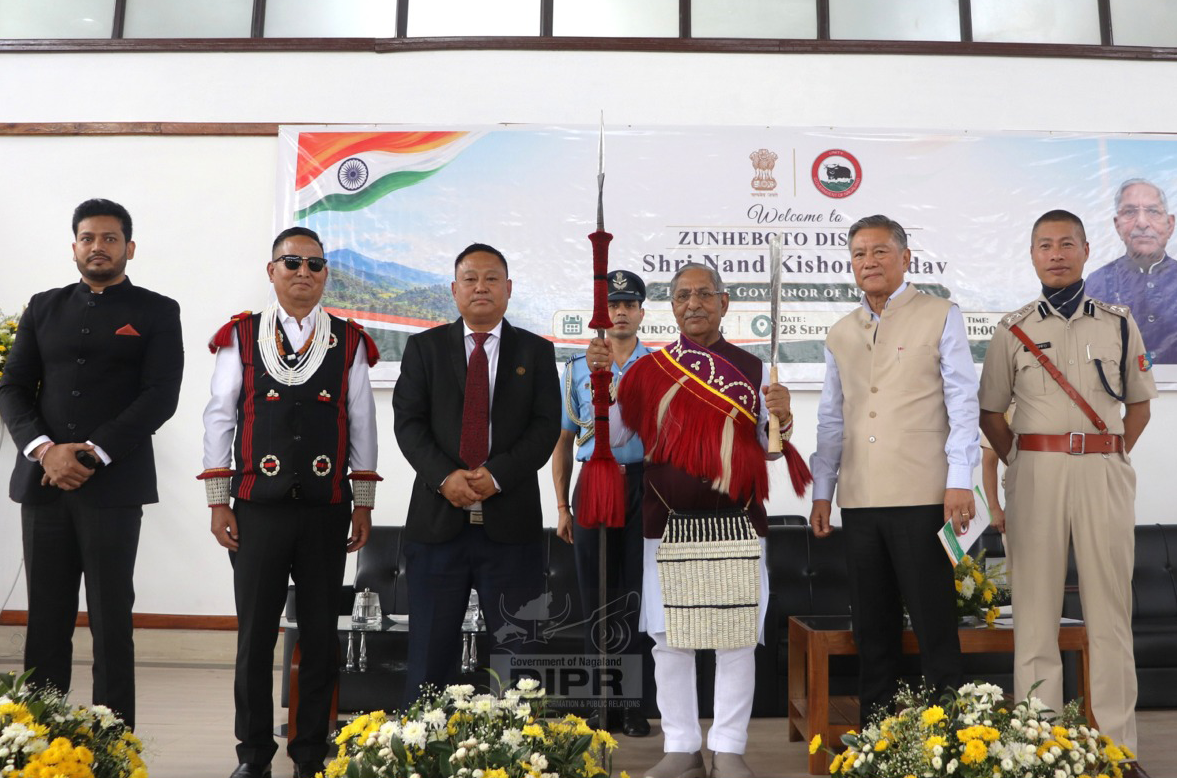
Nagaland Governor, Nand Kishore Yadav reviewed the functioning of the district administration and development priorities of Zunheboto during his official visit to the district headquarters on September 28, while also receiving representations from major Sümi socio-cultural organisations on issues concerning the district and wider Naga society.
The programme was chaired by Deputy Commissioner, Zunheboto, Dharam Raj, IAS, while Advisor for Food & Civil Supplies, Legal Metrology & Consumer Protection and Chairman of DPDB Zunheboto, K.T. Sukhalu, delivered the welcome address.
Describing Zunheboto as the “Land of Warriors”, Governor Yadav highlighted its strong cultural identity and development potential in agriculture, forests, human resources and tourism. He said the district administration is the face of government for ordinary citizens and called for greater emphasis on last-mile delivery of services, particularly in remote areas.
On education, the Governor stressed the need to focus on learning outcomes, teacher and student attendance, retention and transition to higher education or vocational opportunities, with special attention to schools in remote locations. In the health sector, he emphasised the need to ensure adequate personnel, medicines and equipment at the District Hospital, Community Health Centres, Primary Health Centres and Sub-Centres.
Calling for a shift in agriculture from a predominantly subsidy-oriented approach, Yadav stressed productivity, value addition, market linkages and stronger farmer organisations. He also identified electricity, drinking water, roads and digital connectivity as essential components of development and called for improved quality and durability of roads to avoid repeated expenditure on the same stretches.
The Governor stressed the importance of inter-departmental coordination, particularly in resolving delays in projects involving multiple departments through clear timelines and effective coordination.
On tourism, he highlighted the potential of Satoi Wildlife Sanctuary and Ghosü Wildlife Bird Sanctuary, calling for their sustainable development with local youth participation through homestays, cultural experiences and other community-based initiatives.
He also emphasised digital governance and the need for district-level dashboards covering key development indicators to improve accountability, while stressing that citizens with limited digital access should continue to receive adequate facilitation.
Calling upon government officials to remain accessible, responsive and accountable, Yadav said government programmes should translate into visible results on the ground. He expressed hope that Zunheboto would progress by combining good governance and economic opportunities with social development and preservation of its cultural and natural heritage.
The Sümi Hoho submitted a representation covering four major issues. On the Naga political issue, it referred to the Framework Agreement of August 3, 2015, and the Agreed Position of November 17, 2017, as important milestones. The organisation urged the Government of India to bring the long-pending issue to a final, honourable, inclusive and mutually acceptable conclusion and requested the Governor to convey the aspiration to the appropriate authorities.
Download Nagaland Tribune app on Google Play


On Vande Mataram and religious sensitivities, the Hoho affirmed its respect for the National Song and national symbols, while pointing out that some later stanzas contain religious imagery that may create difficulties for people of certain faiths, particularly Christians. It requested that official protocols take into consideration the faith and conscience of all communities while maintaining due respect for the National Song.
The Hoho also sought upgradation of Hezukhu Memorial District Hospital from 75 to 100 beds, along with adequate doctors, nurses, equipment, medicines, diagnostic facilities and infrastructure.
On the proposed Showuba-Pangsha East-West Corridor, the organisation highlighted the long-pending proposal for a corridor passing through Zunheboto towards Shamator, stating that it would improve connectivity between western, central and eastern parts of Nagaland and contribute to economic and social integration.
The Sümi Kükami Hoho, representing hereditary village chiefs, emphasised the continuing importance of the Kükami institution among nearly 400 Sümi villages. It stated that customary laws and practices largely constitute living, unwritten traditions protected under Article 371A and sought consultation with traditional institutions whenever policies or decisions affect customary rights. It also stressed that development should not come at the cost of Sümi identity and traditional institutions.
The Zunheboto Area Public Organisation raised concerns over youth unemployment and substance abuse and called for greater investment in education, sports, skill development and vocational training. It also sought timely completion of road projects and greater support for farming in the Tizu river basin through improved market access, technology, irrigation and storage facilities.
In his vote of thanks, Deputy Speaker of the Nagaland Legislative Assembly, S. Toiho Yeptho, said he had known the Governor from earlier days and appreciated his commitment to public service. He said that the Governor goes beyond expectations in his efforts for the betterment of the people.
Yeptho also observed that Zunheboto, despite being located at the heart of Nagaland, had not developed at the desired pace. He expressed hope that the district would witness further progress and development, with government schemes and programmes reaching the grassroots.