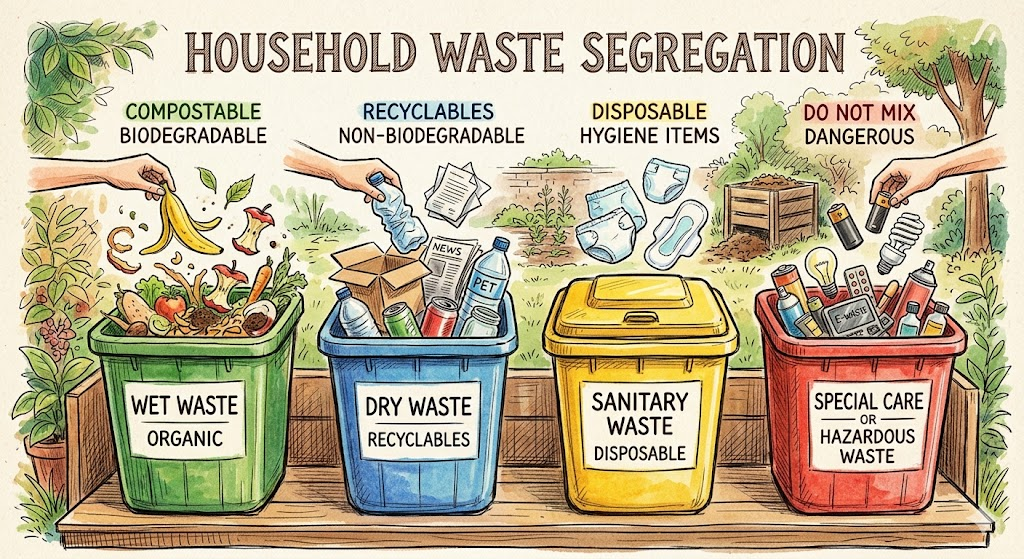
In a significant step towards promoting sustainable waste management and environmental protection, the Home Department has informed all villages across Nagaland to strictly implement segregation of waste at source in accordance with the provisions of the Solid Waste Management Rules, 2026, notified by the Ministry of Environment, Forest and Climate Change (MoEFCC).
The Department stated that the directive has been issued in pursuance of Rule 5(b) of the Solid Waste Management Rules, 2026, which came into force with effect from April 1, 2026. The rules place specific responsibilities on waste generators and emphasize proper segregation of waste at the household level to facilitate efficient collection, processing and disposal.
As per the notified guidelines, every household is required to separate and store waste generated in four distinct streams at the source itself. The first category, Wet Waste, includes kitchen waste, food scraps, vegetable peels, flowers and other biodegradable materials, which are to be stored in a green bin.
The second category, Dry Waste, comprises non-biodegradable materials such as plastic, glass, metal, rubber and similar items. Households have been directed to store such waste separately in a blue bin.
The rules also mandate separate disposal of Sanitary Waste, including used diapers, sanitary napkins, tampons, condoms and incontinence sheets. Such waste must be securely wrapped in pouches provided by manufacturers or in suitable wrapping material as prescribed by local authorities before being placed in a designated sanitary waste bin, separate from wet and dry waste.
Download Nagaland Tribune app on Google Play


Further, households are required to segregate Special Care or Household Hazardous Waste, which includes discarded paint containers, pesticide bottles, compact fluorescent lamps, tube lights, expired medicines, broken mercury thermometers, waste batteries, used needles and syringes, contaminated gauze, cleaning agents, insecticides, electrical bulbs and other hazardous materials notified by the Central Pollution Control Board (CPCB) from time to time. Such waste is to be stored in a red bag for safe handling and disposal.
The District Administration is hereby directed to ensure that the above four-stream source segregation of waste be initiated and implemented in all Villages in co-ordination with the Rural Development, PHED, Urban Development and Municipal Affairs Department in respective Districts and also ensure conduct of adequate sensitization exercise with all Village authorities to promote sustainable waste management.