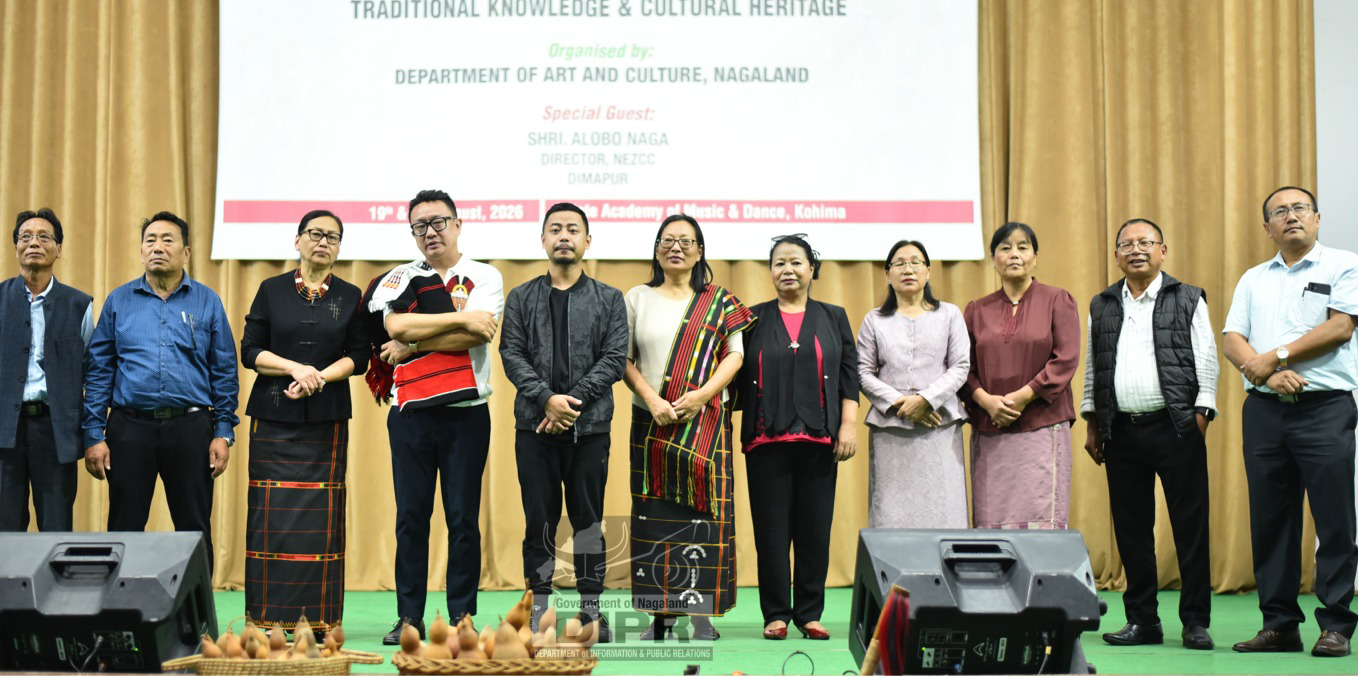
With the initiative of the ‘Living Morung’, a two-day programme to share the concept of traditional and cultural heritage was organised by the Department of Art and Culture at the State Academy of Music and Dance, Kohima, on August 19.
Special guest and Director, NEZCC, Alobo Naga, in his inaugural speech, said that the theme ‘Sharing on Concepts of Traditional Knowledge and Cultural Heritage’ is deeply relevant today because culture is not something to be preserved, but something to be kept alive.
He said knowledge survives only when it is shared, and if elders stop sharing and young people stop listening and learning, centuries of knowledge risk being lost within a single generation. He noted that things are moving so fast today that much is being left behind in the rush forward, putting culture at risk of extinction. Our responsibility, he said, is not only to preserve our heritage, but also to document it, share it, teach it, and make it relevant to the next generation.
He said tradition and modernity do not have to compete; rather, technology and contemporary creativity can be embraced while remaining firmly rooted in heritage. He urged young people to learn from elders, ask questions, and learn songs, dances, stories, languages and dialects, as they are the future custodians of the culture.
He also said that culture is not only what is inherited from the past, but also what is carried into the future. He also hoped that ‘Living Morung’ would become a bridge between elders and youth, tradition and modernity, and the Northeast, so that heritage continues to be preserved, diversity celebrated, and knowledge passed on from one generation to the next.
Download Nagaland Tribune app on Google Play


Director of Art and Culture, Adela Moa, in her welcome address, said that in the past, the indigenous learning institutions known as ‘Morung’ played a very important role in shaping communities. These institutions served as spaces where discipline, respect, social responsibility, moral values, folklore, art, crafts and traditional knowledge were passed down from one generation to the next. However, with rapid modernisation and changing lifestyles, many of these local institutions have gradually declined, resulting in the loss of indigenous knowledge, traditional skills and, in some cases, cultural identity.
She said that recognising this critical need, the State Government introduced the ‘Living Morung’ Initiative in 2005 to revive and strengthen moral, spiritual and cultural traditions.
The programme seeks to promote intergenerational learning, preserve knowledge and heritage, and ensure that the wisdom and traditions of ancestors are passed on to future generations.
She also said that the Department of Art and Culture has been implementing the Living Morung Programme in villages across all districts of Nagaland, where participants and cultural practitioners from different parts of the state come together to experience and learn about their rich cultural heritage, and to share their knowledge, skills, traditions and experiences with one another.
The programme featured exhibitions and demonstrations of various traditional weaving and handicraft-making techniques, along with cultural performances.
