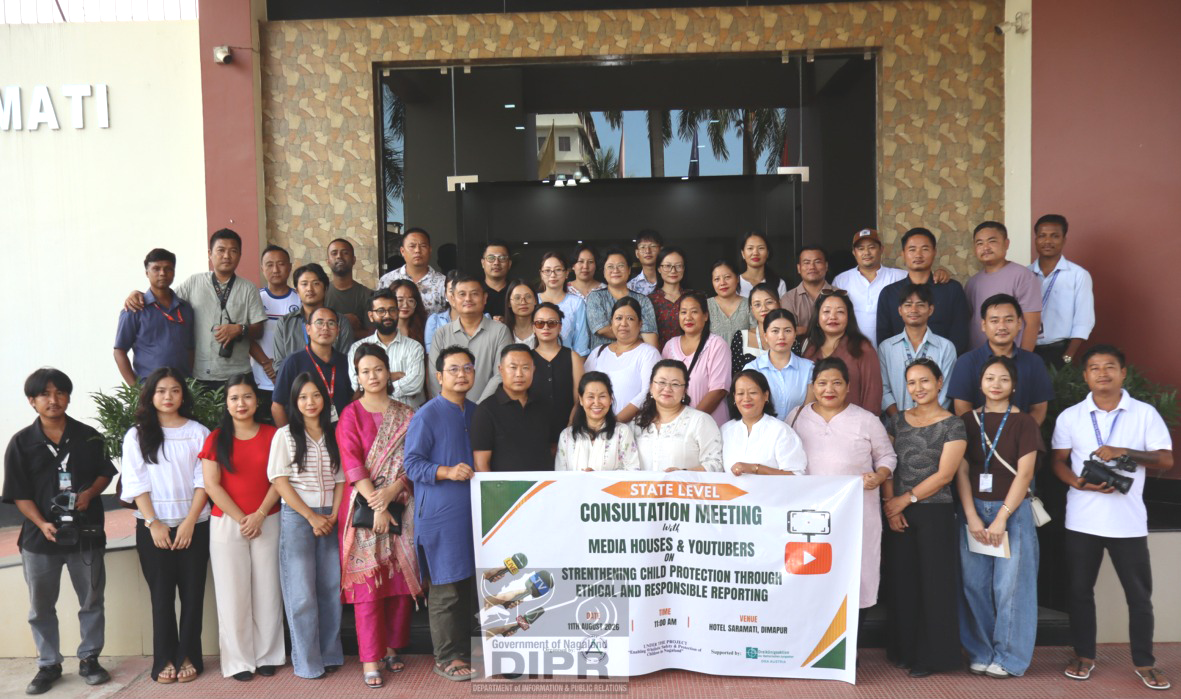
A state-level consultation meeting with media houses and YouTubers on “Strengthening Child Protection through Ethical and Responsible Reporting” was held at Hotel Saramati, Dimapur, on August 11. Organised by Prodigals’ Home, Dimapur, with support from DKA Austria, the consultation focused on strengthening the role of the media in safeguarding children’s rights and promoting responsible reporting of issues involving children.
A session on “Field Experience, Challenges and Looking Ahead” featured journalists Sub-Editor of Eastern Mirror, Prasanjit Dutta and Musaraf Ali, Senior Reporter of Nagaland TV. They highlighted the need for greater caution and sensitivity while reporting cases involving children, particularly children in conflict with the law and underage victims. Also, shared their experiences and highlighted the challenges faced by media professionals while covering child-related cases.
They emphasised the importance of greater legal awareness among journalists, particularly regarding laws and guidelines governing the reporting of cases involving children. They cautioned that lack of information or awareness should not be used as a reason for disclosing a child’s identity or other details that could lead to identification.
Further, underscored the importance of responsible editing in ensuring ethical reporting. They noted that the newsroom desk plays a crucial role in reviewing and shaping reports so that the publication of news does not cause further harm, stigma or distress to children. They called for continued efforts by media organisations and journalists to strengthen ethical practices and ensure that the dignity, privacy and best interests of children remain central to news reporting.
A key session on “Protecting Child Rights & Identity: From Law to Newsroom Practice” was address by Dr. Moalemba Jamir, Associate Editor, Morung Express. In his address, he highlighted the challenges faced by media practitioners in protecting children’s identities amid the rapid circulation of information through social media and closely connected communities. He observed that incidents involving children often generate public solidarity, demands for justice and strong reactions from organisations and community bodies, but such responses can sometimes inadvertently reveal a child’s identity. The media, he said, may also reproduce such information without adequately considering its legal and ethical implications.
He pointed out that indirect identifiers such as the name of a school, locality, neighbourhood, family details, photographs, uniforms and other contextual information can lead to the identification of a child. Merely withholding a child’s name, therefore, is not sufficient, he said, urging both traditional and digital media platforms to exercise greater scrutiny before reproducing information from official releases or social media posts.
Referring to the Protection of Children from Sexual Offences (POCSO) Act, 2012, and the Juvenile Justice (Care and Protection of Children) Act, 2015, he said the identity and privacy of children are accorded strong legal protection. Children in need of care and protection, as well as children in conflict with the law, are entitled to protection from secondary victimisation and further harm.
Download Nagaland Tribune app on Google Play


He further stressed that parental or organisational consent does not automatically absolve media practitioners of their responsibility to protect a child’s privacy and best interests. Even when a child or family is willing to speak publicly, journalists must consider whether publication could result in further trauma, stigma or identification. Dr. Jamir also cautioned against sensational headlines and urged media organisations to adopt neutral and child-sensitive language. He said headlines should focus on verified developments, such as police action or registration of a case, rather than sensationalising offences or revealing identifying details.
Discussing crime data, he referred to National Crime Records Bureau (NCRB) figures and noted that a significant proportion of crimes against children involve sexual offences, including cases registered under the POCSO Act. He, however, pointed out that official statistics may not fully reflect the actual situation due to under-reporting, informal settlements and the prevailing culture of compromise in some cases.
He also warned about the permanent digital footprint created by information shared through platforms such as WhatsApp and Facebook. Even when an online post is deleted, he said, the information may continue to circulate and potentially expose the identity of a child.
Further, he suggested a three-point checklist for journalists before publishing any report involving children: whether the child’s family or background can be identified; whether the locality or community can indirectly reveal the child’s identity; and whether a reader could identify the child by combining details in the report with information available online.
Calling for greater sensitisation of newsrooms on child rights legislation and ethical journalism, Dr. Jamir stressed that being the first to report an incident should not take precedence over verification and responsible reporting. “Being first is not the point. Being verified and ethical is more important,” he said, emphasising the need to balance public interest with the best interests of the child.
The consultation also featured an open house discussion providing media practitioners and participants an opportunity to discuss challenges and responsible approaches to reporting issues involving children. The programme concluded with remarks and a vote of thanks by Director, Prodigals’ Home, K. Ela.
