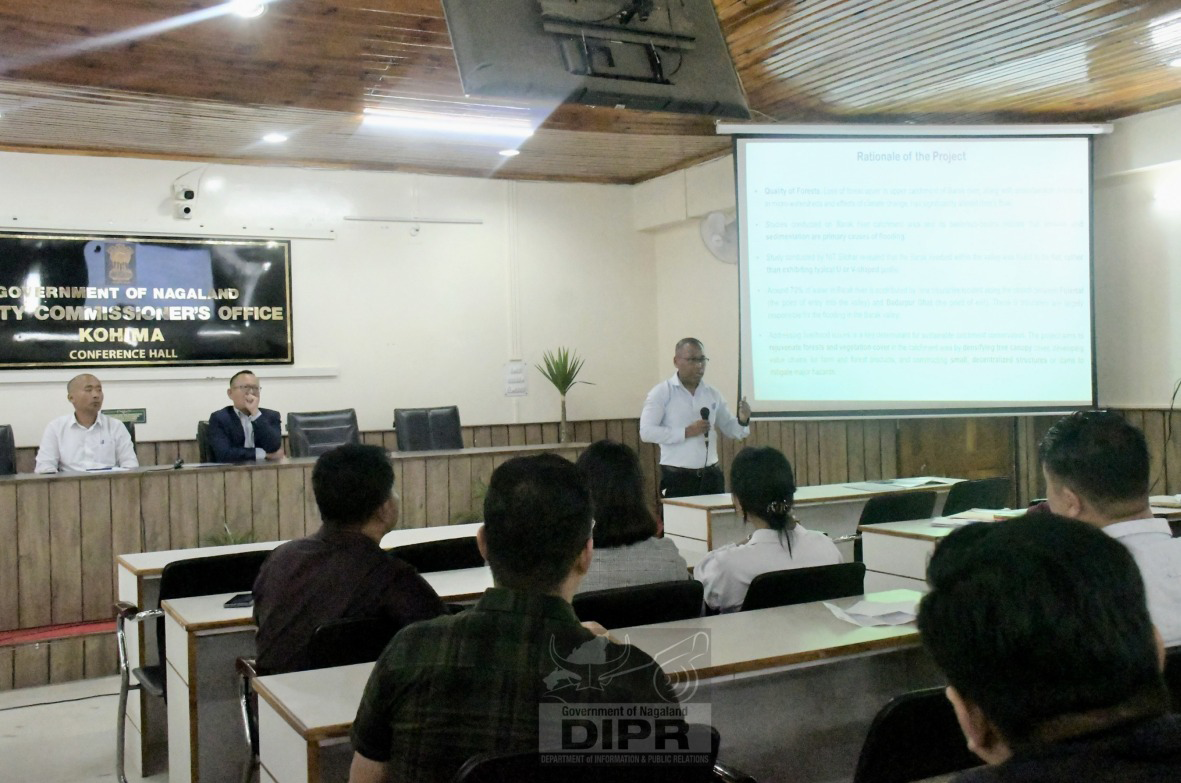
A meeting on the proposed project for “Conservation and Restoration of Catchment Areas of Barak River in the States of Assam, Manipur, Mizoram and Nagaland” was held at the Conference Hall of the Deputy Commissioner’s Office, Kohima, on August 31.
The meeting was chaired by the Additional Deputy Commissioner, Kohima, Ruopfukuotuo Noudi, and was attended by representatives of NERCORMS and officials from concerned departments of the state.
A representative of the North Eastern Region Community Resource Management Society (NERCORMS), made a presentation on the proposed project and its objectives. The project is proposed to be implemented by the North Eastern Council (NEC), Shillong, with NERCORMS as the executing agency. It is proposed to be funded by the Government of India and KfW, Germany.
The project seeks to address environmental challenges in the Barak basin arising from unsustainable land use and inadequate watershed management. Key concerns include deforestation, soil erosion, degradation of wetlands, shifting cultivation, riverbank erosion, high sediment loads and increasing flood risks in downstream areas.
The project will focus on landscape planning, catchment restoration, climate mitigation, development of farm and forest product value chains, forestry and horticulture interventions, and project management. Activities will include soil and moisture conservation, plantation and forest protection, biodiversity conservation, springshed management, livelihood promotion and capacity building of local communities.
Download Nagaland Tribune app on Google Play


The project is expected to improve forest and vegetation cover, strengthen climate resilience, reduce flood risks, enhance livelihood opportunities and promote sustainable management of natural resources. The proposed interventions are expected to benefit communities in project villages as well as neighbouring areas.
The meeting also discussed the ongoing feasibility study of the project and the data and information required from various departments of the State. Inputs relating to community forests and customary land ownership, upper-catchment management, water resources, livelihoods, agriculture, soil health, agroforestry, biodiversity and traditional ecological knowledge were discussed.
The NERCORMS team highlighted that the project is intended to follow a grassroots approach, with the needs and perspectives of local communities forming an important part of the planning process. The importance of including both male and female representatives and ensuring participation of all stakeholders was also emphasised.
Officials from the concerned departments discussed the feasibility of the proposed interventions and the requirements for the feasibility study. It was also proposed that a nodal officer be designated from the State to coordinate activities related to the project.
