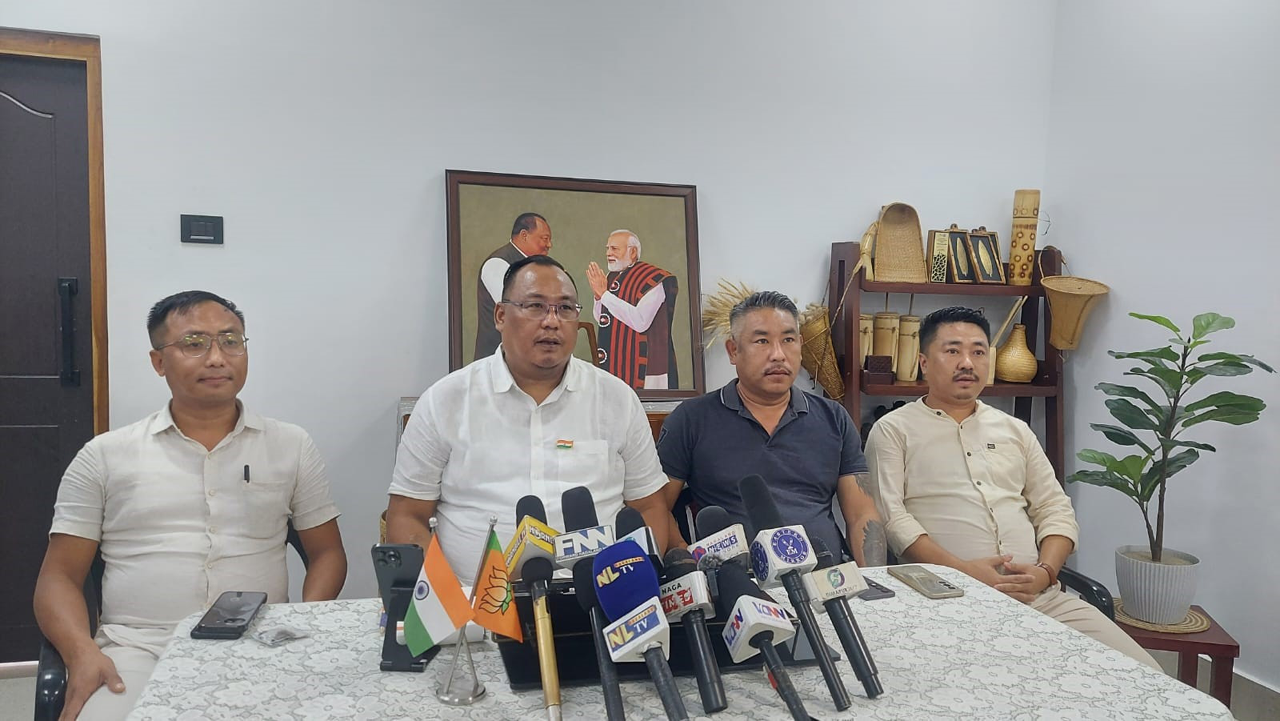
Nagaland BJP president, Benjamin Yepthomi on Monday defended the Election Commission of India (ECI) over the Special Intensive Revision (SIR) of electoral rolls and challenged Congress leader Rahul Gandhi to provide evidence for his allegations concerning “vote chori”, EVMs and the electoral process.
Addressing a press conference, Yepthomi referred to the ECI’s September 26 statement, which said decisions relating to the SIR were taken with the unanimous approval of the full Commission. The ECI has also said that the Supreme Court upheld the legality of the SIR exercise in its May 27, 2026 judgment.
Yepthomi said the ECI had also clarified that a communication to the Cabinet Secretary cited in the ongoing political debate concerned the functioning of an officer on deputation and was not a policy matter relating to the SIR or the Commission’s IT division.
He said political debate on the electoral process should be based on verifiable facts and maintained that the BJP supported an electoral system that was “transparent, credible, inclusive and accessible” to every eligible citizen. He also pointed to measures outlined by the ECI to assist voters during the SIR process, including doorstep assistance by Booth Level Officers and special drives for eligible and first-time voters.
Responding to repeated allegations by Gandhi and the Congress over SIR, Yepthomi said allegations alone could not constitute evidence. He asked the Congress to identify specific cases of alleged irregularities by naming the voter, polling station and constituency involved and providing supporting evidence.
Referring to Congress leaders in Kerala, Yepthomi claimed that some party leaders had acknowledged benefits from the SIR, including the removal of proxy or ineligible voters. He questioned the Congress’ differing positions on the exercise and asked why its national leadership was opposing SIR if, according to him, the process had benefited the party in Kerala.
On allegations concerning EVMs, Yepthomi questioned what he described as the differing response of political parties depending on election results. He referred to Congress victories in several States and contrasted them with the party’s criticism of EVMs following BJP victories elsewhere.
Yepthomi also referred to the Supreme Court’s April 2024 judgment concerning EVMs and VVPATs, saying the Court had considered safeguards including sealing procedures and strong-room security, with candidates or their representatives permitted to participate in relevant processes. He said any allegation of manipulation should be supported by concrete evidence and placed before the appropriate authority.
The BJP leader said Rahul Gandhi had the democratic right to oppose Prime Minister Narendra Modi and the BJP, but argued that political differences should not, in his view, undermine public confidence in democratic institutions.
“India’s democracy is bigger than Mr Rahul Gandhi, India’s democracy is bigger than Prime Minister Narendra Modi,” Yepthomi said, adding that it was also bigger than the BJP and Congress and that “the voters are supreme”.
He called on the Congress to bring forward evidence if it believed wrongdoing had occurred and allow the appropriate legal and constitutional mechanisms to examine such claims.
Yepthomi said the BJP would continue to focus on organisational work, public service, development and grassroots engagement, asserting that political support should be based on voters’ trust rather than allegations.
Download Nagaland Tribune app on Google Play


Meanwhile, responding to queries on the dissent Election Commissioners Sukhbir Singh Sandhu and Vivek Joshi had formally objected at least 14 times over 10 months to decisions and orders relating to the electoral process, including SIR, voter registration, deletions and access to electoral-roll databases, which were reportedly ignored as per Indian Express report, BJP State General Secretary, Sunep Jamir said that the Election Commission is a constitutional body comprising three members of equal rank, with the Chief Election Commissioner being “first among equals”.
He said differences of opinion among the commissioners should not automatically be construed as a breakdown in the functioning of the Commission.
Jamir described the reported objections as dissent rather than allegations against the Chief Election Commissioner. Drawing an analogy with multi-member Supreme Court benches, he said differing views could arise within constitutional institutions but decisions were ultimately taken through the prescribed process.
He pointed to the ECI’s September 26 statement that the decisions taken by the Commission, including those relating to SIR, had the approval of all three commissioners. The Commission has also announced measures concerning Form 6, access to electoral-roll data and the handling of SIR-related notices following the issues raised in internal communications.
On the controversy surrounding Form 6, Jamir said the statutory form prescribed under the Registration of Electors Rules, 1960 could not be altered by the Election Commission itself and argued that changes to the rules would require action by Parliament. He maintained that the additional SIR-related declaration should not be treated as a fundamental alteration of the statutory Form 6.
The Indian Express had reported that Sandhu and Joshi objected to the addition of an SIR-related declaration to the online Form 6, with Sandhu describing the change as “unauthorised and illegal”. The ECI subsequently said the additional declaration was specific to the SIR exercise and that the regular statutory form continued to be used otherwise.
On the deletion of voters during SIR, Benjamin Yepthomi said the exercise was intended to identify duplicate or otherwise ineligible entries and maintain accurate electoral rolls. He argued that deletion figures should be examined in the context of the stated objective of eliminating duplicate entries rather than being presented simply as deletion of genuine voters.
Yepthomi also said the BJP in Nagaland was prepared to examine the issue through its state-level SIR committee and district-level committees. Asked about the possibility of an independent booth-level audit of disputed deletions, he said the party had already constituted a committee to look into the matter.
“We have to look into this very clearly,” Yepthomi said, while stressing the need for genuine voting and accurate electoral rolls.
On concerns raised by NDA allies seeking clarification from the ECI, Jamir said every political party in a democratic system had the right to raise questions and seek clarification, even while being part of an alliance. He said the BJP itself stood to lose voters if names were removed during the revision process and argued that the exercise was not directed at any particular political party.
The BJP leaders also rejected suggestions of political influence over the ECI. Jamir said the Commission was constitutionally independent and referred to the statutory selection mechanism for its members, which includes the Prime Minister and the Leader of Opposition.
Asked why the BJP was defending the ECI if the Commission was an independent constitutional body, Jamir said opposition criticism directly or indirectly implicated the BJP in the allegations and therefore, according to him, the party had a reason to respond.