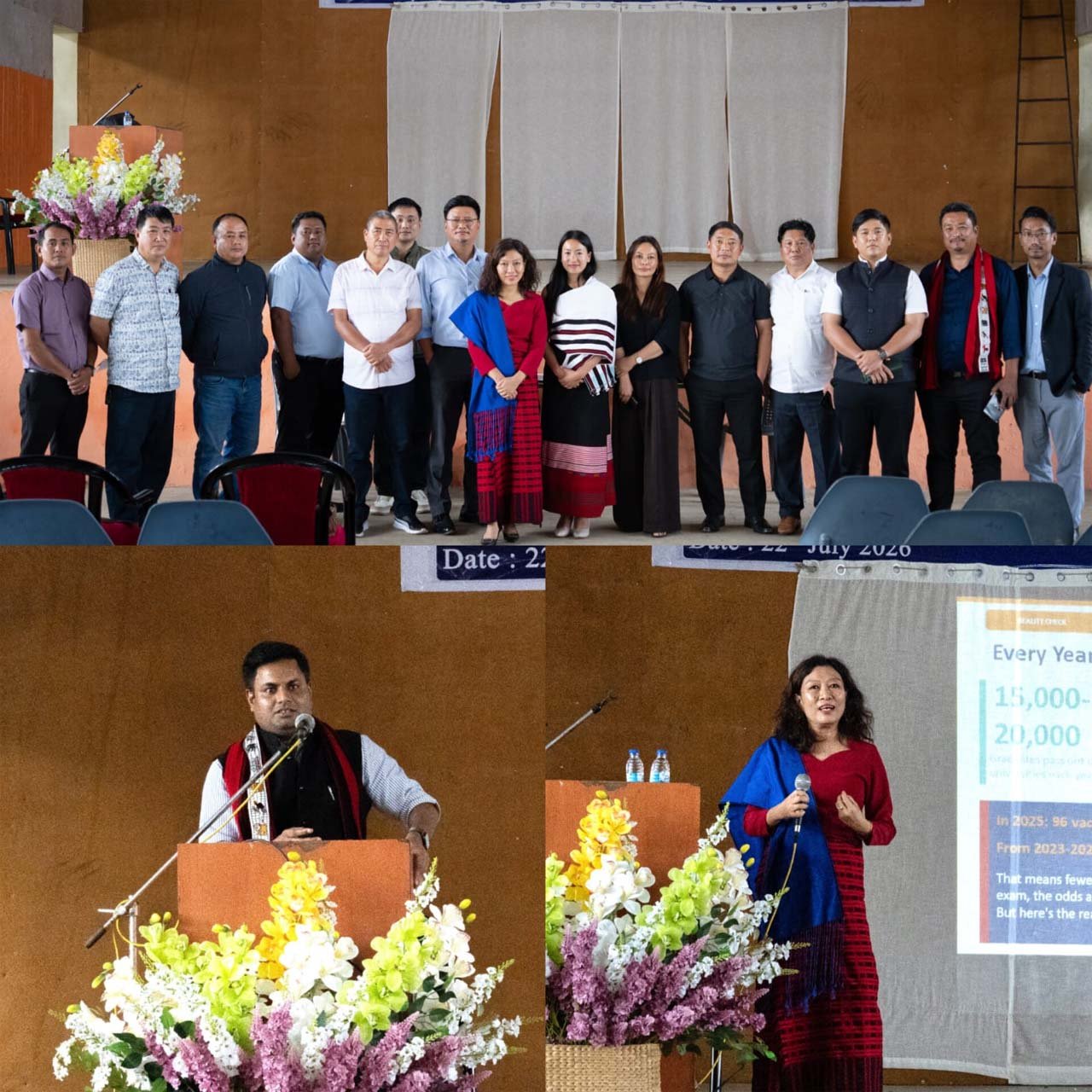
With Nagaland’s unemployment rate among the 15-29 age group standing at 16.7 per cent, nearly 65 per cent of unemployed youth being educated, and around 15,000 to 20,000 graduates entering the job market annually, Meripeni Ngullie, Under Secretary and Project Lead, Nagaland Skill & Entrepreneurship Development Mission (NSEDM), highlighted the growing employment challenge in the state during a one-day sensitisation programme on skill development. Speakers at the programme stressed that government employment alone cannot absorb the state’s growing educated workforce and called for a shift towards entrepreneurship, vocational skills and self-employment and emphasised the need for greater participation in skill development initiatives. Despite the concerns raised, the programme drew only around 90 participants from different parts of Mokokchung district.
The One-Day Sensitisation Programme on Skill Development, organised by the Ao Officers’ Telungjem (AOT) in collaboration with the Nagaland Skill & Entrepreneurship Development Mission (NSEDM), Government of Nagaland, was held at the Town Hall, Mokokchung under the theme “Know Your Skills. Know Your Opportunities.”
Delivering the exhortation, Deputy Commissioner of Mokokchung, Ajit Kumar Verma, IAS, described the programme as “a wonderful initiative” and said it marked the beginning of a larger vision for the district. He acknowledged the efforts of Chief Secretary Sentiyanger Imchen, IAS, whose emphasis on skill development and entrepreneurship had helped shape the state’s renewed focus in the sector.
Verma said the programme represented a significant day for Mokokchung, adding that although it was a modest gathering, it carried a big dream. Referring to the vision of Viksit Bharat, he said nation-building requires a skilled workforce capable of meeting future economic demands.
He observed that despite economic growth, Nagaland continues to face structural challenges, including dependence on government employment, heavy reliance on imported goods despite its fertile land, and limited industrial development.
Calling it a wake-up call, he said skill development is essentially value addition to human resources and has the potential to contribute significantly to the district, state and national economy.
Verma stressed that skill development cannot succeed without creating a favourable ecosystem involving families, communities, educational institutions and government. While the government can provide opportunities, he said the aspiration to learn and improve must come from individuals themselves.
“The difference today is in the skill set,” he said, adding that countries and institutions around the world succeed because of skilled human resources rather than merely having access to the same resources.
He noted that Nagaland possesses immense potential in traditional sectors such as bamboo crafts, handloom, tea, coffee and beauty services, and said the state must build upon these strengths. With a young population, he said there is tremendous scope for developing small enterprises and local industries.
Encouraging young people to “start small but dream big,” Verma said guidance alone is insufficient and must be accompanied by consistency, infrastructure and continuous mentoring.
He also highlighted the mismatch between education and employment, observing that many graduates possess academic qualifications but lack practical skills demanded by industries. He urged youth to focus on acquiring real skills instead of merely collecting certificates.
Nagaland Tribune app on Google Play


Calling for the strengthening of Industrial Training Institutes (ITIs) and polytechnic institutions, Verma shared his vision of establishing a Centre of Excellence equipped with modern infrastructure, new-age trades and qualified instructors capable of preparing youth for global opportunities. He also appealed to private partners to collaborate in strengthening the state’s skilling ecosystem.
Urging all stakeholders to join the mission, he encouraged participants to invest time in self-development, utilise available government schemes and contribute meaningfully towards nation-building.
Earlier, Imosong Imsong, Joint Commissioner of Taxes and Vice President, Ao Officers’ Telungjem, said the programme originated from discussions held during the Ao Officers’ Telungjem All India Meet in Mokokchung on September 13 last year and was further deliberated during the AOT Executive Meeting held on January 31, 2026.
He said the initiative was inspired by Chief Secretary Sentiyanger Imchen’s concern over the growing problem of educated unemployment among Ao youth and the need to create practical pathways through skill development.
Imsong observed that only around 10 out of every 100 educated youths could expect to secure government employment, leaving the remaining majority to seek alternative career options.
He expressed concern that despite Nagaland being one of the country’s most literate states, educated unemployment continues to rise. He also noted that although the government regularly advertises skill development programmes across districts, participation remains low.
Highlighting some of the challenges confronting young people, he referred to drug abuse, excessive dependence on mobile phones and lack of productive engagement, urging youth to make better use of their time and develop the determination to become self-reliant.
He encouraged young people to make use of institutions such as ITI Mokokchung, Nagaland Polytechnic, Mokokchung, and other technical institutes in the state to acquire employable skills and pursue entrepreneurship.
During the technical session, Meripeni Ngullie, presented an overview of the state’s employment scenario and the need for market-driven skill development. She said NSEDM has trained more than 3,400 youth across over 40 trades, but emphasised that the gap between education and employability remains a major concern.
Citing employment statistics, she said Nagaland’s unemployment rate among the 15-29 age group stands at 16.7 per cent, with around 65 per cent of unemployed youth being educated, while nearly 80 per cent of the unemployed comprise educated individuals.
She noted that around 15,000 to 20,000 graduates pass out from institutions within Nagaland every year, while thousands more pursue higher education outside the state, including over 40,000 Naga students studying in Delhi.
Highlighting the limited availability of government jobs, Ngullie said that although only about 250 to 300 NPSC posts are advertised annually, more than 16,000 candidates appeared for the preliminary examination conducted for 96 vacancies in 2025. She said these figures clearly indicate the need for youth to diversify their career aspirations and consider entrepreneurship and skill-based professions.
Ngullie also observed that employers today increasingly value practical skills, work experience and adaptability over academic qualifications alone. She said many young job seekers continue to face difficulties during interviews because of limited exposure and the mismatch between education and industry requirements.
The technical session also featured success stories by Limamatsung and Akumtemsu, founders of L&A Repair & Services, and Talirenla, a freelance drone mapping professional, who shared their entrepreneurial journeys and encouraged participants to explore opportunities through skill development, innovation and self employment. Also few more successful entrepreneurs from NSEDM shared their stories.