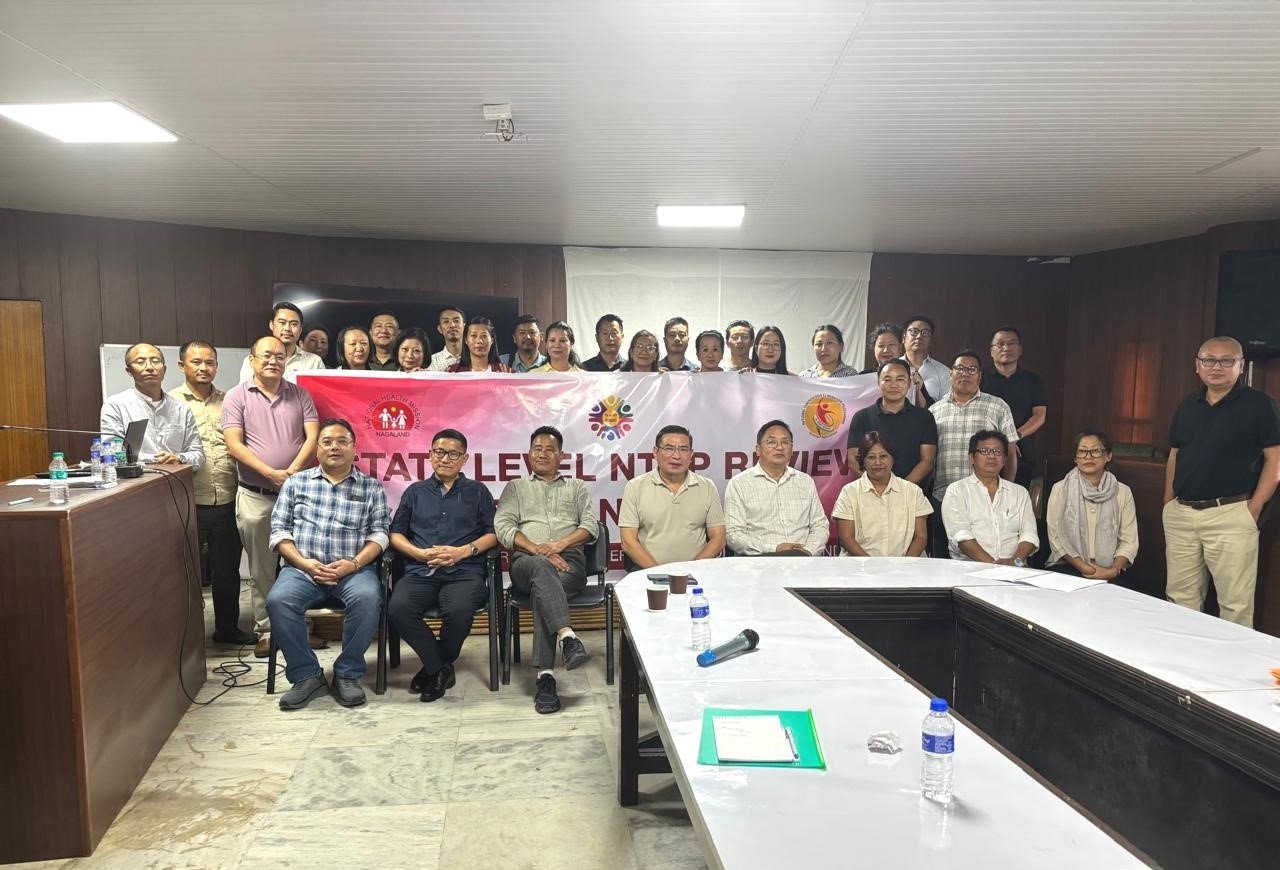
The State TB Cell under the Directorate of Health and Family Welfare, Nagaland, convened its quarterly review meeting for the National TB Elimination Programme (NTEP) on September 3 at the Directorate’s conference hall in Kohima.
Delivering the welcome address and introductory remarks, State TB Officer (STO), Dr Akum Jamir outlined the key programmes being implemented by the NTEP Nagaland alongside the rollout of the 100 Days Campaign. Recognizing the urgency of program evaluation, the STO expressed appreciation for the district teams’ adaptability in preparing strategic plans on short notice, while stressing the importance of the quarterly review meeting.
Dr Jamir contextualized the ongoing effort within global and national health frameworks, reminding participants that public health policies align directly with the United Nations Sustainable Development Goals (SDGs) specifically SDG 3, which focuses on Good Health and Well-Being.
He highlighted the disproportionate burden borne by the country, noting that India accounts for roughly 28% of the global TB burden despite comprising only 17% of the world’s population. This stark ratio underscores the critical need for aggressive elimination strategies at both the national and state levels.
While the national target set by Prime Minister Narendra Modi aimed for TB elimination by 2025, Dr Jamir acknowledged that global setbacks, particularly the disruptions caused by the COVID-19 pandemic, impacted progress.
The STO emphasized that the programme is receiving unprecedented top-tier administrative oversight. Reviews are now routinely conducted directly from the Prime Minister’s Office (PMO) through regular monitoring of Centrally Sponsored Schemes (CSS), which the NTEP is also part of CSS.
Download Nagaland Tribune app on Google Play


Following high-level meetings involving state Chief Secretaries, enhanced monitoring frameworks have been instituted down to the block level, he stated that Prabhari Nodal Officers, dedicated officers have been entrusted to visit individual blocks and districts to oversee execution.
Dr Jamir also informed that State Chief Secretaries are tasked with reviewing execution and monitoring targets every five months to resolve operational bottlenecks promptly.
Reflecting on the evolution from the Revised National Tuberculosis Control Programme (RNTCP) to the current NTEP framework, Dr Jamir highlighted significant diagnostic upgrades across healthcare units.
The strategy has shifted toward rapid molecular diagnostic testing and early detection such as diagnostic upgrades- X-ray machines and advanced diagnostic gears are being positioned at the block and district levels. Role of Sputum Microscopy: Sputum microscopy is increasingly utilized primarily for follow-ups, with chest X-rays and rapid molecular tests serving as front-line tools when symptoms appear.
He also informed that given the scale of the population, screening strategies are prioritizing high-risk and vulnerable populations—particularly individuals aged 14 and older—alongside integrating modern predictive digital tools within the Ni-kshay platform to prevent adverse outcomes.
Dr Jamir further called upon the medical officers, technical staff and administrative teams to maintain momentum, emphasizing that continuous screening and systematic testing remain Nagaland’s primary pathway toward achieving TB elimination goals.
Meanwhile, Dr Collins Z Sono, WHO Consultant updated the participants about the TB Mukt Abhiyan and informed that the State-Level TB Reduction Progress (2015–2024) Incidence wherein Nagaland achieved a 19% reduction in TB incidence rate. For mortality: The state recorded an 18% reduction in TB mortality.
As for National Context: Comparatively, India recorded a 21% reduction in incidence and a 25% reduction in mortality nationally in 2024.
For the way forward he also mandated the health officials with steps such as , including setting weekly screening and treatment targets, maximizing diagnostic facilities, and enforcing real-time data entry in the Nikshay portal among others.
During the meeting district strategic plans were shared by the district officials followed by discussions on ACSM, Drugs, NGOS and Xrays were also held which concluded with Dr Puse Liegise, Director, Medical Education, Department of Health and Family Welfare Nagaland tendering the vote of thanks.