Nagaland Police has launched two new digital initiatives—e-Challan and eSuraksha—while further strengthening two existing digital systems for tenant-landlord registration and hotel guest occupancy, as part of efforts to make policing more transparent, accountable and accessible to the public.
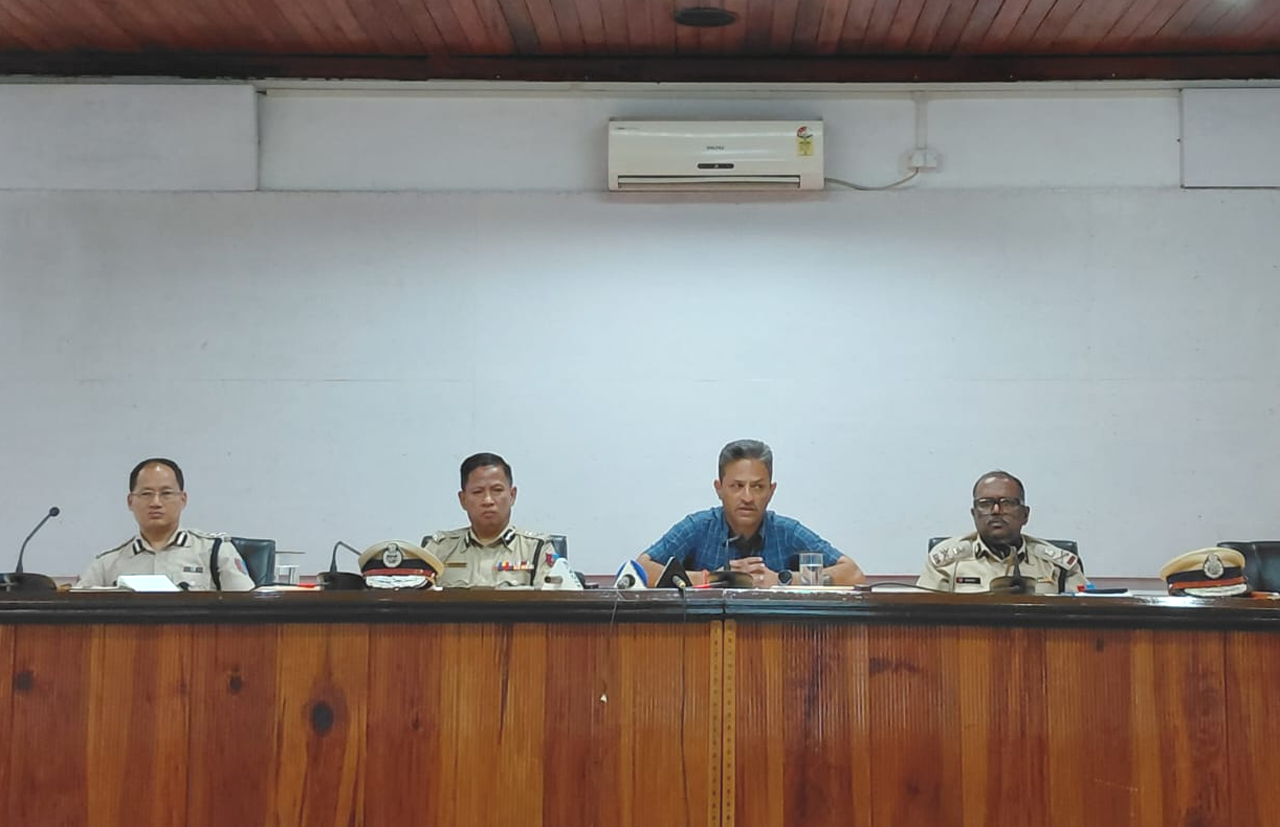
The initiatives were formally announced by Nagaland Director General of Police (DGP) Rupin Sharma, IPS after a unit commanders’ meeting attended by senior officers, including DGs, ADGs, IGs, DIGs and heads of various units of the Nagaland Police. The meeting discussed law and order as well as logistical matters.
Addressing the media, Sharma said the four digital functionalities were intended to improve police service delivery and enable the public to work more closely with the police in improving the law and order situation in the state.
e-Challan system introduced
The DGP said Nagaland Police has adopted the e-Challan system developed by the National Informatics Centre (NIC), an automated digital traffic enforcement system integrated with the Government of India’s Parivahan portal.
The system is aimed at improving transparency and efficiency in traffic enforcement and will eliminate the need for motorists to make cash payments for traffic violations.
Sharma said authorised police officers across Nagaland have been onboarded onto the e-Challan application for imposing and compounding offences under the Motor Vehicles Act.
Motorists can make payments digitally through QR codes and digital payment platforms such as PhonePe, Google Pay and BHIM, among others.
The DGP said the system would also enable Nagaland Police to maintain a digital record of traffic enforcement, including the officer who imposed a fine, the date, the vehicle involved and the nature of the violation. At the backend, senior police officers would be able to monitor the performance of different units and officers involved in traffic enforcement across districts.
He said the new system would also provide a grievance-redressal mechanism for traffic challans.
While motorists would have the option of paying a fine within the prescribed period, Sharma encouraged people to settle traffic penalties electronically at the spot wherever possible, instead of having to subsequently approach police officers or judicial authorities for compounding the offence.
No more physical challans
A major change under the new system is that Nagaland Police will no longer issue physical hard copies of traffic challans.
Challans and receipts generated through the e-Challan system will be sent electronically through SMS or will be available for electronic download.
Sharma said the system would also generate alerts for overdue and pending challans. Unpaid violations would continue to remain in the system and could have consequences when the vehicle is subsequently stopped for another violation.
The DGP cautioned vehicle owners against allowing traffic violations and penalties to remain pending, particularly because the e-Challan system is linked with the mParivahan and Parivahan portals.
Pending challans can be reflected when a vehicle owner seeks to transfer or sell a vehicle. Similarly, issues relating to registration and third-party insurance would have to be addressed before the vehicle could be legally transferred or resold.
Sharma also urged vehicle owners to comply with registration and other requirements under the Motor Vehicles Act, warning that violations could result in penalties and, where applicable, vehicles being seized or impounded.
eSuraksha to enable online police complaints
The second major initiative launched by Nagaland Police is eSuraksha, an online platform intended to make police complaint registration more accessible and transparent.
Sharma said anyone could use the platform to submit a complaint or information to any police station in Nagaland electronically, irrespective of where the complainant is located.
He gave the example of a person sitting in Chennai who may have information about an incident such as child trafficking, theft or abuse occurring in Nagaland. Such a person would be able to submit the information through eSuraksha without physically travelling to the state.
The platform provides options for filing a complaint either by disclosing the complainant’s identity or anonymously.
However, Sharma clarified that while anonymous complaints could be submitted, the police would not be able to communicate the outcome of the inquiry to an anonymous complainant. Those who file complaints using their identity would be entitled to receive information on the outcome of the inquiry or investigation.
Download Nagaland Tribune app on Google Play


Complaints to be monitored across police hierarchy
According to the DGP, complaints filed through eSuraksha will be visible not only to the concerned Officer-in-Charge (OC) of the police station but also to supervisory officers, including the SDPO/ACP, Additional DCP/Additional SP, SP, DIG, IG, ADG and DGP.
This, he said, would allow complaints that remain pending or are not properly addressed to be escalated through the supervisory hierarchy.
Each complaint will receive an acknowledgement number, allowing the complainant to log into the system and check the status of the inquiry.
The platform will also allow complainants to upload supporting documents, photographs, videos and audio files.
Sharma said the system had been designed to make the process simple, including for people who may not know the precise legal category of an offence.
“If you don’t know the crime category and you just describe the crime, the OC will assign the crime category to it,” he said, explaining that the burden of determining the appropriate category would rest with the police.
Seven-day timeline for preliminary inquiry
Explaining the legal framework behind the system, Sharma said that under the new criminal laws, if a complaint discloses a cognizable offence, the police station is required to register an FIR.
Where the nature of a complaint requires a preliminary inquiry, the inquiry is required to be completed within seven days. Complaints exceeding the prescribed period would be flagged and made visible to supervisory officers, enabling them to monitor delays and direct investigating officers to complete the inquiry.
The DGP said the system would provide greater accountability because senior officers would be able to see whether complaints were being acted upon and whether inquiries were being completed within the prescribed period.
He also stressed that a complaint should not automatically be equated with an FIR.
“If a complaint discloses a cognizable offence directly… it will require an FIR. But after a preliminary inquiry, if it discloses a cognizable offence, it becomes an FIR,” Sharma explained.
Complaints and FIRs to be distinguished
ADG (Law & Order) Sandeep Tamgade further explained the distinction between a complaint and an FIR.
He said members of the public might not always know whether an incident constituted a criminal offence, a civil dispute, a cognizable offence or a non-cognizable offence. Determining the legal nature of the information was the responsibility of the police.
Where information clearly disclosed a cognizable offence, the Officer-in-Charge would have very limited discretion and would be required to register an FIR.
However, where it was not immediately clear whether a cognizable offence had been committed, the new criminal laws provide for a preliminary inquiry (PE) in appropriate cases.
Tamgade said the purpose of such an inquiry was to establish whether the complaint disclosed a prima facie criminal case. If the inquiry established that a cognizable offence had been committed, the police would then be required to register an FIR.
He also pointed out that civil disputes do not fall within the police’s jurisdiction and that people have other legal mechanisms available for such matters.
Complainants to know outcome of police action
Tamgade said eSuraksha would provide transparency at the police station level by enabling complainants to know whether their complaint had been registered, why it had not been registered where applicable, and what action had been taken.
He said the new criminal law also requires the police to communicate the outcome of an inquiry or investigation to the complainant.
This could include information that a case had been registered and that a police report, such as a chargesheet or closure report, had been submitted to the court.
According to Tamgade, the digital system would therefore strengthen the service-delivery mechanism at police stations by making the process more transparent to complainants.
Police to reach out to complainants
The DGP said eSuraksha was also intended to reduce the need for complainants to physically visit police stations.
He urged citizens to use the online system and said police officers should not insist that people come to a police station merely for the purpose of lodging a complaint.
“If any police officer insists on your coming to the police station, please inform the senior officers,” Sharma said.
He clarified, however, that complainants or victims might subsequently be required to associate with police during an inquiry or investigation when officers need to ask questions or obtain further information.
The DGP described the initiative as a significant step towards improving transparency and accountability in the police system, particularly in addressing longstanding concerns that complaints lodged at police stations were sometimes not registered or that complainants were unaware of the progress of their cases.
Tenant-landlord and hotel occupancy systems
Sharma also highlighted two digital systems that have already been operational in Nagaland for about a year—the tenant-landlord registration system and hotel occupancy registration system.
Both systems are OTP-based and are intended to assist the police in maintaining records of people residing in rented accommodation and those staying in hotels.
The DGP appealed to landlords and tenants across the state to make use of the tenant-landlord application and urged hotels to ensure that their guests are properly registered through the hotel occupancy system.
He said comprehensive registration would help the police locate suspects or victims when necessary and prevent criminals from using rented accommodation or hotels to remain anonymous.
Sharma said the systems would help the police “deny territory” to criminals and wrongdoers by reducing the possibility of people staying in accommodation without any record being available to the authorities.
Appeal for public participation
The DGP urged the public to make maximum use of all four digital functionalities—e-Challan, eSuraksha, tenant-landlord registration and hotel occupancy registration.
He said the initiatives were not merely technological interventions but part of a broader effort by Nagaland Police to improve transparency, accountability and public service delivery.
Sharma also requested the media to disseminate information about the new systems and help create awareness among the public so that the platforms could be widely adopted across the state.
The initiatives, he said, were aimed at making policing more systematic while enabling citizens to interact with the police without unnecessary physical visits and ensuring greater visibility of police action at different levels of the department.