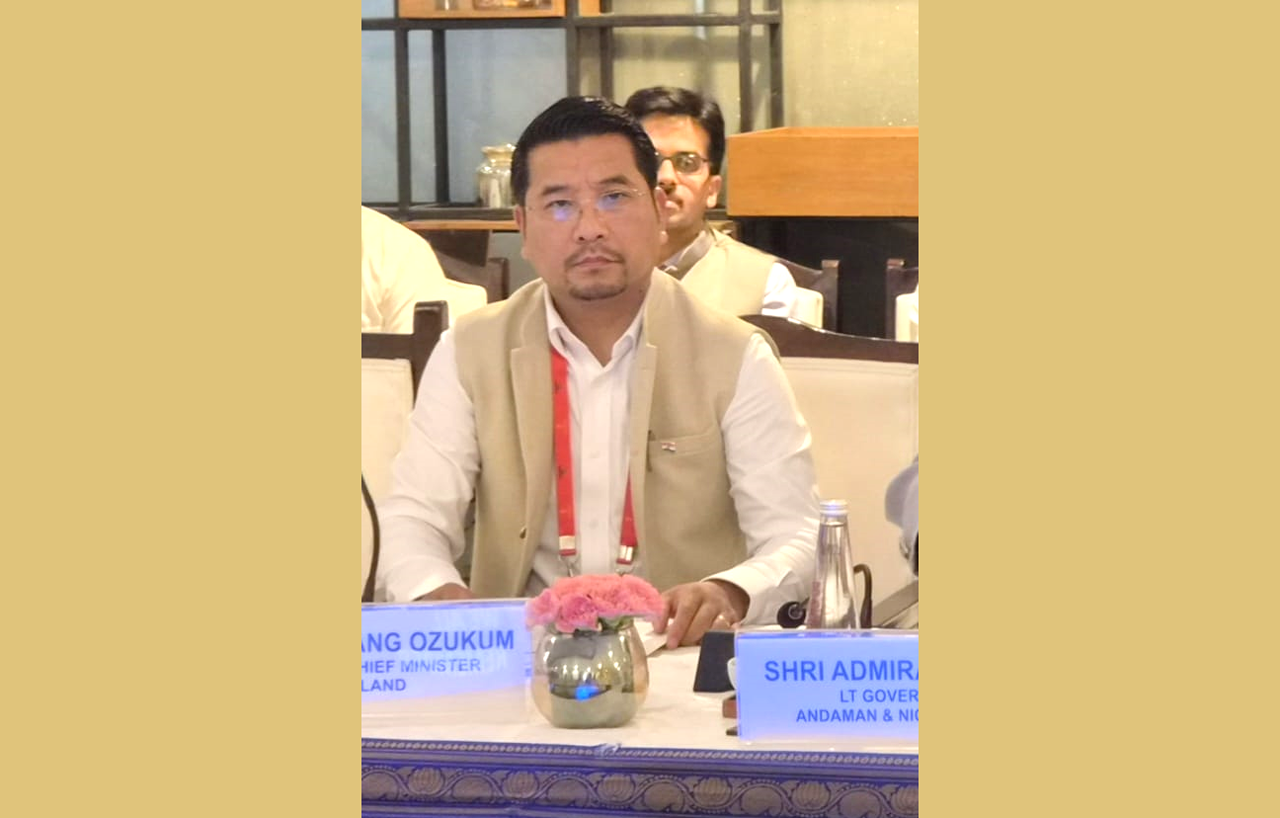
Nagaland Advisor for Water Resources, Tongpang Ozukum has sought greater flexibility and timely release of funds for water infrastructure projects in the State, highlighting the unique challenges posed by its short working season and difficult terrain at the Jal Shakti Departmental Summit in New Delhi.
The two-day summit, hosted by the Ministry of Jal Shakti at Sushma Swaraj Bhawan on September 1 and 2, brought together Ministers, senior officials and representatives from States and Union Territories. Secretary, Water Resources Department, Nagaland, Akunu S Meyase, also attended the summit.
Speaking at the summit, Ozukum said Nagaland primarily implements Minor Irrigation Projects and therefore faces relatively few difficulties relating to land acquisition, contractual or project management issues, design modifications and inter-State or inter-agency coordination. However, he identified the timely release of funds as a major challenge affecting project implementation.
He pointed out that the effective working season in Nagaland is limited to about six months, from November to April, making timely fund releases essential for completing water infrastructure projects within the available construction period.
Ozukum also raised concerns over the requirement of producing Audit Certificates every nine months, describing it as a challenge for the Department. He suggested that Nagaland be permitted to submit the certificate once every two years.
On the introduction of the SNA-SPARSH module, which enables real-time monitoring of fund releases and expenditure while strengthening financial transparency and accountability, the Advisor requested that mother sanctions under the system be released in a maximum of two instalments annually.
He further suggested that Surface Minor Irrigation projects approved by the State Level Sanctioning Committee should not necessarily be subjected to re-approval in subsequent years.
Download Nagaland Tribune app on Google Play


Addressing the issue of cost escalation caused by delays in commencement of projects, Ozukum called for provision to accommodate price escalation so that the scope of work does not have to be altered and quality is maintained. He also proposed increasing the development cost ceiling for Minor Irrigation Projects from ₹4 lakh to ₹6.5 lakh per hectare to address implementation challenges.
The Advisor expressed concern that Nagaland had not received a single project under the Flood Management and Border Areas Programme (FMBAP) for more than a decade, despite the State having submitted four proposals. He urged the Ministry of Jal Shakti to sanction projects for Nagaland under the FMBAP during the current financial year.
Ozukum also highlighted erosion-related challenges at several locations, including the Chathe River in Chümoukedima, Tuli town in Mokokchung and Naginimora in Mon district. He requested the Ministry to permit both conventional and non-conventional construction methods for anti-erosion projects, depending on local requirements.
Highlighting the State Government’s initiatives, Ozukum said the Nagaland Strategic Water Resilience Initiative was being undertaken during 2026-27 with the objective of strengthening water security across the State.
He noted that despite receiving heavy monsoon rainfall, Nagaland experiences acute water shortages during the lean season due to its hilly terrain and high surface runoff. To address the challenge, the State has adopted farm ponds as micro water-harvesting structures under the NABARD Rural Infrastructure Development Fund (RIDF).
According to Ozukum, the initiative is aimed at strengthening rural livelihoods and ecosystems while demonstrating the potential of water conservation, storage, groundwater recharge and sustainable water management.
Prime Minister Narendra Modi addressed the valedictory session of the summit, which was attended by the Union Minister for Jal Shakti, Ministers from States and Union Territories, and senior officials from the Ministry of Jal Shakti and participating States and Union Territories.