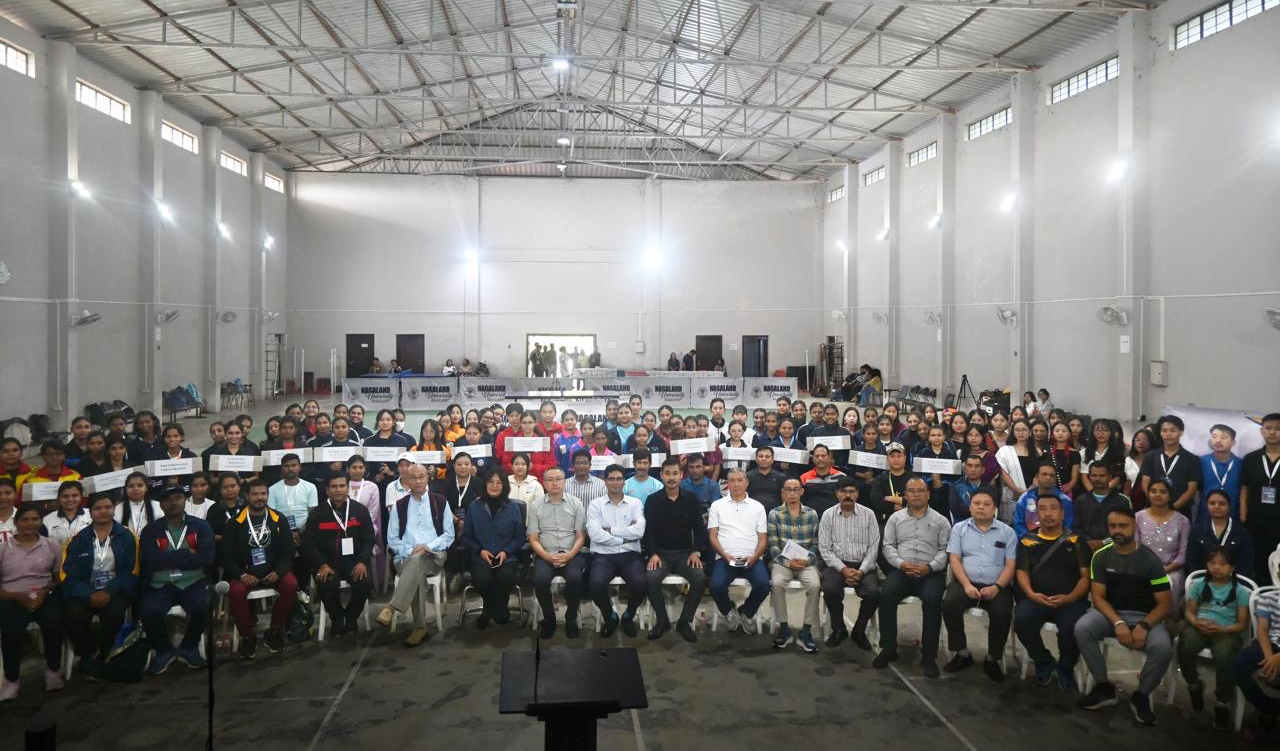
KG Kenye stresses democratic rights, constitutional safeguards and civic responsibility
Nagaland University hosted the 18th National Youth Parliament Competition 2026 at its Lumami campus on October 27, with Nagaland Minister for Power and Parliamentary Affairs and former Member of Parliament, K.G. Kenye, as the chief guest at the inaugural ceremony and one of the judges for the competition.
The event aimed to promote parliamentary democracy, constitutional values and democratic participation among students while nurturing leadership qualities, critical thinking and a sense of civic responsibility. It provided a platform for young participants to engage in democratic discussions and understand parliamentary procedures and decision-making.
The inaugural ceremony was chaired by Dr Thokchom Ghanakumar Singh of the Department of Law, Nagaland University. The programme began with the University Anthem, followed by a welcome address and introduction of dignitaries by Dr Tovishe Phucho of the Department of Chemistry.
Group Coordinator Prof (Dr) Anupam Kurlwal presented the concept note for the competition. He is Head of the Department of Law at MDU Centre for Professional and Allied Studies, Gurugram, and was nominated by the Ministry of Parliamentary Affairs, Government of India, for the competition.
Addressing the gathering, Kenye reflected on India’s democratic journey since Independence and the challenges involved in building and sustaining a democratic republic. He highlighted the contributions of Dr BR Ambedkar and the members of the Constituent Assembly in establishing a constitutional framework that has sustained the country’s democratic system through changing times.
He observed that India’s diversity, encompassing different cultures, traditions, languages and social realities, makes the functioning of democracy both challenging and significant.
Highlighting Nagaland’s distinct constitutional position, Kenye discussed the circumstances surrounding the State’s formation and the significance of Article 371A of the Constitution in safeguarding Naga religious and social practices, customary laws and procedures, and the ownership and transfer of land and its resources. He described the provision as an important constitutional safeguard for protecting the identity and interests of the Naga people.
Download Nagaland Tribune app on Google Play


Addressing the young participants, Kenye urged them to value the democratic rights and freedoms available to Indian citizens, particularly freedom of expression. Referring to people in parts of the world who are denied opportunities to express their views, he said the freedom to speak carried corresponding responsibilities. He encouraged the participants to communicate with sincerity, commitment and purpose.
Earlier, Vice-Chancellor In-charge of Nagaland University, Prof Bendang Ao, said the university was committed not only to academic and research excellence but also to nurturing responsible citizens.
He observed that democracy becomes stronger when young people think critically, express themselves respectfully, respect differing opinions and place the national interest above everything else.
Ao said the National Youth Parliament Competition was more than a contest, describing it as a platform for young people to learn democratic debate, develop leadership qualities, understand parliamentary procedures and appreciate dialogue, discipline and mutual respect. He also highlighted Nagaland’s rich cultural heritage and vibrant democratic experience.
The inaugural session concluded with a vote of thanks by the university’s PRO, Peter Ki.
The competition commenced after the inaugural programme. The panel of judges included Kenye, Prof. (Dr) Anupam Kurlwal and Dr Imtiwati Jamir, Principal of Jubilee Memorial College, Mokokchung.
Phalwani secured first prize, followed by Alika in second place and Akimeni Nk Newmai in third place. Three special prizes were awarded to Vemutulu, Phuhton and Ilihon K. Chishi.
The competition underscored the importance of youth engagement in democratic processes and the role of educational institutions in nurturing informed, responsible and active citizens.