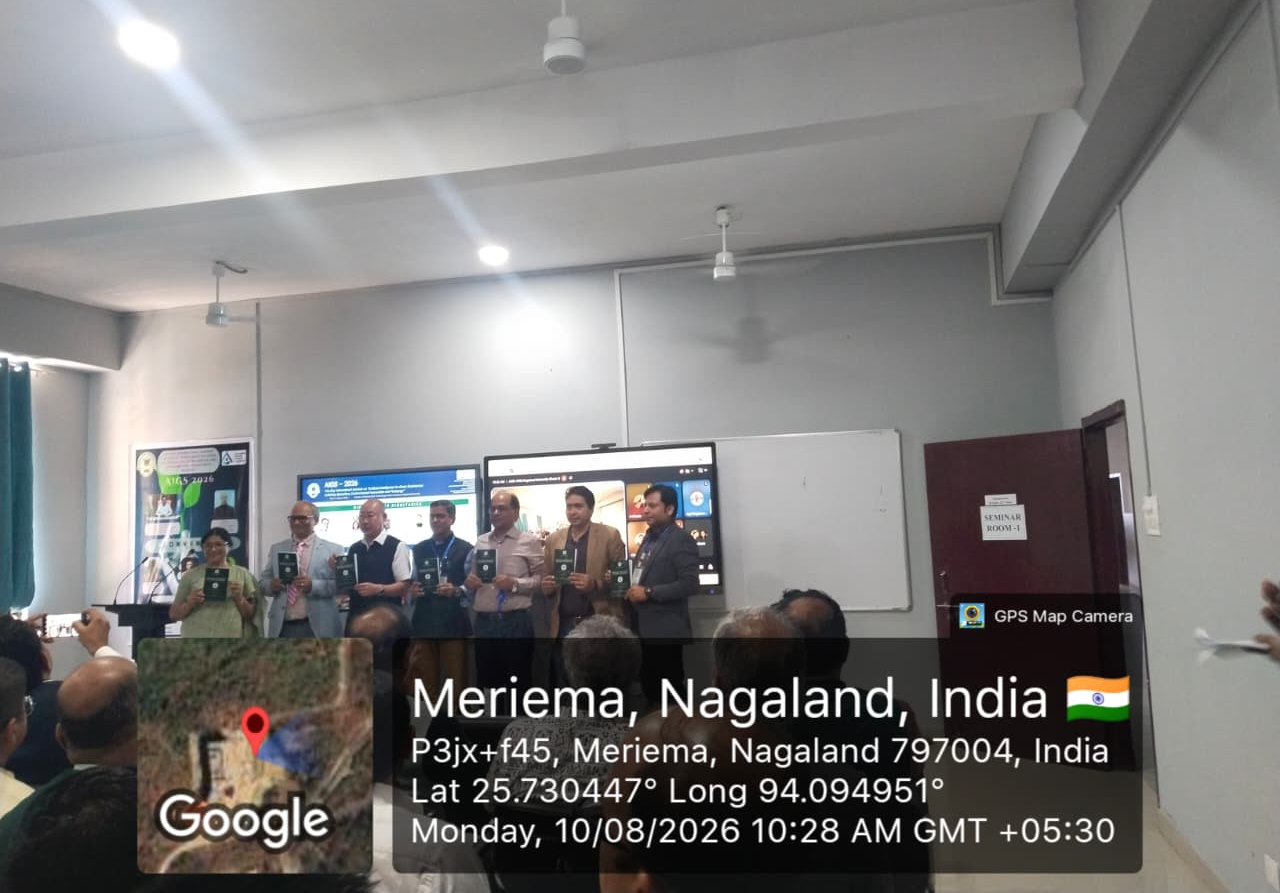
Nagaland University successfully organised a Two-Day International Seminar, AIGS–2026, on the theme “Artificial Intelligence for Green Sustenance: Collating Agriculture, Environmental Humanities and Pedagogy” on August 10 and 11 at the School of Engineering & Technology, Kohima Campus, Nagaland University. The seminar was sponsored by the Anusandhan National Research Foundation (ANRF), Government of India, and Nagaland University and was conducted in hybrid mode.
The seminar brought together distinguished academicians, scientists, researchers, faculty members and young scholars from India and abroad, providing an interdisciplinary platform to deliberate on the role of Artificial Intelligence (AI) in agriculture, environmental sustainability, education, humanities, ecology, climate resilience and responsible development.
The seminar was convened by Prof Prabhakar Sharma, Dr Subhashis Banerjee and Dr Prasenjit Pal.
The inaugural session commenced with the National Anthem, University Anthem and ceremonial lighting of the lamp. Prof Prabhakar Sharma, Convenor, delivered the Welcome Address, followed by addresses by Prof Sujata Dash, Dean, School of Engineering & Technology, and Prof N Venuh, Pro-Vice Chancellor, Nagaland University, Kohima Campus. The keynote address was delivered by Prof Saroj Sharma, Vice Chancellor, Ranchi University.
Prof Jagadish K Patnaik, Vice Chancellor, Nagaland University, also addressed the gathering and highlighted the importance of interdisciplinary and responsible applications of AI for sustainable development.
The academic programme featured plenary lectures, parallel technical sessions and a dedicated poster session covering a wide range of subjects. Prof Shyam S Phartyal, Mizoram University, delivered a plenary lecture on “Citizen Science in the Age of Artificial Intelligence: Bridging Science, Humanities, and Education for Green Sustenance,” while Prof Nigamananda Das, Nagaland University, spoke on the “Environmental Impact of AI.”
The technical sessions brought together diverse perspectives on AI-enabled sustainable agriculture, environmental monitoring, climate resilience, pollution and microplastic studies, smart technologies, chemical research, bio-AI convergence, food-waste reduction, ecosystem restoration, agro-ecotourism, sustainable education, competency-based learning, digital integration in higher education, indigenous ecological knowledge and AI-assisted research.
The seminar also witnessed significant international participation. Scholars and experts from China,
Brazil, Japan, Mexico, the United States and Spain, along with researchers from several institutions across India, presented their work on areas including microplastic monitoring, climate resilience, PFAS contamination, sustainable agriculture, biochar and nutrient transport, food packaging, environmental humanities and emerging applications of AI.
Download Nagaland Tribune app on Google Play


The second day further expanded the interdisciplinary discourse through presentations on agricultural ergonomics, solar-powered biomass technology, sustainable pineapple production in Nagaland, watershed and groundwater assessment, microplastics in agro-ecosystems, indigenous medicinal-plant knowledge, biodegradable packaging, geospatial analysis, flood-risk assessment, soil erosion, climate-resilient agriculture and water-quality management.
The Humanities and Social Sciences sessions explored the growing influence of AI on critical thinking, research aptitude, pedagogy, literature, indigenous knowledge systems, spiritual ecology, posthuman ecofeminism, digital narratives, sustainability education and Northeast Indian literary studies. A dedicated poster session also showcased innovative research on solar-powered agricultural machinery, AI-enabled smart hydroponics, organic nitrogen management, soybean cultivation, indigenous plant materials, traditional pest-management practices and biological control.
The two-day deliberations culminated in the Valedictory Programme on August 11. The programme included presentation of the seminar report, cultural presentations, felicitation, distribution of certificates and awards, and feedback from participants.
Prof Santosh Kumar Singh, Dean, School of Sciences, Nagaland University, addressed the gathering. Dr Subhashis Banerjee, Convenor, proposed the Vote of Thanks, following which the seminar concluded with the National Anthem.
The seminar concluded with a strong emphasis that technological advancement can achieve lasting significance only when it is ethically responsible, socially inclusive and ecologically sustainable.
AIGS–2026 thus served not merely as a two-day academic event, but as a platform for fostering continued research, dialogue and collaboration towards building a greener, more inclusive and sustainable future.
