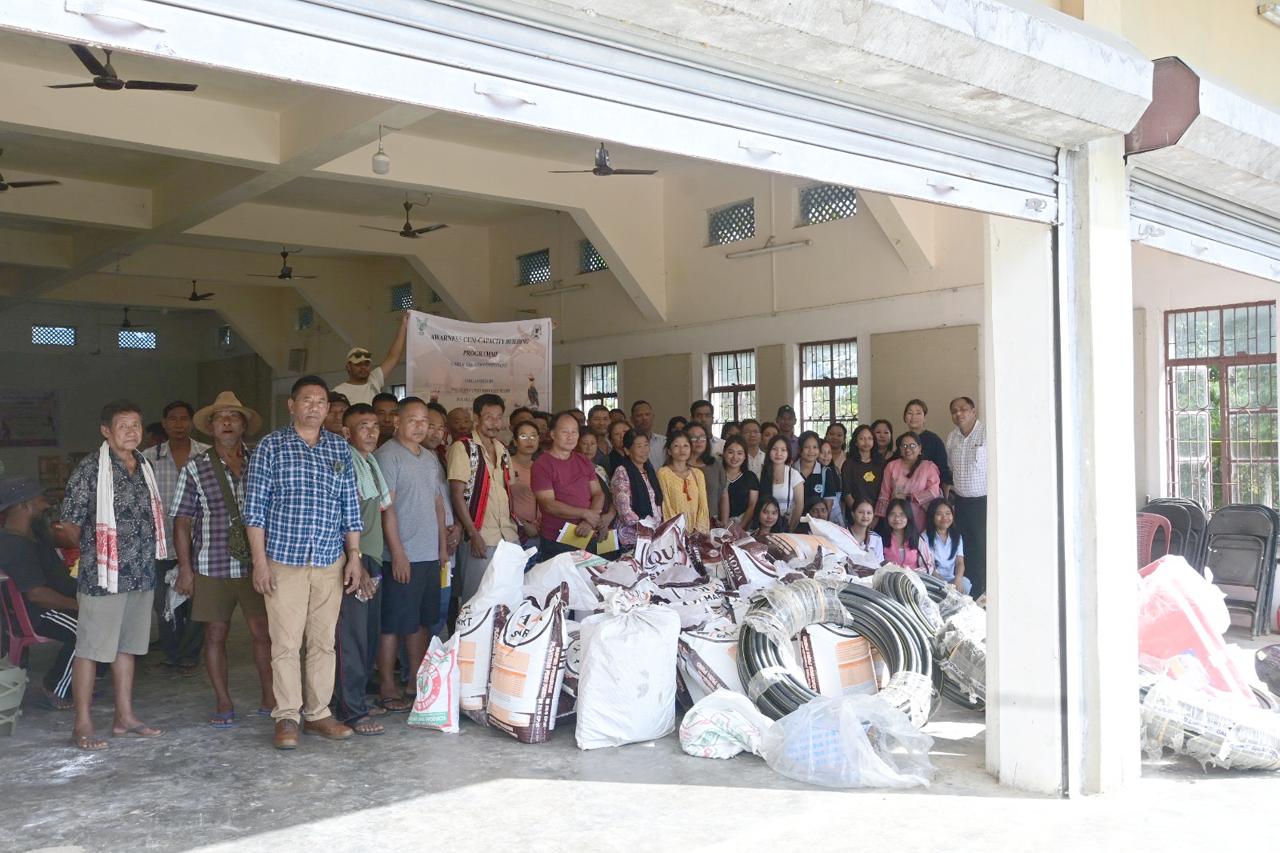
In a bid to promote scientific fish farming and strengthen sustainable aquaculture in Nagaland, the Department of Zoology, Nagaland University, in collaboration with the ICAR–National Bureau of Fish Genetic Resources (ICAR–NBFGR), Lucknow, organised an Awareness-cum-Capacity Building Programme and Farmers’ Interaction-cum-Fisheries Input Distribution Programme at Japu Village under Mangkolemba in Mokokchung district.
The programme, conducted under the NEH Component of the CRP Agrobiodiversity Project, aimed at enhancing the technical knowledge of fish farmers, promoting scientific aquaculture practices, and improving rural livelihoods through training, practical demonstrations and the distribution of essential fisheries inputs.
The event was attended by the Chairman and members of the Village Council, the Gaon Bura (GB) of Japu Village and beneficiary fish farmers.
The Nagaland University delegation was led by Prof Bendang Ao, Director of the Research and Development Cell, Prof Ranjit Kumar, Head of the Department of Zoology, and Dr T Temjen, Deputy Librarian. The programme was coordinated by Dr Pranay Punj Pankaj, Associate Professor, Department of Zoology, with Dr Pukhrambam Rajesh Singh, Dr Lobeno Mozhui and Dr Ramita Sougrakpam serving on the organising team.
Welcoming the participants, Dr Pranay Punj Pankaj highlighted the importance of scientific interventions, technology transfer and community participation in promoting sustainable aquaculture and improving the socio-economic conditions of fish farmers.
Addressing the gathering, Prof Ranjit Kumar and Prof Bendang Ao stressed the role of universities in taking research-based technologies to rural communities. They encouraged farmers to adopt scientific fish farming practices while preserving indigenous knowledge systems for the sustainable management of fisheries resources.
A major highlight of the programme was the distribution of fisheries inputs to beneficiary farmers under the ICAR–NBFGR project. The assistance included nutritionally balanced fish feed, agricultural-grade lime, HDPE pipes, pond protection nets, fish harvesting seine nets, insulated thermocol ice boxes, weighing scales, shovels, spades and other essential aquaculture equipment.
Download Nagaland Tribune app on Google Play


The organisers said the inputs would help improve pond preparation, water quality management, fish health, harvesting efficiency, post-harvest handling and overall aquaculture productivity.
An expert-farmer interactive session formed the core of the programme, providing a platform for scientists and farmers to exchange knowledge on scientific pond preparation, liming, water quality management, fish health, feeding practices, stocking density, disease prevention, biosecurity and harvesting techniques, while also recognising the importance of indigenous fisheries knowledge.
The technical session was coordinated by Dr Pranay Punj Pankaj, Dr Pukhrambam Rajesh Singh and resource person Dr Jaya Kishor Seth, Associate Professor, Department of Zoology, Visva-Bharati University, Santiniketan.
Farmers actively participated in the discussions, shared field experiences and expressed keen interest in adopting improved aquaculture practices to increase fish production and strengthen sustainable livelihoods.
The programme concluded with an open house discussion, during which farmers highlighted local challenges and opportunities in fisheries development. The organising team assured continued technical guidance and academic support for strengthening sustainable aquaculture in the region.
Delivering the vote of thanks, Dr Pukhrambam Rajesh Singh expressed gratitude to the Village Council of Japu, beneficiary farmers, ICAR–NBFGR, university authorities, faculty members, research scholars and student volunteers for their cooperation and active participation.
The Department of Zoology also acknowledged the contribution of its faculty members, researchers and volunteers for ensuring the successful conduct of the programme.
Sponsored by the ICAR–National Bureau of Fish Genetic Resources, Lucknow, under the NEH Component of the CRP Agrobiodiversity Project, the initiative was led by Dr Aditya Kumar, Scientist and Principal Investigator, with the approval of Dr Kajal Chakraborty, Director, ICAR–NBFGR.
The organisers said the programme reflects the shared commitment of Nagaland University and ICAR–NBFGR to promoting sustainable aquaculture through research, extension services, technology dissemination and community engagement, thereby contributing to rural livelihoods, food security and fisheries development in Nagaland and the Northeast.