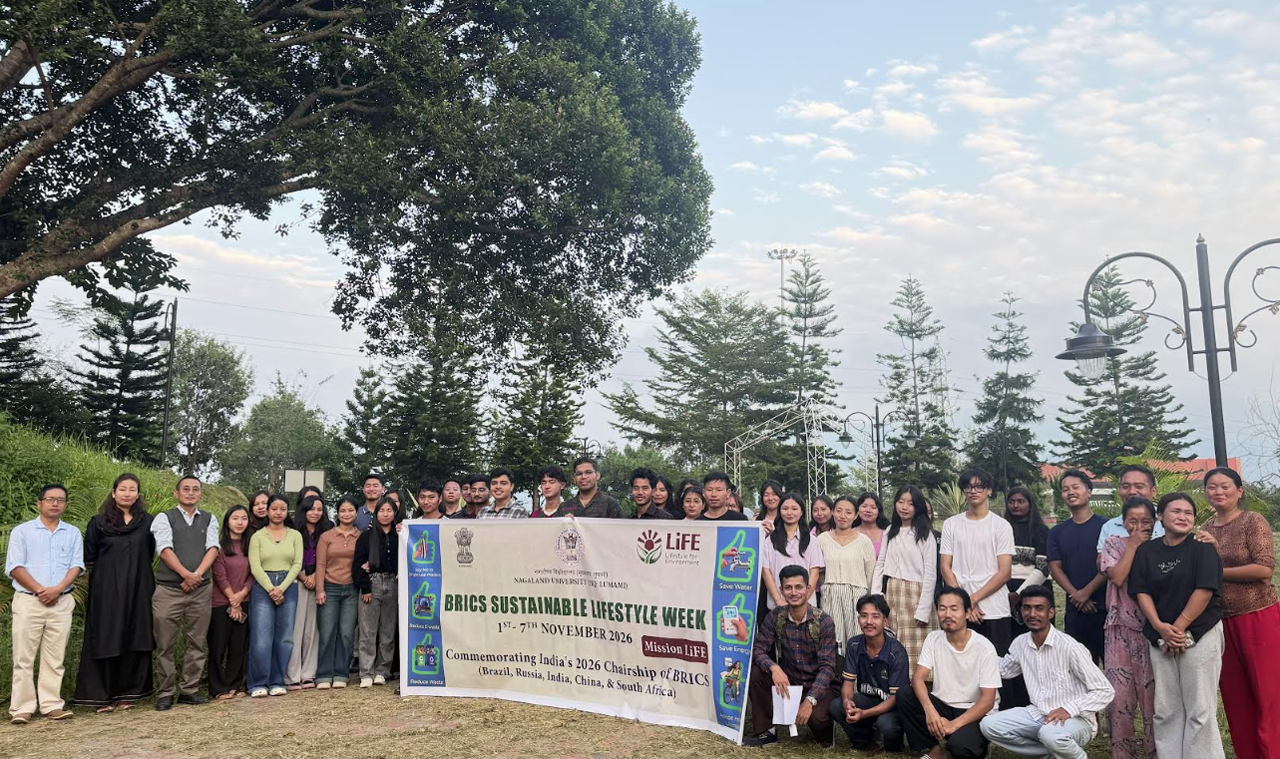
Nagaland University organised a programme at Rajiv Gandhi Park, Lumami, on November 4 under the theme “Adopt Sustainable Food Systems” as part of the BRICS Sustainable Lifestyle Week (BSLW) 2026, being observed from November 1 to 7.
Chairing the programme, Dr. Lobeno Mozhui, Assistant Professor, Department of Zoology, highlighted the close links between traditional diets, agricultural health and environmental sustainability. She appreciated efforts to promote nutrient-rich local dishes such as Galho, a traditional preparation of rice and vegetables, while cautioning against excessive dependence on standard commercial food products.
She also drew attention to the potential of everyday kitchen waste, urging people to view food scraps not as rubbish but as a valuable bio-resource. Redirecting organic waste into compost, she said, could enrich soil and help restore local ecosystems.
Introducing the programme, Peter Ki, PRO, Nagaland University, linked India’s 2026 BRICS Chairship with the Sustainable Lifestyle Week initiative. He said India’s Chairship theme, “Building for Resilience, Innovation, Cooperation and Sustainability,” places sustainability at its core and aligns with Mission LiFE.
He explained that BSLW seeks to translate this vision into everyday action by encouraging individuals, communities and young people to adopt practices that promote environmental resilience and collective well-being. He also urged students and youth to take the Mission LiFE pledge through a dedicated online portal, which remains open from November 1 to 7 to facilitate wider public participation.
Serving as the resource person, Dr Lirikum of the Department of Zoology, MDRC, Nagaland University, presented composting as a practical, kitchen-based method of converting organic waste into nutrient-rich soil. He encouraged people, particularly hostel residents who generate considerable quantities of food waste, to recycle kitchen scraps instead of discarding them or relying entirely on commercial fertilisers, and use the compost to grow plants and vegetables.
He explained that microbes break down organic matter into compost containing essential macronutrients, including nitrogen, phosphorus and potassium (NPK), while developing a biologically active soil structure. Composting also contributes to environmental protection by reducing greenhouse gas emissions. Food waste decomposing in landfills releases methane, a greenhouse gas with a much higher warming potential than carbon dioxide. Diverting such waste for composting helps reduce emissions, prevent foul odours and maintain cleaner surroundings, he said.
Download Nagaland Tribune app on Google Play


Dr Lirikum also outlined key practices for effective composting. Composting containers, whether plastic bins, wooden boxes or concrete tanks, should have adequate aeration to prevent anaerobic conditions that can generate methane. The compost pile should be turned and mixed every four to five days to maintain airflow, while kitchen scraps should be shredded into smaller pieces to increase the surface area available for microbial activity and speed up decomposition.
He further advised caretakers to monitor the compost pile and prevent excessive acidity, which can inhibit microbial activity and affect the quality of the finished compost.
Nagaland University is observing BRICS Sustainable Lifestyle Week 2026 to promote environmentally responsible living through public outreach, citizen engagement and action-oriented initiatives. Activities are being conducted under three key themes: “Adopt Sustainable Food Systems,” “Say No to Single-Use Plastics” and “Reduce Waste (including E-Waste).”
India holds the BRICS Chairship from January 1 to December 31, 2026. BRICS is a platform of major emerging and developing economies that cooperate on economic growth, development finance, multilateralism and global governance. Originally established as BRIC in 2001, the grouping became BRICS following South Africa’s inclusion in 2010.
Rather than functioning as a formal treaty-based organisation, BRICS provides a platform for member countries to consult and cooperate on issues including trade, investment, climate, health, technology and reform of global institutions. Its principal financial institution, the New Development Bank (NDB), supports infrastructure and sustainable-development projects across member and partner countries.
The BRICS Sustainable Lifestyle Week seeks to advance India’s Chairship priority of “Promoting Sustainable Lifestyles” by translating the broader agenda of international cooperation into citizen-led and youth-driven local action.
The programme was attended by Dr Tovishe Phucho, Chairperson of Mission LiFE, along with MDRC faculty members, university staff, research scholars, students and service providers from Toti-La Café, established under the Women Technology Park (WTP) Incubation Hub.