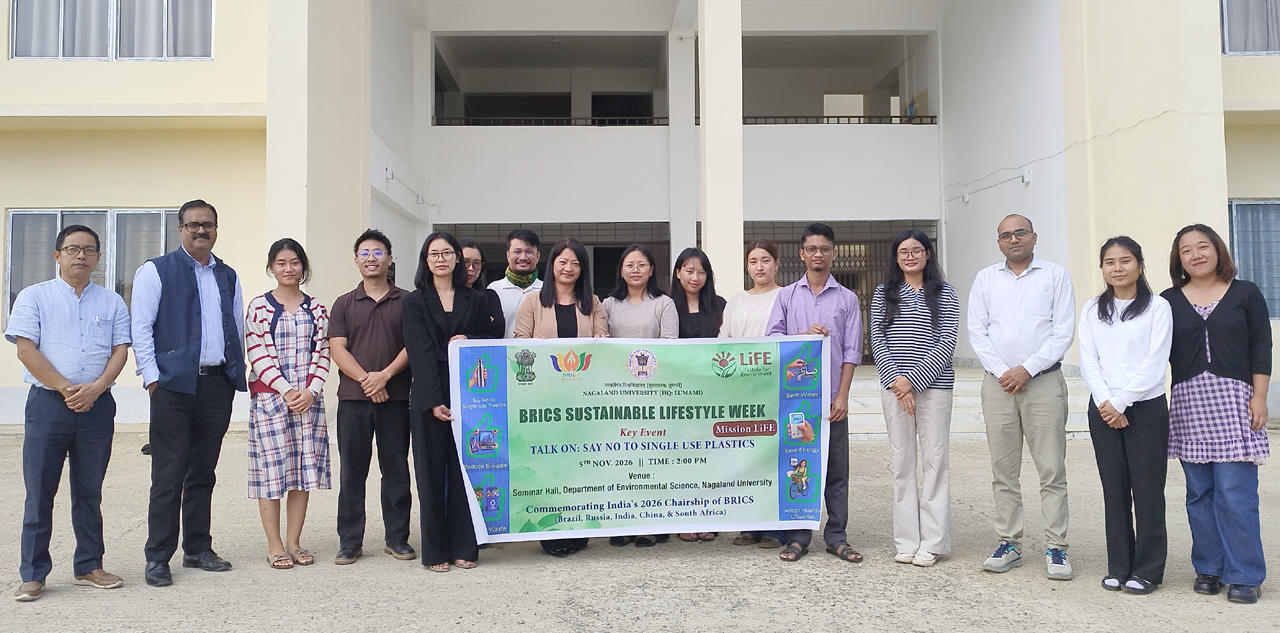
Nagaland University observed BRICS Sustainable Lifestyle Week (BSLW) with a special programme on “Say No to Single-Use Plastics” at the Conference Hall of the Department of Environmental Science on November 5.
The programme, being held from November 1 to 7, 2026, began with a welcome address by Dr Latonglila Jamir, Head of the Department of Environmental Science and member of the university’s Committee for Mission LiFE.
Public Relations Officer Peter Ki introduced the programme, highlighting the alignment between India’s 2026 BRICS Chairship, with its focus on sustainability, and the objectives of Mission LiFE.
Delivering the lecture, Dr Jamir discussed the origins, widespread use and environmental consequences of single-use plastics. She explained that the growing dependence on convenience-driven products has created an ecological challenge, as plastics used for only a few minutes can persist in the environment for centuries.
She highlighted the environmental and toxic impacts associated with the entire life cycle of plastics, from petrochemical extraction and manufacturing to consumption and disposal. Tracing the growth of plastic use, she noted that consumption increased sharply from the early 1950s and expanded further through the 1990s. Although environmental concerns emerged during the 1960s and 1970s, and research continued in subsequent decades, effective restrictions and bans gained momentum only after 2018.
Dr Jamir also explained the seven major categories of plastics: PET, HDPE, PVC, LDPE, PP, PS and Others.
Presenting global and national figures, she said approximately 400 million metric tonnes of plastic waste are generated worldwide every year, with around half comprising single-use products. The global recycling rate, she noted, remains at about 9%.
Citing 2019 data for India, she said the country generated around 9.5 million tonnes of plastic waste annually, of which 43% comprised single-use items such as packaging materials, straws and cutlery. At least 10,000 tonnes of plastic waste reportedly remain uncollected every day. Although India has introduced a national ban on identified single-use plastic items, effective implementation remains a challenge. She also noted that India processes approximately 30% of its plastic waste.
Explaining the factors behind low recycling rates, Dr Jamir pointed to difficulties in separating multilayered packaging made of plastic, paper and cardboard, as well as the lower cost of producing virgin plastic compared with recycling. Food contamination in discarded containers also affects recycling unless they are properly cleaned before disposal.
Download Nagaland Tribune app on Google Play


She further explained that repeated reprocessing of synthetic polymers can cause degradation of polymer chains and weaken their structural integrity, making high-quality recycling technically challenging.
Highlighting international examples, Dr Jamir referred to Germany’s deposit-refund system, known as Pfand, which has helped achieve a high return rate for drink containers. She also cited South Korea’s mandatory Pay-As-You-Throw system and waste-sorting requirements, Sweden’s waste-to-energy infrastructure, Rwanda’s nationwide restrictions on non-biodegradable bags and the United States’ extended producer responsibility measures.
Concluding her lecture, she called for greater use of alternatives such as cotton, jute, glass, stainless steel, bamboo and paper. She urged people to incorporate the 4R framework—Refuse, Reduce, Reuse and Recycle—into their everyday practices.
However, she stressed that individual responsibility must be complemented by effective policy measures and industrial innovation. Drawing on the principles of green chemistry, she emphasised that preventing waste at its source is easier and more effective than managing it after it has been generated.
The programme was attended by faculty members, staff, research scholars and students, including Prof. Ashutosh Tripathi of the Department of Environmental Science, Coordinator of SWAYAM at Nagaland University and member of the Committee for Mission LiFE, along with other departmental faculty and researchers.
The lecture was followed by a practical plastic collection drive in and around the Department of Environmental Science, reinforcing the programme’s message through community participation.