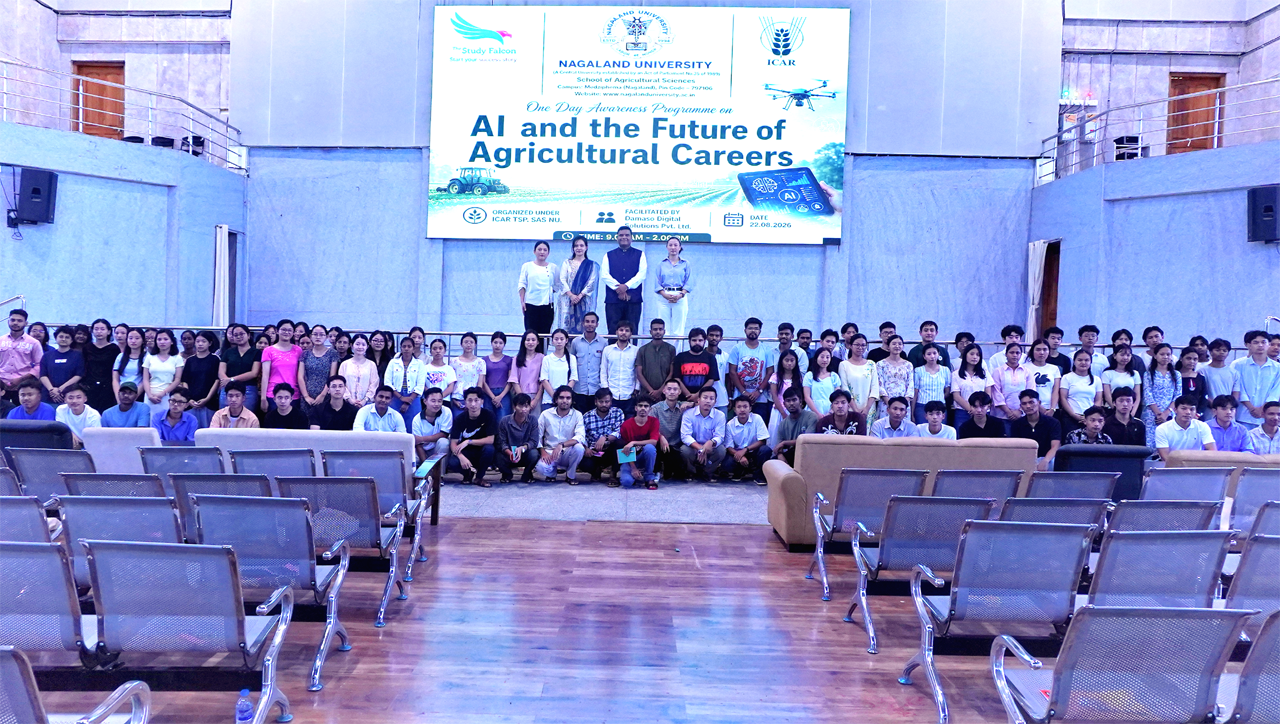
The School of Agricultural Sciences (SAS), Nagaland University, Medziphema Campus, organised a one day awareness programme on “Artificial Intelligence and the Future of Agricultural Careers” on August 22 under the ICAR Tribal Sub Plan (TSP) led by Prof Akali Sema as the Coordinator, Dr Mary N Odyuo, Associate Professor, as Principal Investigator (PI), Dr Debika Nongmaithem and Dr Sentirenla Assistant professors and Co-PIs.
The programme was facilitated by Damaso Digital Solutions Pvt. Ltd. and aimed to familiarise students with the growing role of Artificial Intelligence (AI) in agriculture and the emerging career opportunities at the intersection of agriculture and technology.
The programme highlighted that AI is no longer limited to computer science but is increasingly becoming relevant across the agricultural ecosystem, from crop and disease monitoring and precision farming to smart irrigation, drones, soil analysis, yield prediction, market intelligence and supply chain management.
The sessions introduced participants to key AI concepts in simple and practical terms, including Artificial Intelligence, Machine Learning, Generative AI, Computer Vision, Predictive Analytics, AI Automation and Agentic AI. Emphasis was placed on understanding these technologies not merely as tools but as emerging components of modern agricultural practice.
Download Nagaland Tribune app on Google Play


A major focus of the programme was on the new career directions emerging in agriculture and technology. Opportunities discussed included precision agriculture, agricultural data analysis, remote sensing and GIS, drone and field mapping, AgriTech product development, digital agriculture and advisory services, crop health image analysis, AI enabled agricultural extension, agricultural technology consultancy and regional language translation.
The programme also stressed that technological skills must be complemented by strong human capabilities. Critical thinking, communication, empathy, adaptability, ethics and leadership were highlighted as essential skills for agricultural professionals working with AI. Participants were encouraged to question AI generated outputs, understand its limitations and retain human judgement in decision making.
An interactive component allowed students to visualise the farm of the future, exploring how AI, robotics, drones, data analytics, automated systems and smart water management could work together in agricultural production. A group activity further challenged participants to conceptualise how a farm of 2035 could integrate emerging technologies.
The programme concluded with an emphasis on the need for agricultural students to become AI ready rather than simply technology dependent.