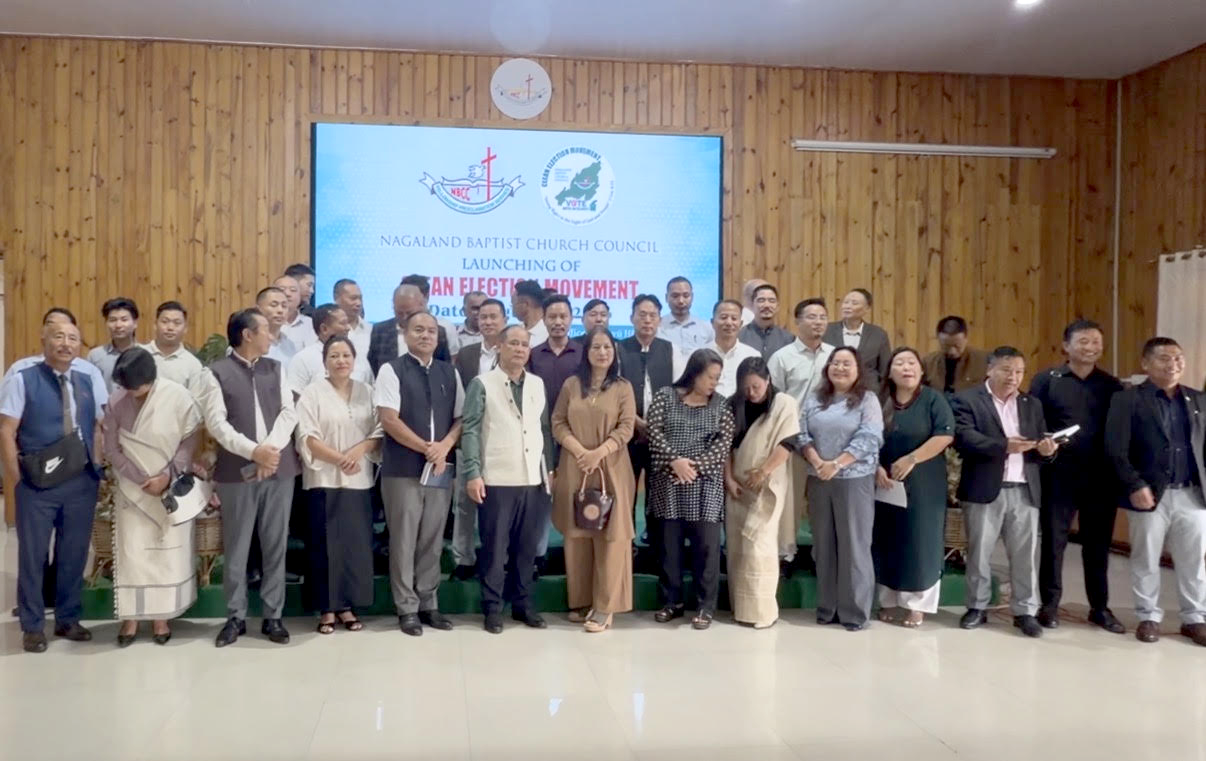
The Nagaland Baptist Church Council (NBCC) on Friday launched its Clean Election Movement (CEM), renewing its call for clean, ethical and responsible elections in Nagaland.
The movement was launched at Platinum Hall, NBCC Office, Bayavü Hill, Kohima, with Rev Dr Mar Pongener, General Secretary, NBCC, affirming the council’s continued commitment towards electoral integrity.
Speaking at the launching, Rev Dr Mar Pongener said the NBCC had been raising its voice and working towards clean, ethical and responsible elections for many years. Through churches and various initiatives, he said, the council had consistently urged people to reject electoral malpractice and uphold honesty, justice, accountability and responsible citizenship.
He said the launching of the CEM was not the beginning of the NBCC’s concern over electoral corruption, but represented a renewed commitment and call to continue the journey with greater conviction, unity and perseverance.
Acknowledging that change had not come on the scale expected, Rev Pongener said this should not be interpreted as a failure of the efforts made so far. He pointed to increased public awareness, growing questions around old electoral practices, and continued efforts by churches and organisations to speak against electoral corruption as signs of progress.
“We must therefore recognize both realities: the persistence of the problem and the presence of progress,” he said, stressing that neither progress should be exaggerated nor the remaining challenges allowed to discourage continued efforts.
Rev Pongener further cautioned against political loyalty based primarily on family, clan, group, friendship or personal interest, rather than character and public responsibility. Such practices, he said, ultimately undermine the common good.
He also challenged the mindset that an individual vote cannot make a difference because “everyone does it”, warning that such an attitude normalises electoral corruption.
According to him, the consequences of corrupt elections do not end on polling day but can continue for five years or even longer, raising the fundamental question of whether those elected ultimately serve the public or those who helped them gain power.
Highlighting the role of the Church, Rev Pongener called for continued efforts to educate citizens on the ethical and moral dimensions of elections.
He urged churches not to give up even when change appears slow, saying that faithfulness to the witness is more important than quick results.
He also called for continued teaching on electoral ethics, particularly emphasising that selling one’s vote should be understood not merely as a political choice but as an ethical and moral issue.
The NBCC General Secretary noted that the council, along with churches and associations, had already organised numerous awareness programmes, seminars and consultations and invested considerable time and resources in the effort.
However, he stressed that the ultimate objective should go beyond conducting programmes and instead focus on building a culture of clean elections in society.
Calling for renewed determination, Rev Pongener said disappointment must not be allowed to turn into despair.
He urged people to begin the change within themselves, their homes, churches and communities, and to continue the effort until integrity becomes not merely a slogan during election season but a way of life in Nagaland society.
Villo Naleo, Secretary, Social Concern Department, NBCC said the initiative seeks to address practices that have increasingly influenced the electoral process, including the use of money and muscle power, proxy voting, coercion, intimidation, manipulation of voters and other forms of electoral malpractice.
Naleo said that in a Christian-majority society like Nagaland, electoral integrity should not be viewed merely as a political or administrative concern but also as a matter of moral responsibility, Christian witness and social transformation.
According to the NBCC, the movement traces its origins to 1975, when the Church recognised that electoral integrity was not simply a political issue but also a spiritual and ethical concern. Drawing on the Christian responsibility to be the “salt and light” of society, the movement seeks to contribute to the moral well-being of the state.
Download Nagaland Tribune app on Google Play


Naleo highlighted several reasons for the continuation of the movement, stating that electoral malpractice undermines the democratic principle of “one person, one vote”, while money and muscle power distort the electoral process through practices such as vote-buying and money-driven politics.
He also stressed that elections have a direct bearing on the future of society and that Christian citizenship requires responsible participation in public life.
The CEM envisions the Church playing a multifaceted role by educating citizens, promoting ethical voting, encouraging freedom of conscience and speaking against corruption and injustice.
It also seeks to promote peace and non-violence during elections, encourage responsible Christian participation in public life, mobilise communities against electoral malpractice and uphold integrity within Church institutions themselves.
Naleo said Nagaland’s electoral experience cannot be understood entirely through conventional models of democracy, given the strong influence of community, clan, village and family relationships on political behaviour.
Against this backdrop, the CEM seeks to encourage constructive dialogue between traditional Naga values and democratic principles, while promoting electoral choices based on conscience, integrity and the common good.
The movement has called for continuous voter education, stronger grassroots engagement, broader partnerships, greater participation of young people, protection of freedom of conscience, rejection of money and muscle power and promotion of accountable leadership.
It has also emphasised the importance of sustained prayer and spiritual renewal as part of the effort towards clean elections.
Highlighting recent initiatives, Naleo said that during 2025–2026, the CEM conducted seven Clean Election discussions and consultations targeting first-time voters across colleges, higher secondary institutions, fellowships and churches.
Through these programmes, the movement has reached approximately 3,000 students and young people, strengthening its focus on youth as key participants in shaping the future electoral culture of Nagaland.
The movement has called upon citizens to make individual commitments against electoral malpractice, including refusing to buy or sell votes, rejecting proxy voting and intimidation, respecting every voter’s freedom and conscience, and participating peacefully and responsibly in elections.
It further calls for voters to choose leaders based on character, integrity, competence and commitment to the common good, while upholding the dignity of every citizen and respecting the democratic process.
Naleo stressed that the Clean Election Movement should not remain limited to election-season campaigns but should evolve into a continuous programme of civic, moral and political education.
The movement’s broader vision is to see a Nagaland where elections are free, fair, peaceful, transparent and participatory; where citizens can vote according to conscience; where political leadership is understood as public service; and where electoral choices contribute to justice, good governance and the common good.
Concluding the overview, Naleo said clean elections require more than clean candidates, requiring “clean voters, clean political practices, responsible institutions and a renewed moral commitment to the common good.”
The CEM called upon citizens, churches, civil society organisations, political leaders, candidates, youth, women and communities to work collectively towards an electoral culture where every citizen is free to exercise their conscience and every vote is cast honestly.
Earlier, the programme was led by Chuti Semy, Counsellor, Rengma Baptist Church, Kohima.
programme began with an invocation by Azonuo Ciesotsu, Member, Social Concern Board, followed by the welcome and introduction by Sentiyabang, Media/Publication & Social Concern Coordinator, NBCC.
A special song was presented by Sosin Naomi Kent, Assistant Music Director, Rengma Baptist Church, Kohima, while Ghunato Assumi, Associate Pastor, Sumi Baptist Church, Zunheboto, shared a testimony on the Clean Election Movement.
The programme also featured the release of the CEM Nagamese song, with Rev Dr Küzhopoyo Tünyi, Pastor, Chakhesang Baptist Mission Center Church, giving an introduction to the song and its message.
A prayer was offered by Rev Dr Kevichalie Metha, Pastor, Peraciezie Baptist Church, Kohima.
The programme concluded with a vote of thanks by Imlongchaba Chang, School Ministry Coordinator, NBCC, followed by the closing prayer by Sankara Narayan, Pastor, Bethel Masiha Church.