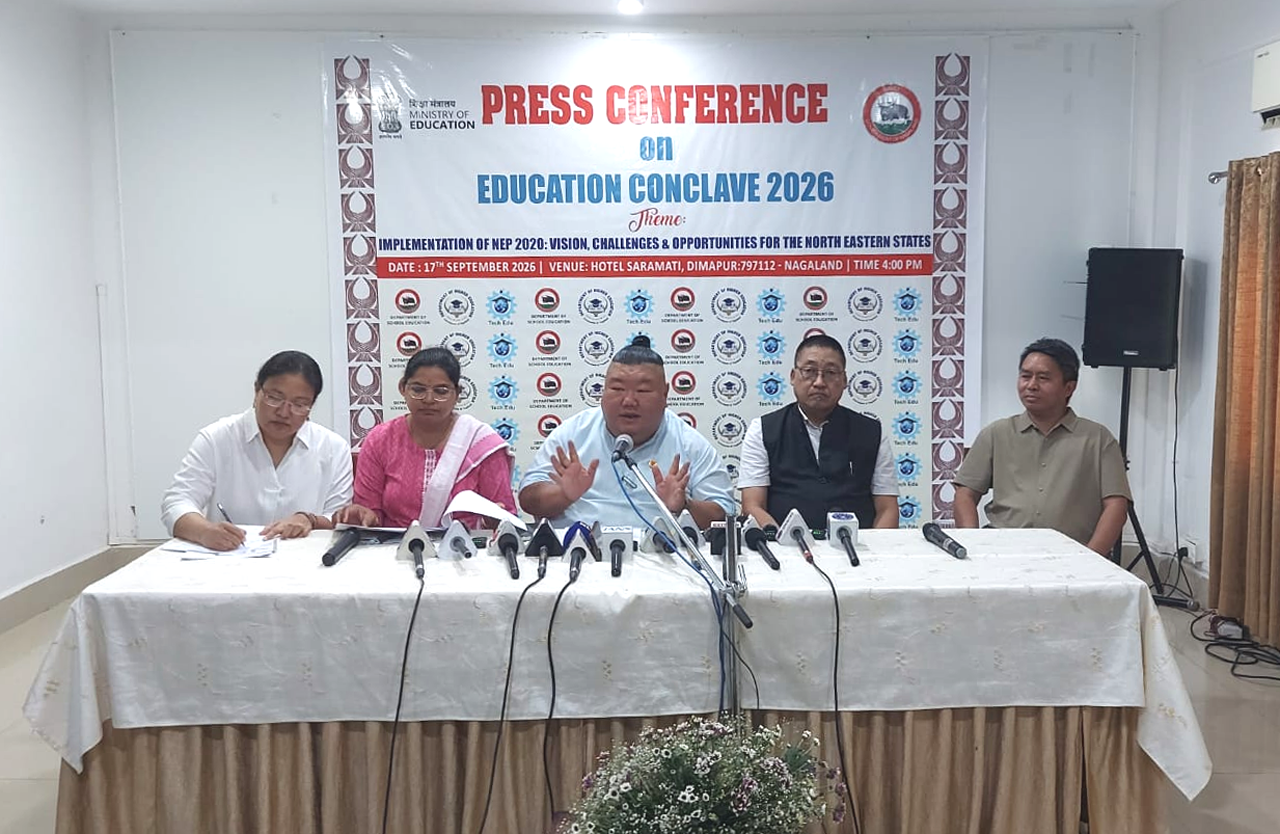
Nagaland will host the first Northeast National Education Policy (NEP) 2020 Conclave for the Northeast region on September 18 and 19 at JP Park & Banquets, Naga United Village, Chumoukedima, bringing together education ministers, academicians, university leaders and stakeholders from the eight Northeastern States to deliberate on challenges and strategies for implementing the policy.
Announcing the Conclave at a press conference in Dimapur on Thursday, Minister for Higher Education and Tourism Temjen Imna Along said the event would provide a platform for the Northeastern States to collectively examine the challenges of implementing NEP 2020 and develop a practical roadmap for its effective implementation.
He said the conclave was being organised with the support of the Ministry of Education, Government of India, and the Nagaland Government through the departments of Higher Education, School Education and Technical Education, along with SCERT and other stakeholders.
Along said the conclave would focus not only on higher education but also on school and technical education, innovation, technology, skills and management.
“The main agenda of the Conclave is not only pertaining to higher education, but also school education, technical education, and also the innovation of new technologies, ideas, skills and management in the sector of education,” he said.
Funding, infrastructure major challenges
Identifying key challenges to NEP 2020 implementation, the Minister said funding, infrastructure, institutional capacity, quality of teaching, research and innovation remained critical concerns.
He said the policy called for a significant increase in funding for school, higher and technical education, but questions remained over how the required resources would be generated without placing an undue burden on students.
Download Nagaland Tribune app on Google Play


“Nagaland’s education system is currently under-resourced,” Along said, stressing the need to expand institutional capacity through new infrastructure for schools, colleges and universities as well as improving existing facilities.
He also highlighted the need for improved teacher training, introducing more stronger assessment standards and promoting research and innovation to improve the quality of education.
According to Along, successful implementation would also require greater decentralisation, stronger coordination between governments and institutions, and a shift towards a more learner-centric education system.
“This will require not only a change in mindset among students, teachers, and administrators, but also the development of new teaching and learning methods,” he said.
Eight NE States to participate
Along said delegations from all eight Northeastern States had been confirmed for the conclave, with education ministers from five States expected to participate.
He said professors, academicians, university leaders, representatives of central institutions and officials from the Ministry of Education would also participate, along with ministers and advisers from the Northeastern States.
The conclave is expected to facilitate sharing of best practices and resources among institutions, while developing mechanisms for mentoring, capacity-building and managerial support.
Along said stakeholders would work towards preparing a realistic, flexible and result-oriented roadmap for NEP 2020 implementation in the region.
“We are looking forward to having good discourse, good technical sessions, and also looking forward to come up with a resolution and build partnership and networking with our fellow States and stakeholders,” he said.
He said the proposed regional partnership would help the Northeastern States collectively articulate their needs and identify practical ways to implement NEP 2020 more effectively.
The Minister expressed hope that the conclave would lead to a team of stakeholders who could work collectively across the region and support implementation of the policy in their respective institutions.