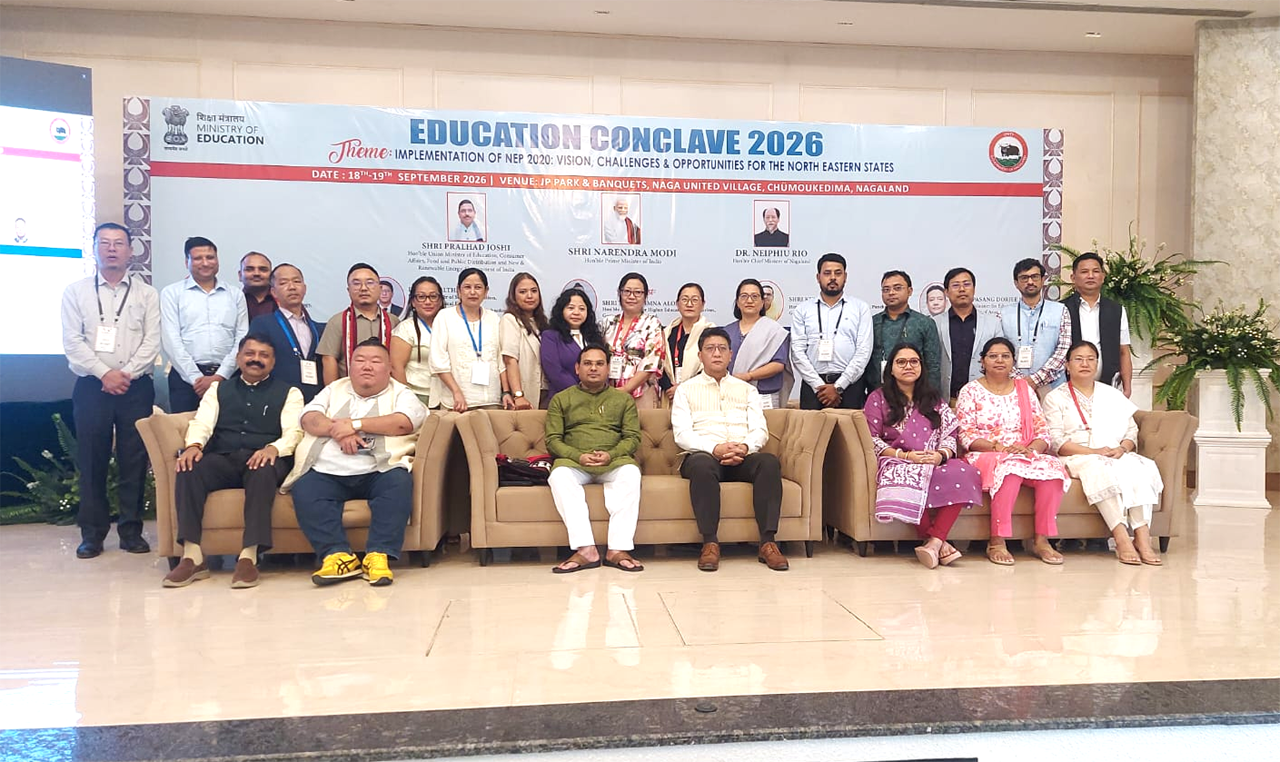
The two-day Northeast Education Conclave in Nagaland has adopted a wide-ranging set of resolutions seeking a distinctly region-specific approach to implementing the National Education Policy (NEP) 2020, with emphasis on measurable learning outcomes, teacher capacity, multilingual education, indigenous knowledge, vocational pathways, technology, infrastructure and greater financial support for the Northeastern states.
Held on the theme “Implementation of NEP 2020: Vision, Challenges & Opportunities for the North Eastern States,” the conclave brought together representatives from seven Northeastern states for deliberations on the challenges and opportunities in school, higher and technical education. The resolutions are to be submitted to the Ministry of Education, Government of India.
The participating states noted that significant reforms had already been initiated under NEP 2020, but identified a recurring gap between programme implementation, classroom practice and demonstrated learning outcomes, particularly in the areas of Foundational Literacy and Numeracy (FLN), assessment and digital education.
Focus on learning outcomes and teacher capacity
The conclave resolved that states should strengthen monitoring systems capable of verifying actual classroom implementation and student learning while reducing repetitive compliance-based reporting. FLN monitoring should also identify and support children who advance to higher grades without acquiring foundational competencies.
Teacher capacity development was identified as another system-wide priority. While teachers remain central to NEP implementation, challenges persist in the relevance and coverage of training, institutional capacity and professional qualifications. The resolutions noted that teachers in private and unaided schools often remain outside government-supported professional development opportunities.
The states, therefore, called for a comprehensive and continuous professional development system that is subject- and stage-relevant, linked directly to classroom practice and accessible across school categories. Teacher training and qualification targets, it said, should be matched by adequate institutional capacity and flexible pathways for serving teachers.
Multilingual education and indigenous knowledge
Recognising the exceptional linguistic, cultural and geographical diversity of the Northeast, the conclave called for context-responsive curriculum and multilingual education strategies.
The resolutions noted that mother-tongue education in the region faces challenges related to the large number of languages, availability of teachers and learning materials, parental preferences and transition to subsequent mediums of instruction.
States were therefore urged to develop context-specific multilingual strategies with planned language transitions. The use of the local environment, indigenous knowledge and community resources in curriculum, teaching-learning materials and experiential learning was also recommended.
Stronger vocational and skill pathways
The conclave also called for vocational education to be connected more clearly with further education, certification and livelihoods.
While states are expanding vocational and skill exposure, including community-based initiatives, the link between school-level vocational learning and subsequent education, employment and entrepreneurship remains weak, the resolutions noted.
It proposed progressively linking vocational education with ITIs, polytechnics, higher education institutions and industry, along with certification, internships, employment and entrepreneurship opportunities. Skill programmes should also be designed according to locally relevant economic and livelihood opportunities.
Inclusion, accessibility and well-being
The resolutions identified shortages of special educators, difficult terrain, infrastructure deficiencies and unequal digital connectivity as continuing barriers to equitable participation in education.
It called for inclusion, physical and digital accessibility, and student and teacher well-being to be integrated into regular school-quality processes. Regular teachers should be strengthened to handle inclusive classrooms, with support from specialist services, cluster arrangements and appropriate partnerships.
On technology, the conclave stressed that digital platforms and smart classrooms should function as enablers rather than substitutes for meaningful pedagogy and teacher-student interaction.
States were urged to map digital access gaps, promote responsible use of technology and address connectivity, electricity and infrastructure constraints.
Collaboration among schools and departments
The resolutions also called for structured mechanisms to facilitate the sharing of effective practices, professional expertise and resources across schools and sectors.
PM SHRI and other exemplary schools were proposed as resource and demonstration centres for neighbouring schools, while inter-departmental convergence was recommended for addressing requirements extending beyond the mandate of school education.
The school-education deliberations broadly called for a shift from programme coverage to verified learning, training attendance to improved classroom practice, uniform implementation to context-responsive solutions, vocational exposure to viable pathways, and isolated initiatives to state-wide improvement.
Skill hubs proposed in colleges and universities
In higher education, the conclave proposed the establishment and strengthening of skill hubs within existing colleges and universities.
The proposed hubs could provide industry-relevant vocational and emerging skill-based courses in areas such as digital technologies, Artificial Intelligence, entrepreneurship, tourism, healthcare, agriculture, handicrafts and other sectors relevant to the Northeastern economy.
The resolutions called for dedicated grants for infrastructure, equipment, laboratories, trainers and digital resources. Such an approach, it said, could integrate skill development with mainstream higher education while reducing the need for students to migrate outside the region for specialised training.
Greater vertical mobility in higher education
The conclave also sought greater opportunities for vertical academic mobility within Northeastern higher education institutions in line with the flexible and multidisciplinary framework of NEP 2020.
Colleges were proposed to be encouraged to introduce more postgraduate courses, including suitable one-year PG programmes where academically and regulatorily appropriate. This would enable students completing four-year undergraduate programmes to progress smoothly to higher studies and potentially strengthen postgraduate education, research, teaching and professional career opportunities within the region.
North East Knowledge System proposed
One of the major higher education proposals was the establishment of a North East Knowledge System based on the region’s rich indigenous heritage.
The proposed system would promote the study and documentation of indigenous agriculture, ecological practices, traditional medicine, weaving, crafts, architecture, languages, oral traditions, performing arts and other community-based knowledge systems.
It could also facilitate collaboration among universities, colleges, research institutions, indigenous communities and government agencies for knowledge documentation, curriculum development, research and innovation.
The conclave stressed that the diverse intellectual and cultural heritage of the Northeast should be recognised as an important component of contemporary education and research.
State public universities, annual conclave sought
The resolutions further recommended the establishment and strengthening of state public universities in the Northeastern states to expand access to quality higher education and develop institutions responsive to the region’s specific needs.
Such universities, it proposed, could serve as centres of excellence in multidisciplinary education, research, innovation, skill development and indigenous knowledge, with academic programmes aligned to the region’s economic, cultural and ecological priorities.
The conclave also proposed institutionalising an annual Northeast Education Conclave or review meeting to ensure sustained inter-state cooperation and follow-up on NEP implementation.
The annual platform could bring together state governments, universities, higher education institutions, policymakers, experts, industry and other stakeholders to review progress, identify emerging challenges and share successful practices. Each conclave should conclude with clearly defined action points, responsibilities and timelines, followed by periodic monitoring.
Special financial package proposed
The participating states also proposed that the Government of India consider a Prime Minister’s Special Financial Package for NEP implementation in the Northeast.
The proposed package would address the region’s distinctive geographical, infrastructural and socio-economic requirements, including connectivity, digital infrastructure, laboratories, libraries, hostels, teacher training and skill development facilities.
A targeted funding mechanism, the resolution said, would help educational institutions overcome implementation constraints and create meaningful opportunities for students in rural, urban, remote and border areas.
Technical education gaps highlighted
The technical education sessions identified several gaps in the implementation of NEP 2020 and called for region-specific interventions.
One of the concerns was the need to clearly distinguish diploma certificates offered by polytechnics from diploma programmes in colleges. The terminology and concept of diplomas, particularly those exclusive to polytechnic education, were considered insufficiently addressed in the policy.
The resolutions suggested that NEP policy documents should incorporate case studies from remote Northeastern regions to enable more effective implementation in geographically challenging areas.
Resources, internships and industry linkages
The technical education resolutions called for periodic resource allocation by the Centre and concerned state governments for technical expertise, infrastructure, laboratory equipment and other requirements.
The absence of government-funded internships for students was also highlighted. To address the issue of industry exposure, the formation of a forum of Education Ministers of the Northeastern states was proposed to facilitate industry linkages.
As most Northeastern states, except Assam, have a relatively limited industrial presence, the resolutions suggested that the Government of India explore partnerships with private industries and public sector undertakings in eastern India to work with polytechnics and engineering colleges on training, exposure and recruitment.
Timely recruitment of teaching faculty and laboratory staff according to institutional requirements was also emphasised.
The technical education sessions additionally proposed the development of knowledge laboratories focusing on the unique art, customs and languages of the Northeastern states, with scope for research and documentation.
Connectivity and implementation mechanism
The conclave identified physical, power and digital connectivity as major region-specific challenges affecting technical and higher education.
It proposed strengthening connectivity across the Northeast through wider stakeholder partnerships involving state Power Departments, PWDs and network service providers to address gaps in electricity, transportation, accessibility and digital connectivity.
An Implementation Committee was also proposed to cater to various initiatives related to NEP 2020 implementation.
In addition, the establishment of a forum of Education Ministers of the Northeastern states was proposed to carry forward issues related to education and technical departments and strengthen inter-state coordination.
Start-ups and AI policy
The technical education resolutions also recognised the importance of developing a startup ecosystem from the school level through polytechnic and degree education.
The conclave proposed a clear policy framework governing the use of Artificial Intelligence in academic activities, including teaching, assessment and student use. Defined guidelines or legislation, it noted, could help reduce the misuse and overuse of AI in education.
The resolutions adopted across the three sectors thus sought to move NEP 2020 implementation beyond uniform policy adoption towards approaches that take into account the Northeast’s terrain, dispersed population, linguistic and cultural diversity, infrastructure limitations and emerging economic opportunities.
The recommendations are expected to form the basis of the region’s collective inputs to the Ministry of Education, with the participating states seeking greater collaboration, resource support and sustained monitoring to translate NEP 2020 objectives into measurable educational outcomes.