The Naga Students’ Federation (NSF) has directed educational institutions and its affiliated bodies across the Naga homeland not to invite or include government functionaries, including the Governor of Nagaland, in programmes or official functions where the revised “Vande Mataram” is to be sung or played.
The directive was issued in pursuance of the NSF’s stated opposition to the compulsory playing or singing of the revised Vande Mataram at government programmes and official functions. The Federation instructed all its federating units and subordinate bodies to communicate the directive to institutions within their respective jurisdictions and ensure strict compliance until further directions.
At the same time, the NSF announced that the first phase of its agitation—a peaceful demonstration in connection with the ongoing session of the Nagaland Legislative Assembly—has been kept in abeyance.
According to the Federation, the decision followed Communique No. AS/LEG-27/2023 dated September 3, 2026, issued by the Minister of Parliamentary Affairs and Chairperson of the Committee to Examine the Applicability of Laws Passed by Parliament. The communique sought additional time to submit the committee’s report on the matter and assured that the collective views and sentiments of the Naga people would be taken into consideration.
In a statement, the NSF, however, made it clear that its principal demand remains the adoption of a strong resolution by the Nagaland Legislative Assembly against the imposition of the revised Vande Mataram in government programmes and official functions.
The Federation warned that if no such resolution is adopted, it would proceed with the next phase of its democratic agitation.
Calling upon its federating units and subordinate bodies to remain vigilant, the NSF sought their full cooperation in implementing the directive. It reiterated that its position was rooted in freedom of conscience, religious liberty, democratic safeguards and peaceful coexistence.
The Federation also reaffirmed its commitment to pursuing its demands through democratic and peaceful means and called upon all concerned institutions and bodies to take note of the directive and ensure compliance.
NSF rejects government appeal
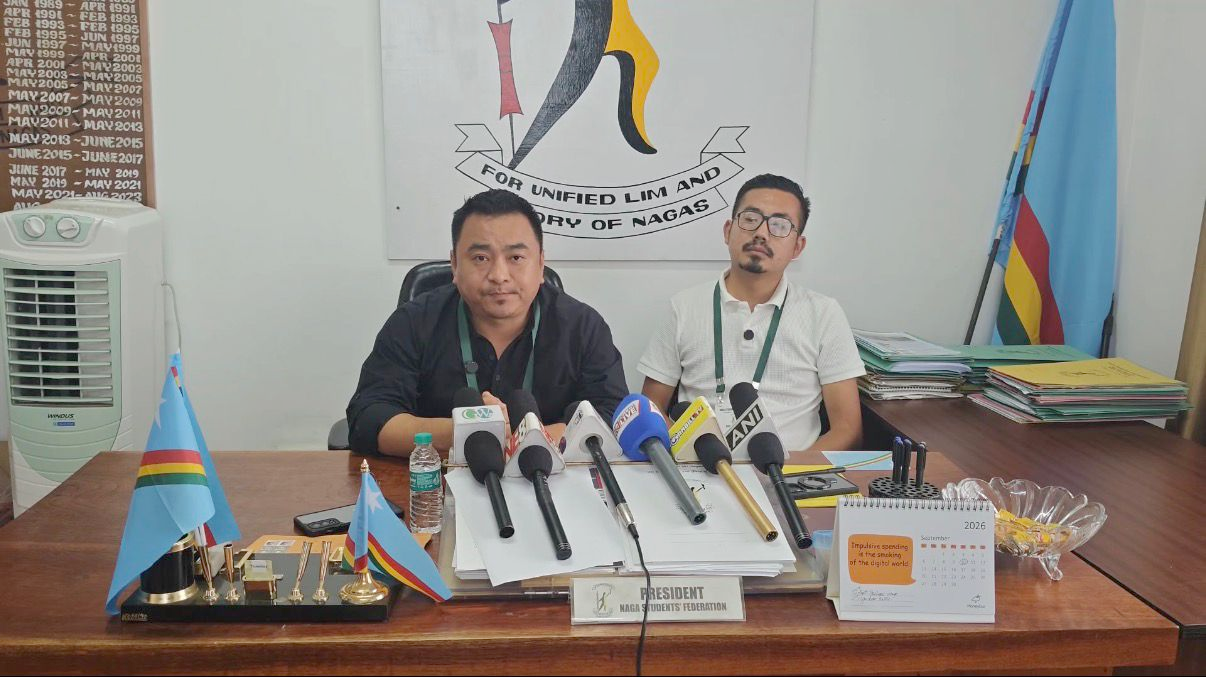
Earlier, in the day, addressing media persons at the NSF office, NSF President, Mteisuding Heraang said the Federation’s second day of protest was conducted on the theme of a “singing revolution”, with participants using songs as a form of peaceful democratic agitation.
He said the NSF had a “very successful” second day of protest against what it described as the imposition of “Vande Mataram” on the Naga people.
The NSF president was referring to a letter issued by KG Kenye, Minister of Power and Parliamentary Affairs, Government of Nagaland, dated September 3, 2026. In the letter, Kenye informed the NSF that the matter had earlier been referred to the Committee to Examine the Applicability of Laws Passed by Parliament for examination and recommendations.
Download Nagaland Tribune app on Google Play


According to the Minister, the Committee held sittings on March 18, May 18 and June 24, 2026, and adopted its report. However, the report was not presented before the Assembly in view of the recent Prevention of Insults to National Honour (Amendment) Bill, 2026, which has been passed by both Houses of Parliament and is awaiting publication in the Gazette of India.
The letter stated that the committee had decided, as an interim measure, to withhold its report until the final outcome of the Bill was known. It further said the committee proposed to revisit the matter thereafter, taking into consideration the collective views and sentiments of the people of Nagaland.
The government subsequently requested the NSF to call off its ongoing protest.
However, Heraang said the Federation was not prepared to compromise on the issue.
“We outrightly reject the imposition of Vande Mataram against the Naga people,” he said, adding that the NSF’s objection was linked to what it considers religious references in the lyrics and the Christian faith of the majority of Nagas.
He said the NSF would continue its agitation until the government takes a definitive position, including through a resolution or legislation in the Nagaland Legislative Assembly.
NSF asks institutions to refrain from inviting Governor
As part of its next course of action, the NSF has directed educational institutions, its federating units and subordinate bodies to refrain from inviting the Governor of Nagaland to their formal programmes and events.
Heraang clarified that the directive was not against Governor of Nagaland personally, but was intended to avoid situations where “Vande Mataram” could be played as part of the Governor’s protocol.
“We are not against the Governor, but why we are against inviting the Governor is wherever he goes, under his protocol, the Vande Mataram is always being played,” he said.
He appealed to the Governor to understand the sentiments of the Naga people, stressing that the decision should not be viewed as an insult or personal opposition to the constitutional office.
The NSF also appealed to civil society organisations and tribal bodies to consider refraining from inviting the Governor to formal programmes as part of its broader campaign.
Heraang said the Federation would not compromise on the issue “until and unless the government takes its stand against Vande Mataram by passing a resolution or a bill in the Assembly.”
Protest to be intensified
The NSF president said the Federation had adopted different forms of peaceful agitation over the two days.
On the first day, protesters displayed placards and raised slogans against “Vande Mataram”, while the second day saw the federation launch its “singing revolution”.
He said the federation would announce its next course of action after deliberation, but made it clear that the agitation would be intensified.
The NSF had temporarily dispersed after receiving the government’s letter, but Heraang maintained that the federation would continue to pursue the issue through democratic means.
The NSF’s latest position comes amid the ongoing debate in Nagaland over the applicability of directives concerning the National Song and their implementation in the State.