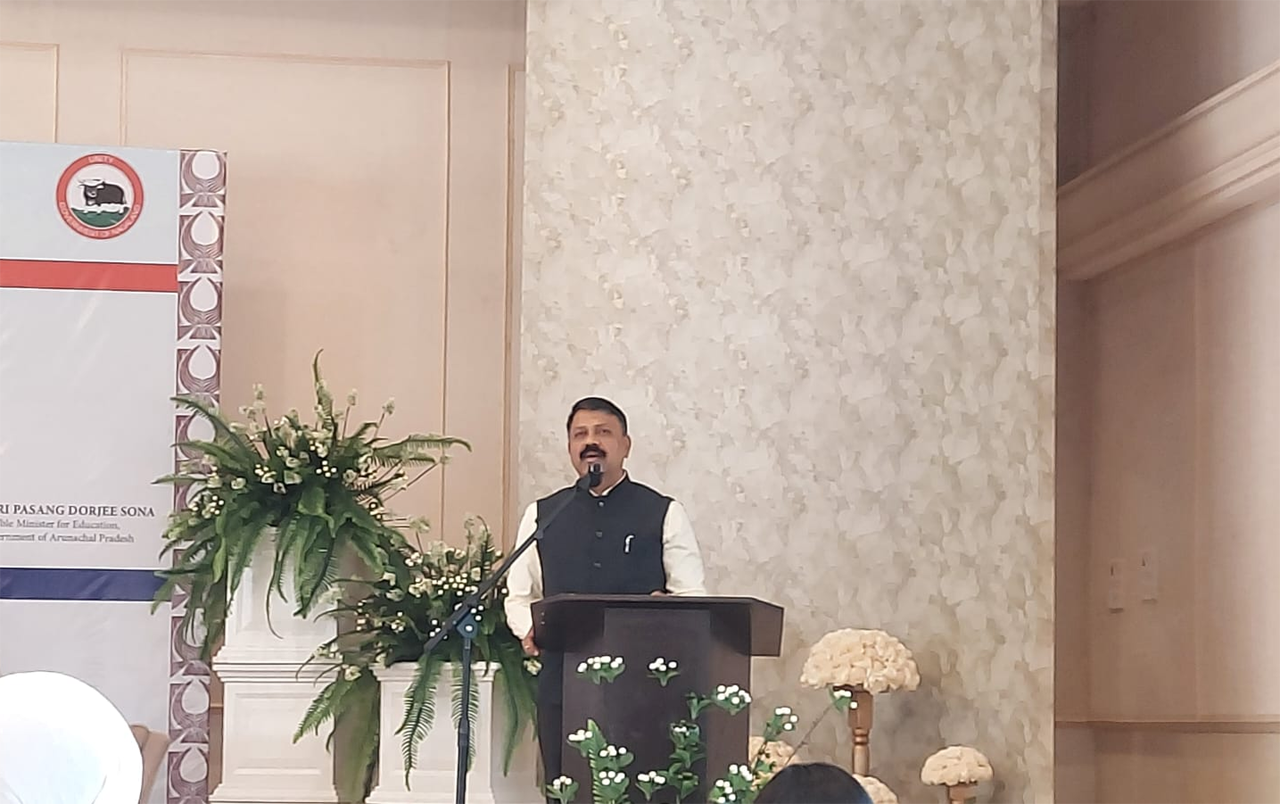
Additional Secretary, Department of Higher Education, Ministry of Education, Government of India, Anandrao V Patel has called for stronger industry-academia linkages, greater student mobility among Northeastern states and wider use of digital education platforms to achieve the objectives of the National Education Policy (NEP) 2020.
Addressing the Northeast Education Conclave, Patel said the two-day deliberations had provided the Centre with a better understanding of the challenges being faced by states and districts in implementing NEP 2020. He said policymakers in Delhi often did not fully understand ground-level issues and stressed that the leadership of the Northeastern states would be crucial to successful implementation of the policy.
Emphasising the changing nature of employment, Patel said a degree alone was no longer sufficient and students needed to acquire skills relevant to the latest industry requirements. He said NEP sought to promote dynamic curricula through stronger collaboration between educational institutions and industry, enabling young people to secure employment, become future leaders and contribute to national development.
He identified preparing for the demographic dividend, addressing climate change, creating a skilled workforce with multidisciplinary abilities and developing an education system rooted in Indian heritage as major challenges. NEP, he said, sought to address these through equitable access, holistic and multidisciplinary education integrated with skills, research, and the development of critical and creative thinking.
“Identifying the problem is easy, but solving it requires a little more leadership qualities,” Patel said, stressing the need to equip students with problem-solving abilities. He also underlined the importance of restoring respect for teachers and recognising them as essential members of society.
On higher-education access, Patel highlighted the NEP target of achieving a 50 percent Gross Enrolment Ratio (GER) by 2035. He said the transition from Class 10 and 12 to higher education continued to see significant dropout and called for concerted efforts to bridge the gap. Achieving the target, he said, would require additional infrastructure, teacher training and recruitment of more teachers.
Nagaland Tribune app on Google Play


Patel urged the Northeastern states to establish mechanisms that would facilitate movement of students across the region. Students from Assam, he said, should be able to study in Nagaland, Manipur or Mizoram, while students from the Northeast should also be able to pursue studies in institutions elsewhere in the country without unnecessary barriers.
He said the Academic Bank of Credits and credit-transfer mechanisms were central to NEP implementation and urged institutions to participate actively. He also stressed the importance of Open and Distance Learning (ODL) and online courses to expand access without depending entirely on physical infrastructure.
Highlighting the importance of Indian Knowledge Systems (IKS), Patel said the Northeast possessed rich traditional knowledge, arts, culture and languages that could contribute significantly to India’s educational development. He said the release of primers in 121 Indian languages, including tribal languages of Arunachal Pradesh, represented an important step towards multilingual education and the eventual use of more Indian languages as mediums of instruction.
He also called for greater use of technology, including regional-language e-content, Divyang-friendly educational software and virtual laboratories. He said NCERT had made hundreds of virtual laboratories available and urged states to use schemes such as Samagra Shiksha and PM-USHA to strengthen digital infrastructure.
On industry-academia collaboration, Patel said students from the Northeast could undertake training in industrial clusters outside the region, including Mumbai, Kolkata and Chennai. He said around 80 industrial clusters had been identified for such opportunities and that Boards of Apprenticeship could help connect students and institutions with industry.
Sharing progress under NEP, Patel said 51 percent of institutions had adopted the National Higher Education Qualifications Framework (NHEQF), while 58 percent had adopted the National Credit Framework (NCRF) and 56 percent had adopted the four-year undergraduate programme. He said 69 percent of institutions had adopted the Academic Bank of Credits.
He further highlighted the SAMARTH digital platform, saying more than 15,000 higher educational institutions had been fully onboarded and over one crore students were active on the platform. The system, he said, could support digitisation of university and college administration, including academic, financial and human-resource planning.
Patel also highlighted the SWAYAM and SWAYAM Plus platforms for expanding access to online and industry-aligned courses. He said SWAYAM had around 16,000 total courses and 4,200 unique courses, while SWAYAM Plus had around six lakh registered learners, 550 courses and MoUs with 89 industry partners.
Calling for stronger research ecosystems, Patel urged Northeastern universities to collaborate with national laboratories and institutions such as IITs. He also suggested that schools regularly expose students to higher educational institutions so that they could understand career opportunities and develop greater interest in higher education.
He said taking school students to universities and laboratories could help reduce dropout rates, broaden career awareness and ultimately increase enrolment in higher education.
Patel said NEP 2020 offered institutions considerable flexibility to modify curricula according to local requirements and described its implementation as a major transformation of India’s education system, with learner-centric education, digital learning, industry collaboration, research, internationalisation and Indian Knowledge Systems among its key pillars.
Patel also acknowledged the rich cultural heritage, linguistic diversity, traditional knowledge and social traditions of the North-Eastern States. He said that the region has much to offer the rest of the country and can serve as an important centre for learning, cultural exchange and knowledge development.
He encouraged educational institutions to document and promote the region’s indigenous knowledge, arts, languages, crafts and community practices. Such efforts, he said, would enable students from across the country to study and learn from the distinctive cultural and intellectual traditions of the North-East.
The Additional Secretary described NEP 2020 as a potential turning point for the North-Eastern States. He said that effective implementation of the policy could expand educational opportunities, strengthen institutional capacity, encourage research and innovation, and create new pathways for the professional and personal development of young people.