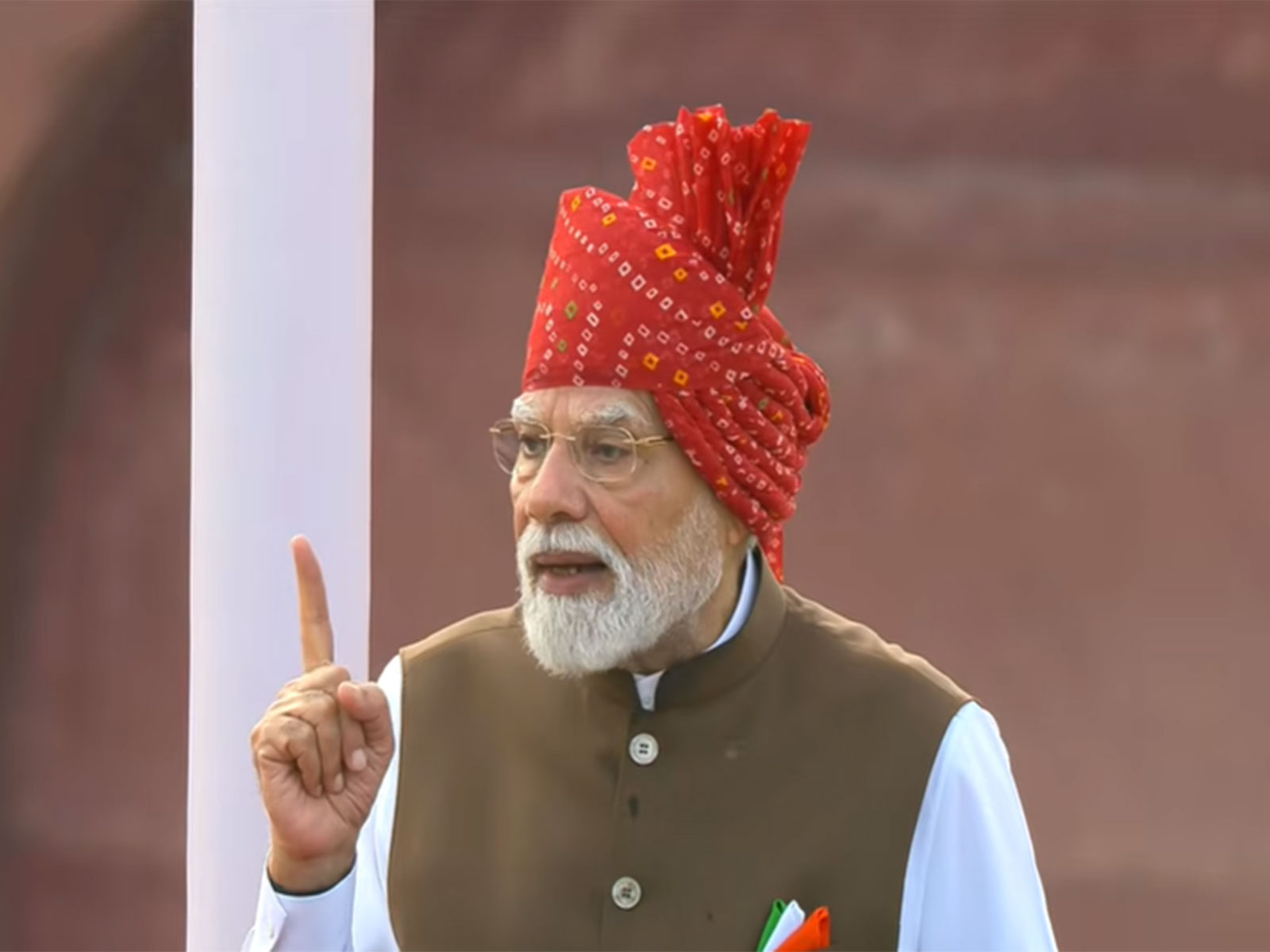
Prime Minister Narendra Modi on Saturday placed India’s youth at the centre of the country’s journey towards becoming a developed nation by 2047, unveiling an expansive seven-pronged roadmap for growth and announcing major initiatives spanning employment, sports, artificial intelligence, education, manufacturing, technology, energy, defence and global trade in his 80th Independence Day address from the Red Fort.
Addressing the nation after hoisting the National Flag, Modi said the youth would be both the greatest beneficiary and the principal driver of a developed India. He called for the country’s development ambitions to be closely aligned with the aspirations, energy and participation of young Indians.
“When I speak of a developed India, when I speak of propelling the nation forward at a rapid pace, the greatest beneficiary and the greatest enabler of this vision is the youth of my country, the youthful energy of my nation,” he said.
He said India must move forward with its youth as the highest priority, stressing that the country’s young population would play a decisive role in determining the direction of the nation over the next two decades.
A major announcement was the launch of the Pradhan Mantri Viksit Bharat Rojgar Yojana, under which the government will invest ₹1 lakh crore to promote employment and create opportunities for approximately 3.5 crore young people. Modi said first-time employees joining the private sector would receive an incentive of ₹15,000, while companies creating additional employment would also receive incentives.
The Prime Minister also addressed the growing burden of competitive examination coaching on families and announced a nationwide initiative for free online coaching. He said the government would use India’s digital public infrastructure, available teaching talent and technology to create an extensive online network through which young people preparing for different examinations could access quality coaching without having to bear the high cost of private coaching institutions.
Technology and emerging sectors, meanwhile, featured prominently in the Prime Minister’s vision for India’s youth. He announced that one crore young people would be trained in artificial intelligence, reflecting the government’s effort to equip India’s workforce with skills required by the rapidly changing technological landscape.
Modi also highlighted India’s growing start-up ecosystem, noting that the country now has more than 2.5 lakh registered startups under the Startup India initiative. Referring to the government’s ₹1 lakh crore Innovation Fund, he encouraged young entrepreneurs to pursue ambitious ideas, assuring them that resources would be made available to support innovation.
Sports as a pillar of youth development
Sports occupied a significant place in the Prime Minister’s Independence Day address, with Modi linking India’s sporting ambitions to its broader development journey.
He said India’s performance in international sports has steadily improved and that the country is moving forward as a strong contender to host the 2036 Olympic Games. He also announced a nationwide sports talent-hunt campaign aimed at identifying promising children between the ages of five and 15.
The programme, he said, would be conducted across villages, cities and schools. Children identified through the initiative would have their abilities assessed and would subsequently receive specialised training to prepare them for representing India at the highest level.
Modi pointed out that the Olympic Games encompass around 40 sports and approximately 325-350 events, but India does not participate in or qualify for nearly two-thirds of these events. He said the country must therefore identify talent at an early age and expand its presence across disciplines in which it has traditionally had limited participation.
He also highlighted the expansion of India’s sporting ecosystem through the Target Olympic Podium Scheme, Khelo India Games, University Games, Winter Games and Beach Games, besides investments in sports infrastructure, coaching, sports medicine and sports nutrition.
“Even if they are unable to become athletes themselves, a vast new field of opportunities is opening up within the support system around sports,” the Prime Minister said, pointing to the growing employment and professional opportunities in coaching, sports science, medicine, nutrition, management and allied fields.
India, he said, is also preparing to host the Commonwealth Games in 2030 while pursuing its ambition to host the 2036 Olympics.
‘Shakti Ki Saptadhara’ for India’s next phase of growth
A major feature of Modi’s address was the unveiling of what he described as ‘Shakti Ki Saptadhara’, or seven streams of strength, which he said would provide the foundation for India’s next phase of economic and technological development.
The first stream is manufacturing. Modi called for India to emerge as a reliable global supply-chain hub, stressing that Indian manufacturers must focus on cost, quality and scale. He said the country should move beyond being merely a large consumer market and build capabilities across the entire value chain, from design and components to manufacturing and finished products.
The second stream is agriculture and food processing. Modi said free trade agreements have opened access to large international markets and called upon Indian farmers and businesses to move from farm production to export-oriented value chains. Traditional Indian foods, millets, spices, fruits and flowers, he said, should be developed into globally recognised brands.
The third stream is technology and innovation. Modi said India must become a global hub for artificial intelligence, quantum technology, robotics, space technology and data centres. Recalling India’s success with UPI and digital public infrastructure, he said the country should now take next-generation communication technologies to the world, including the development and global expansion of Made-in-India 6G technology.
The fourth stream is Gati Shakti and high-speed connectivity. The Prime Minister called for seamless connectivity through high-speed rail, modern highways, inland waterways, airports, ports and multimodal logistics hubs. Port-led development, he said, would also be an important component of India’s growth strategy.
Defence production constitutes the fifth stream. Modi stressed that India must become self-reliant in defence manufacturing and develop next-generation defence technologies so that the country can emerge not merely as a defence market but as a global supplier.
The sixth stream is green energy and the Blue Economy. The Prime Minister called for India to achieve global leadership in renewable energy, green hydrogen and energy storage while expanding opportunities in fisheries, coastal tourism and ocean technology.
The seventh stream is India’s soft power. Modi highlighted Yoga, Ayurveda, holistic healthcare, handicrafts, Indian culture, films, animation, gaming and digital content as areas through which India can strengthen its global influence and create new economic opportunities.
Download Nagaland Tribune app on Google Play


Semiconductor manufacturing to expand
The Prime Minister also placed semiconductor manufacturing at the heart of India’s technological self-reliance.
He said three major semiconductor plants have already begun production and that chips manufactured in India have started reaching international markets. He said another five to eight semiconductor plants are expected to become operational over the coming years.
Describing semiconductors as indispensable to electronic goods, medical equipment, transportation and the broader modern technology ecosystem, Modi said building domestic chip-manufacturing capacity would create a major pathway towards self-reliance and a developed India.
He also underlined the strategic importance of critical minerals, saying the technology sector depends heavily on their availability. The government, he said, is pursuing the National Critical Minerals Mission and Critical Minerals Corridor while entering into agreements with other countries to secure reliable supplies.
Modi linked this effort to energy security, noting that semiconductors, artificial intelligence and data centres would require enormous amounts of electricity. India, he said, is targeting 100 GW of nuclear power capacity by 2047, with five new reactors expected to become operational in the next several years.
MSMEs urged to expand into global markets
The Prime Minister called upon India’s micro, small and medium enterprises to take full advantage of the country’s free trade agreements and establish a stronger presence in international markets.
He said India has entered into FTAs with around 40 countries since 2014, creating significant opportunities for domestic producers. Indian textiles, machinery, pharmaceuticals, seafood and other products, he said, must reach global consumers.
However, Modi stressed that Indian products would have to meet international standards in terms of quality, cost and reliability if they are to compete successfully.
He also urged Indian businesses to develop globally recognised companies and brands. Asking why India should not have 50 companies among the Fortune 500 in the coming decade, he said the country should also aim to have an Indian bank among the world’s top five banks and Indian pharmaceutical companies and professional services firms among global leaders.
He said India’s talent, technical capabilities, linguistic strengths and entrepreneurial culture provide a strong foundation for creating internationally competitive businesses.
Youth urged to stay away from drugs
The Prime Minister also expressed concern over the growing challenge of drug abuse among young people and called for a collective national effort to build a Nasha Mukt Bharat.
He said India’s future depends on ensuring that the country’s younger generation remains healthy, strong and capable of contributing to national development. Combating drug abuse, he stressed, cannot be left to the government alone and must become a collective responsibility of families, communities and society.
Modern civil defence network announced
Modi also announced plans to establish a modern and extensive Civil Defence network capable of responding to contemporary security and disaster-related challenges.
He said the proposed network would involve modern training and enhanced capabilities to protect citizens during crises. The Prime Minister also highlighted the increasing contribution of women to nation-building, pointing to their growing participation in aviation, the armed forces, sports, STEM education and other areas.
India’s global ambitions
The Prime Minister’s address also presented a broader vision of India moving up the global value chain and becoming a manufacturing, technological and innovation powerhouse.
He stressed that India should not remain merely a market for advanced technologies developed elsewhere but should build its own capabilities in manufacturing, design, innovation and critical technologies.
The emphasis on semiconductors, artificial intelligence, quantum technology, 6G, robotics, space, green energy and defence manufacturing reflected the government’s push to position India as a major technology and production centre.
At the same time, Modi sought to connect economic development with employment, entrepreneurship and opportunities for young people, arguing that a developed India would have little meaning unless its benefits translated into better opportunities for the country’s youth.
Reiterating his confidence that India would achieve the goal of becoming a developed nation by 2047, Modi said the country was moving forward with a new resolve and urged citizens to dream big and work collectively to turn those aspirations into reality.
The Prime Minister also hoisted the National Flag at the Red Fort, with the ceremony synchronised with a 21-Gun Salute fired by the ceremonial battery using indigenous 105mm Light Field Guns, marking the 80th Independence Day celebrations.
(with inputs from ANI)