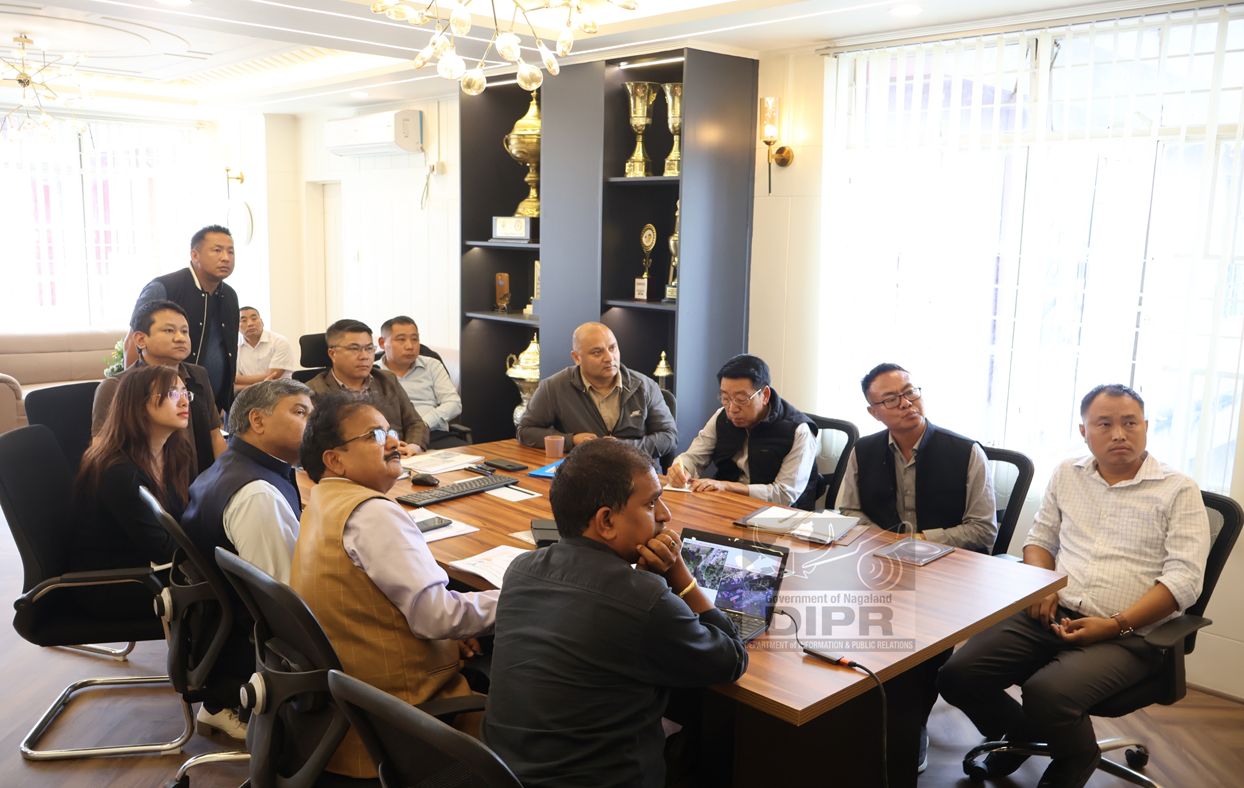
A Project Monitoring Group (PMG) meeting to review the progress of ongoing highway projects under the National Highways and Infrastructure Development Corporation Limited was held on May 14 at the Office Chamber of the Deputy Commissioner, Kohima.
Chaired by Deputy Commissioner Kohima, B Henok Buchem, NCS, the meeting brought together Revenue Officer Kohima, and other district administration officials, NHIDCL representatives, contractors, consultants, and other stakeholders to assess the progress of four-lane highway works, tunnel construction, and traffic management along the Kohima-Dimapur corridor.
During the meeting, officials reviewed the package-wise implementation of the four-lane highway project and the progress of the Kohima bypass. NHIDCL informed that Package-I have achieved around 26 percent physical progress, while Package-II has reached approximately 43 percent progress in the Kohima sector. Package-III road works have reportedly achieved nearly 90 percent completion and are expected to be opened for traffic movement by July 2026.
Tunnel construction remained one of the key focus areas during the meeting. Officials stated that separate contracts are being executed for major tunnel sections, including box tunnels and push technology tunnels. The push technology tunnel at Chainage 157 has crossed 50 percent progress and is targeted for completion by December 2026, while tunnel sections at Chainages 153 and 156 are expected to be completed by June 2027.
Officials further informed that GSB, WMM, and DBM works are progressing in various stretches of the Kohima sector. Temporary diversions, culverts, and drainage improvement works are also being undertaken to ensure smoother traffic movement during the monsoon season. Concerns related to sinking zones, landslides, compensation issues, and tunnel-affected areas were also deliberated upon, with district administration and NHIDCL officials stressing the importance of coordination to avoid delays in project execution.
NHIDCL officials also informed the meeting that a major 81-metre bridge has already been proposed and that the Detailed Project Report (DPR) for the structure has been completed. A consolidated DPR covering the Dimapur-Kohima corridor, including slope protection works, alignment improvements, and related infrastructure, is expected to be submitted to the Ministry by June or July for approval.
A separate DPR presentation on the rehabilitation of existing bridges, construction of new bridges, slope protection, and landslide mitigation measures along the Kohima–Mao Road (NH-02) was also held during the day under the chairmanship of Deputy Commissioner Kohima B. Henok Buchem. The presentation was attended by officials from the Sub-Divisional Office (Civil) Jakhama, NPWD (R&B) South Division, NPWD (NH) Kohima, NHIDCL Regional Office Kohima, consultants, and members of the Southern Angami Public Organization.
Download Nagaland Tribune app on Google Play


Consultants highlighted that advanced investigations including LiDAR surveys, drone radar imaging, slope stability studies, and subsurface investigations had been carried out at critical locations along the highway corridor. Existing bridge condition assessments revealed that out of six existing bridges, four were found to be in poor condition and are proposed for replacement with wider-span bridges, while additional new bridges are also planned in vulnerable stretches.
The presentation further detailed engineering interventions proposed to address recurring sinking zones, erosion-prone areas, and landslide locations. Proposed measures include reinforced soil structures using geogrid and geocell technology, drainage enhancement through geocomposite layers, gabion retaining walls with anchor systems, soil nailing works, and slope stabilization techniques.
Several sharp curves and accident-prone stretches were also reviewed. Consultants informed that road widening and curve improvement works are being proposed wherever feasible while taking into consideration habitation areas, land acquisition concerns, and existing structures. Discussions were also held on alternative alignments aimed at avoiding major landslide zones and improving traffic safety.
During the interaction, officials raised concerns regarding private constructions close to vulnerable landslide areas and stressed the need for precautionary measures to prevent further risks. Clarifications were also sought on specialized slope protection mechanisms for highly unstable stretches where conventional retaining walls may not be sufficient.
Deputy Commissioner, B Henok Buchem, while expressing gratitude to all departments and stakeholders for their cooperation, urged officials and implementing agencies to adopt a humane and people-centric approach while dealing with affected residents and the public during the execution of the proposed infrastructure works.