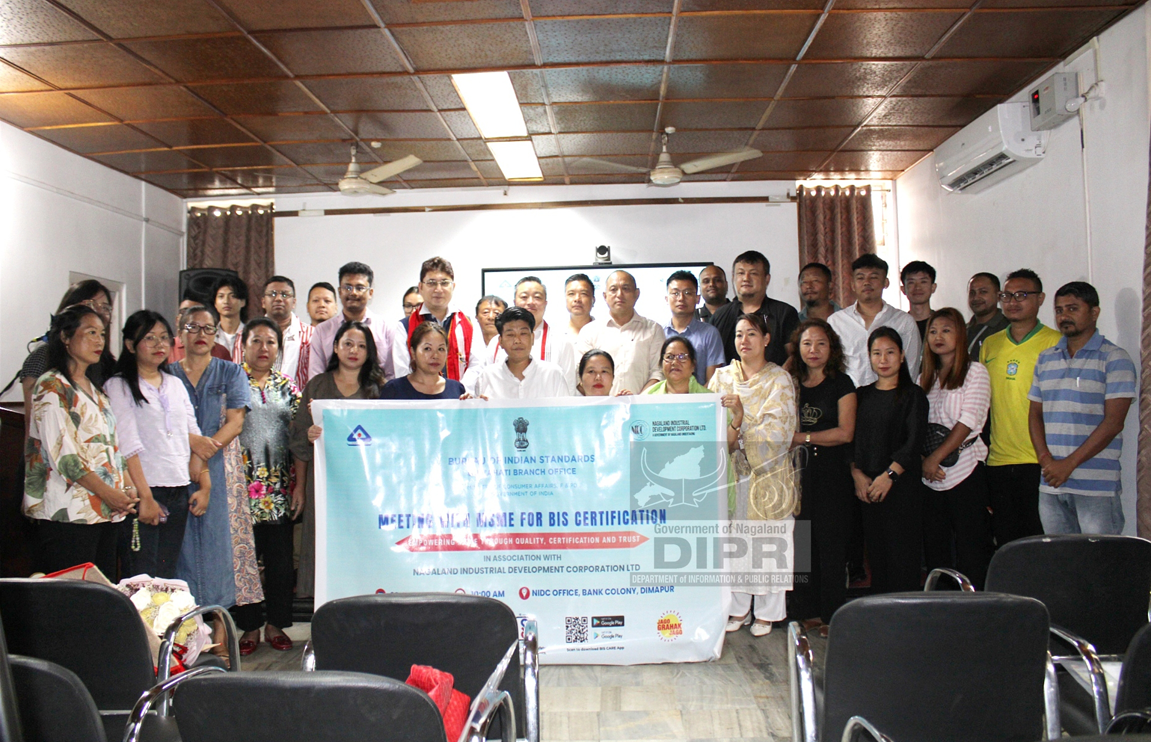
A Sensitization Programme for Micro, Small and Medium Enterprises (MSMEs) on Quality Standards and Bureau of Indian Standards (BIS) Certification was held at the Conference Hall of the Nagaland Industrial Development Corporation (NIDC), Bank Colony, Dimapur on June 20.
The programme was organized by the Bureau of Indian Standards (BIS), Guwahati Branch Office, Ministry of Consumer Affairs, Food and Public Distribution, Government of India, in association with Nagaland Industrial Development Corporation (NIDC) Ltd. The event aimed to create awareness among MSMEs on quality standards, certification procedures, and the benefits of adopting BIS standards for business growth, market competitiveness and consumer confidence.
The inaugural session included addresses by Director and Head, Guwahati Branch Office (GHBO), BIS, Shouvik Chanda, and Chairman, NIDC, Kvulo Lorin.
Addressing the participants, Chanda said BIS, the National Standards Body of India, is engaged in formulating Indian Standards, product certification, management system certification, hallmarking and consumer awareness activities.
He stated that the programme was organised to promote the culture of quality among MSMEs and create awareness about BIS certification, consumer rights and quality assurance mechanisms. He encouraged entrepreneurs to adopt quality standards to improve product competitiveness and access wider markets within and outside the country.
Chanda also urged consumers to be aware of quality marks and their rights while purchasing products and to make use of available grievance redressal mechanisms in case of substandard products.
Chairman, NIDC, Kvulo Lorin, who was the chief guest of the programme emphasized the need to move beyond awareness programmes and focus on achieving tangible results. He noted that entrepreneurs had taken time away from their businesses to attend the programme and stressed that the session should lead to practical outcomes rather than remain a mere formality.
Lorin urged MSMEs to take advantage of BIS certification opportunities, stating that quality standards and certification were essential for businesses seeking to expand beyond local markets and compete at the national level. He highlighted that while infrastructure had been developed to support enterprises, its full potential could only be realized when businesses adopted recognized standards and quality systems.
Calling for continued support from BIS, Lorin requested simplified and sector-specific guidance for industries such as food processing, bamboo and cane products, textiles, handlooms, and construction materials. He stressed that entrepreneurs needed clear information on applicable standards, testing requirements, and certification procedures.
Download Nagaland Tribune app on Google Play


The NIDC Chairman also announced that NIDC would serve as a single-window facilitation point for MSMEs interested in pursuing BIS certification. He assured entrepreneurs that the corporation would assist them in navigating the certification process, accessing financial support where required, and following up until the certificates were obtained.
Urging participants to leave the programme with a concrete decision, Lorin encouraged them to engage with BIS officials, seek clarifications, and take the next steps towards certification. He expressed confidence that adherence to quality standards would enable local enterprises to access larger markets and unlock new business opportunities.
The programme was chaired by Moanochetla Longkumer. While welcome address was delivered by Temjenyanger Jamir, General Manager, NIDC. The programme concluded with a vote of thanks proposed by Tzudir Jamir, Deputy General Manager, NIDC.
During Session I, Dr Shasanka Sekhar Borkotoky, Consultant (Standardization Activity), BIS, presented an overview of BIS and highlighted the importance of quality standards for MSMEs. He explained the role of standards in improving product quality, ensuring consistency, enhancing market acceptance and increasing competitiveness.
Session II focused on BIS Product Certification (ISI Mark). Rahul Roy, Scientist-B, Guwahati Branch Laboratory, BIS, explained the certification process, requirements and benefits of obtaining BIS certification. He highlighted how certification ensures product quality, safety and reliability while strengthening consumer trust.
In Session III, Shouvik Chanda elaborated on Management System Certification Schemes and other support mechanisms available for MSMEs. He informed participants about various certification schemes and opportunities that could help enterprises improve quality management systems and expand their market reach.
An interactive session on questions, clarifications and experience sharing was also conducted, enabling participants to engage directly with BIS officials and experts on certification-related issues and quality compliance requirements.
