Skyroot Aerospace on Friday achieved a major milestone in India’s space programme as its Vikram-1 Test Flight-1 successfully reached orbit, becoming the maiden flight of the country’s first privately developed orbital-class rocket.
The successful mission marks a watershed moment for India’s private space sector, making India the third country in the world to achieve private orbital launch capability.
Prime Minister Narendra Modi congratulated Skyroot Aerospace on the successful launch, describing it as a significant achievement for the country’s growing space ecosystem.
The mission, named “Mission Aagaman,” was launched from the Satish Dhawan Space Centre and successfully completed all planned stages of flight. The 24-metre-tall carbon-composite launch vehicle carried out stage separations, orbital manoeuvres and payload deployment as scheduled before injecting its payloads into a nearly 450-kilometre Low Earth Orbit (LEO).
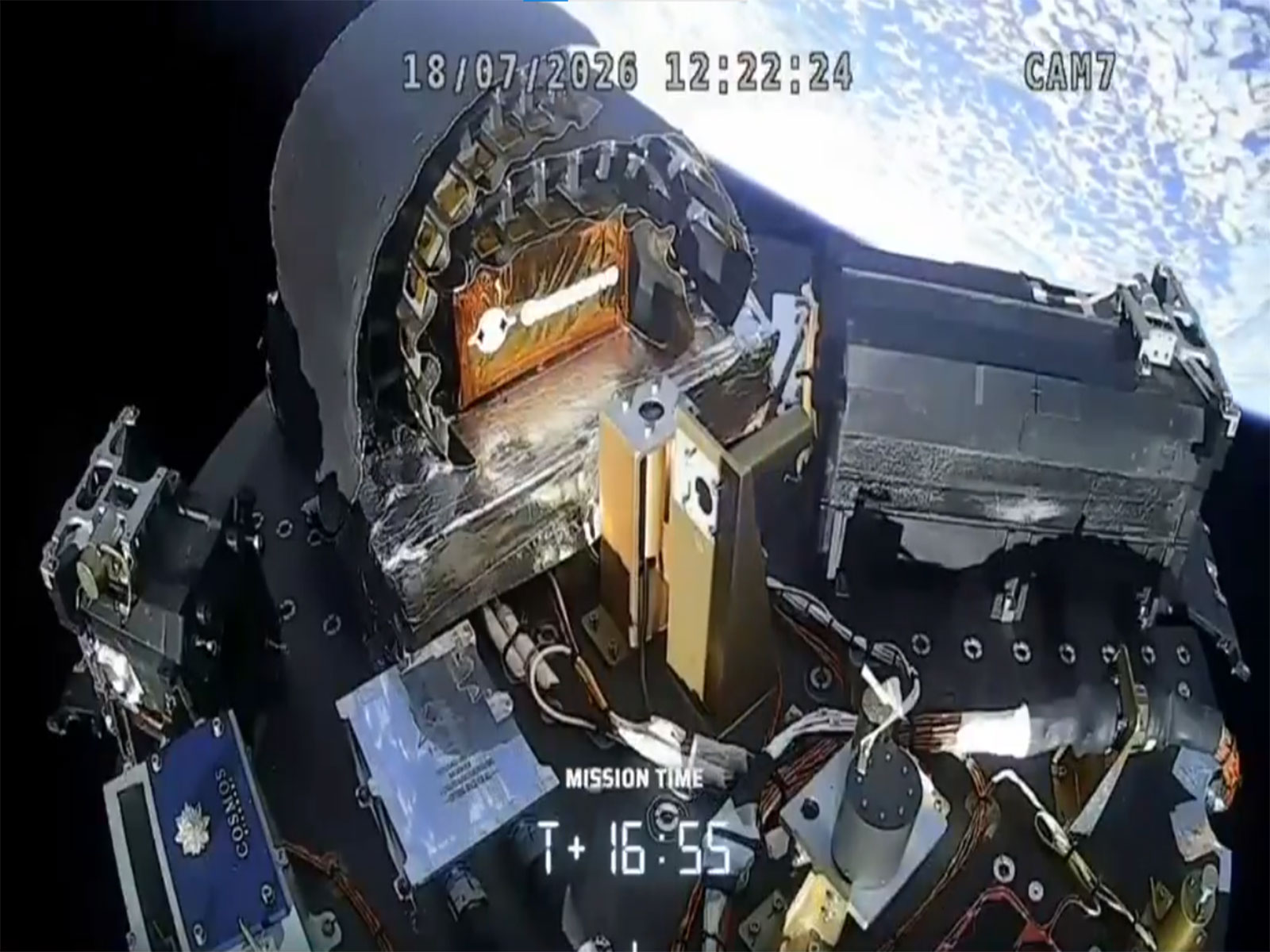
The rocket completed its final burn before its Orbital Adjustment Module (OAM) successfully inserted the payloads into the intended orbit. The OAM, equipped with a 3D-printed liquid engine, provided the final orbital boost and demonstrated its capability to start, stop and restart in space—an important feature for future satellite deployment missions.
During the ascent, Kalam-1200, the rocket’s solid-fuel first stage, propelled Vikram-1 through the densest layers of the atmosphere before separating as planned. The payload fairing was then jettisoned, exposing the onboard satellites to space.
The second-stage Kalam-250 completed its burn and separated successfully, followed by the ignition of the third-stage Kalam-100, the smallest and highest-flying solid propulsion stage of the launch vehicle. After the completion of the solid-propulsion phase, Stage 3 separated, allowing the Orbital Adjustment Module to execute the final orbital insertion manoeuvre.
Designed with three solid-fuel propulsion stages and a liquid-fuel orbital adjustment module, Vikram-1 is capable of placing payloads weighing up to 350 kilograms into a 450-km Low Earth Orbit, positioning it as a key launch vehicle for the growing small satellite market.
The maiden mission carried multiple payloads, including “Diamond Lotus,” a laboratory-grown diamond developed by Bengaluru-based Cosmos Diamonds.
Download Nagaland Tribune app on Google Play


Adding a symbolic touch to the mission, one of the payloads included a handwritten postcard from Prime Minister Modi bearing the words “Vande Mataram.” The postcard travelled into space alongside handwritten messages from members of the Skyroot team, investors, policymakers and supporters from across the world, making Mission Aagaman a shared celebration of India’s expanding space ambitions.
The successful orbital mission represents a significant boost to India’s commercial space programme and highlights the growing role of private industry in advancing the country’s space capabilities following the opening of the sector to private participation.
External Affairs Minister (EAM) S Jaishankar on Saturday hailed the successful launch of Vikram-1, calling it a historic moment for India’s space sector.
In a post on X, Jaishankar said the launch of “India’s first privately developed launch vehicle” by Hyderabad-based Skyroot Aerospace was “truly historic”.
“India’s space ambitions soar to new heights! The successful launch of #Vikram1, India’s first privately developed launch vehicle, by #SkyrootAirspace @SkyrootA today is truly historic. The rocket is a reflection of what can be achieved when the innovation & entrepreneurial drive of India’s youth are backed by the bold reforms of PM @narendramodi’s vision.” EAM Jaishankar wrote on X.
Meanwhile, Indian Space Research Organisation (ISRO) Chairman V Narayanan on Saturday congratulated Skyroot Aerospace after its Vikram-1 Test Flight-1 successfully reached orbit, describing it as a major milestone for India’s private space sector.
Narayanan said the successful mission marked the first time an Indian private rocket had been placed in orbit. “This is the first successful attempt by an Indian private rocket to reach orbit. First of all, I thank Prime Minister Narendra Modi,” he said.
He credited the 2020 space sector reforms for enabling greater private participation and said the achievement reflected the success of those policy initiatives.
“The space sector reforms announced in 2020 have made this possible. The Prime Minister has always guided us, and I thank him for his support,” he said.
Congratulating the Skyroot Aerospace team, Narayanan said the company and its employees deserved appreciation for the achievement.
He also acknowledged the role of the Indian National Space Promotion and Authorisation Centre (IN-SPACe) for facilitating private participation in the sector and thanked the ISRO team for its support.
“When private participation in the space sector began, we had only one startup. Today, we have more than 400 space startups. This is just the beginning under the leadership of our Prime Minister as we move towards making India a developed nation,” Narayanan said.
IN-SPACe Chairman Pawan K Goenka also announced the successful completion of the first launch by an Indian private-sector rocket, saying Skyroot Aerospace’s Vikram-1 exceeded its mission objectives by successfully reaching orbit.
“I am privileged to formally announce that the first-ever Indian private-sector launch has been successfully completed. Not only did Vikram-1 meet its mission objective, which was simply to clear the tower, it went all the way up to a 453-km orbit, successfully completed all the tasks, and achieved something well beyond expectations,” Goenka said.
(with inputs from ANI)