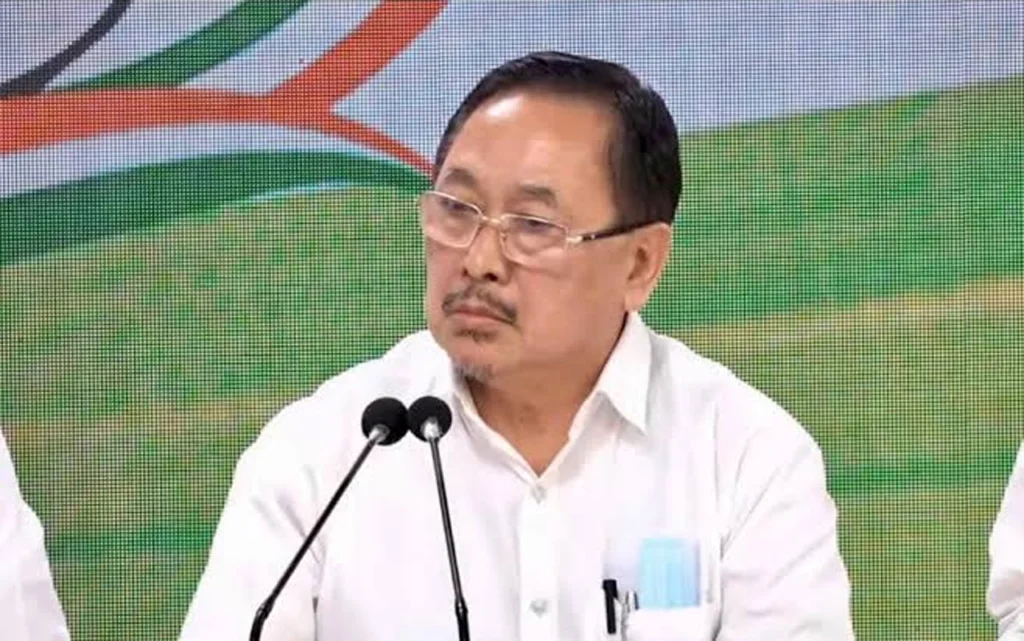
Former Nagaland Pradesh Congress Committee president, K Therie has claimed that the demand for President’s Rule in Nagaland has “mass support” as the public wants peace and freedom.
In a statement, Therie said the public now understands that the NPF is the “roadblock” and that the mandate was to ensure an early solution. He said the mandate was also given to the NPF on its commitment “to pave the way” for an honourable and acceptable solution.
“Agreements are now legal tender documents,” he said.
Therie said the NPF was rejecting President’s Rule although its demand for fresh talks at the level of a Minister had again been rejected. He accused the NPF of having a “dangerous double tongue”, saying that in most public meetings it talks of an “early solution” while demanding fresh talks at the level of a Minister.
He also referred to the statement of the Nagaland BJP president that the regional party had no agenda. Therie said the BJP had promised “election for solution” in 2018.
“NPF is on life support from BJP,” he alleged. “If Nagaland BJP really meant a solution, they have the power to do it. Having awaited upon BJP for 7 years to deliver their promise, we thought the only way is PR.”
Therie said that, in his consideration, Prime Minister Narendra Modi was ready to implement the agreements and only needed the cooperation of the State Government of Nagaland.
“In the above-given situation, PR is the only way. There is sufficient ground to proclaim PR in Nagaland,” he stated.
Therie said the NPF had already committed “to pave the way in favour of honourable and acceptable solutions” and argued that the Government of India could proclaim President’s Rule, honouring the commitment of the NPF, as talks had concluded.
Download Nagaland Tribune app on Google Play


Secondly, Therie alleged that the State Government had failed to carry out its constitutional duties in maintaining law and order.
He said internal disturbances in Nagaland and Manipur had continued without control and alleged that the State Government had failed to enforce constitutional machinery in the State according to the provisions.
“The machineries were asked to compromise with insurgents and to collect commissions for various factions,” he alleged.
Therie further alleged that the NPF and its alliance were compromising the State’s interests, safety and economy. He said the State Government, being a party to the Government of India, had a duty to represent the stakeholders and was supposed to consult them and work out details acceptable to the stakeholders.
“However, they have failed to follow orders or directions sent by the Union Government to work out the details,” he alleged, referring to Articles 355, 356 and 365 of the Constitution.
Besides these constitutional provisions, Therie alleged that the State Government had failed to enforce public order, which he described as the sovereign power of the State provided under Article 246 (Seventh Schedule), as well as Article 371A.
He also alleged that the State Government had failed to carry out ILP and RIIN provisions justly and without bias or ill will.
Therie said the removal of RN Ravi, the then interlocutor and Governor, and the repeated mandates given to the NPF had “seriously weakened” the aspiration for an early solution and “pushed back the political will of the Central Government”.