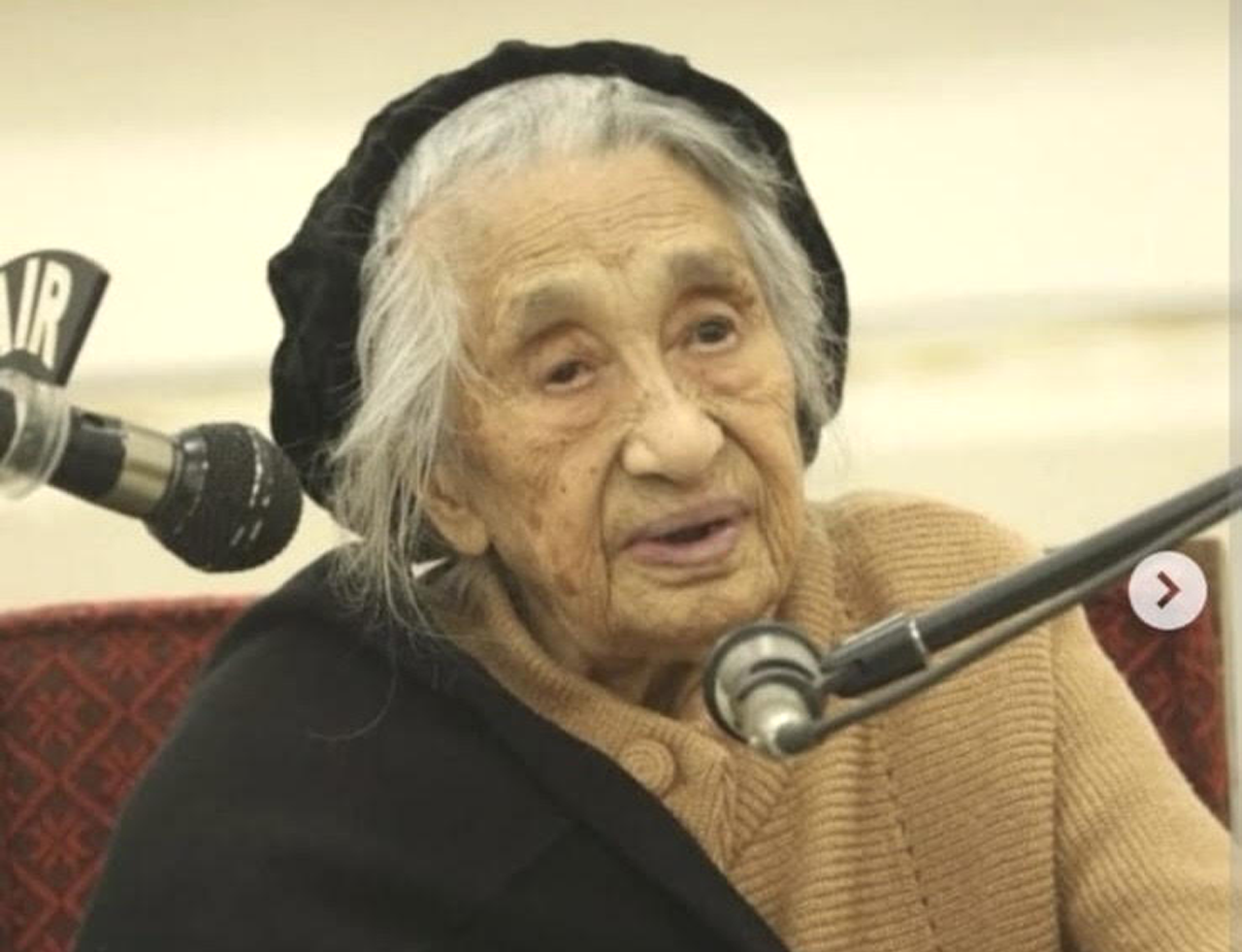
Ura Academy has renamed its hall “Rev. Beilieü Hall” in memory of late Rev. Beilieü Shüya, recognising her 56-year association with the institution and her pioneering contributions to education, Christian ministry and the development of the Academy.
The announcement was made by Ura Academy president Dr Shürhozelie Liezietsu at a condolence gathering on Friday, where he remembered Beilieü as a pioneer educationist and a selfless contributor to the growth of the institution.
Describing the occasion as one nobody had prepared for, Dr Shürhozelie said it nevertheless provided an opportunity to recall the life and contributions of Beilieü, whom he described as a mature and respected figure whom people could look up to.
Beilieü Shüya, whose full name was Rheibeilieű Shüyatsu, was born in Kohima on August 15, 1928. She died on September 18, 2026, aged 98.
She was the daughter of Lhousuohie of Meriema village, regarded as one of the first educated persons from the village, and Zenuo, sister of A.Z. Phizo of Khonoma. She was the eldest of 10 children. Her maternal grandfather was reportedly the second person from Khonoma to embrace Christianity.
Pioneer of Ura Academy
Recalling the origins of Ura Academy, Dr Shürhozelie said Angami leaders gathered at Chüziema on May 23, 1970, to discuss literature and decided to form an Angami Literature Committee.
The committee comprised Rüzhükhrie Sekhose, Dr H.V. Sakhrie, Kezhagwelie Peseyie, Beilieü Shüya and Shürhozelie Liezietsu. At a subsequent meeting on June 8, 1970, Zhavise Vihienuo, Tsolie Chase, Neilichu Belho and Vikeyieu Chalieu were included.
With neither a proper venue nor adequate funds initially, the committee relied on Beilieü, who had founded the National School at the present site. She allowed the committee to use the school premises for its meetings and programmes, helping sustain its early activities.
The Angami Literature Committee was renamed Ura Academy a year later, with the broader objective of creating an institution inclusive of the entire Tenyimi community. From 1971, the Academy began organising an annual workshop.
Dr Shürhozelie recalled that Beilieü would close her school for three days whenever the Academy held its annual programme, allowing the premises to be used for the event. She would arrange for students to clean the compound, assist with preparations and put up flags around the premises.
As the Academy expanded, the need for a permanent building became increasingly apparent. When finding suitable land proved difficult, Beilieü donated the present site to Ura Academy. The land, he said, had originally been gifted to her by her parents.
Nagaland Tribune app on Google Play


Dr Shürhozelie described the gesture as a sacrifice made out of love for the Tenyimi community and said her contribution should be remembered and acknowledged by posterity.
He said Beilieü had been associated with Ura Academy since 1970 and remained a member of its Chatha (Board of Directors) until September 18, 2026—nearly 56 years.
“Even though she has parted from us, posterity and the community will forever remember her as the Mother to Ura Academy,” he said.
First Naga woman to be ordained
Rev Beilieü Shüya is remembered as the first Naga woman to be ordained and as a prominent figure in the Naga Christian revival movement.
She began her schooling at Mission School, Kohima, and later studied at Mission School, Golaghat, Government High School, Kohima, and Cotton College, Guwahati. She completed her first two years of B.A. at Scottish Church College, Calcutta, and the third year at Tribhuvan University, Nepal.
Her academic pursuits also included a diploma from the International Montessori Association, Kolkata, a Perspective Course in Education at William Carey University, California, a B.Ed from Utkal University, Bhubaneswar, an M.Th from Los Angeles University and an M.A. in Tenyidie from Ura Academy.
She was also a javelin throw champion in Bengal.
In 1946, she experienced what she described as being filled with the Holy Spirit and began conducting prayer meetings. Through these gatherings, she ministered to people and encouraged them to renew their faith and deepen their relationship with Jesus Christ.
Her Christian convictions also brought periods of imprisonment. She spent three months as a security prisoner over her interpretation of the International Press of Khuzama and was imprisoned again in 1956 in connection with A.Z. Phizo’s family. During her imprisonment in Kohima, Nagaon and Guwahati, she translated numerous passages of the Bible.
In 1978, she was ordained at the World Mission Conference in Chennai, becoming the first Naga woman to receive ordination. She was also among the first generation of the Nagaland Christian Revival Church.
Education, mission and public service
Rev. Shüya made significant contributions to education. In 1959, she became the first headmistress of Baptist English School, Kohima. She later established schools in Kohima in 1964 and in Phek and Pughoboto, expanding educational opportunities in Naga communities.
Her missionary work took her to several countries and regions, including Israel, the United Kingdom, the United States, Germany, Egypt, the Philippines, Indonesia, Korea, Thailand, Singapore, Sri Lanka, Burma, Russia, China, Nepal, Arunachal Pradesh and Bhutan.
She made 11 pilgrimages to Jerusalem for the Feast of Tabernacles and was invited to the inaugural breakfast of U.S. President Bill Clinton on January 20, 1993.
She was also a Life Member and Vice-President of the Nagaland State Bharat Scouts and Guides. In recognition of her contributions, she was honoured with the Silver Star by the then President of India, Dr APJ Abdul Kalam, at Rashtrapati Bhavan, New Delhi, on July 11, 2007.
A strong advocate of the Tenyidie language, she urged the Tenyimias during Ura Academy’s 75th anniversary in 2014 to embrace Tenyidie as their first language.
Even in her later years, she remained active in public life, attending Ura Academy events and giving a personal interview for the publication Nagas 80 Plus in 2023 at the age of 95.
Rev. Beilieü Shüya’s life spanned Christian ministry, education, scholarship, sports, missionary work and language advocacy. Her passing marks the end of a long and pioneering chapter in Naga church, education and cultural history.
Ura Academy’s decision to rename its hall after her places her enduring contribution to the institution at the centre of its collective memory.