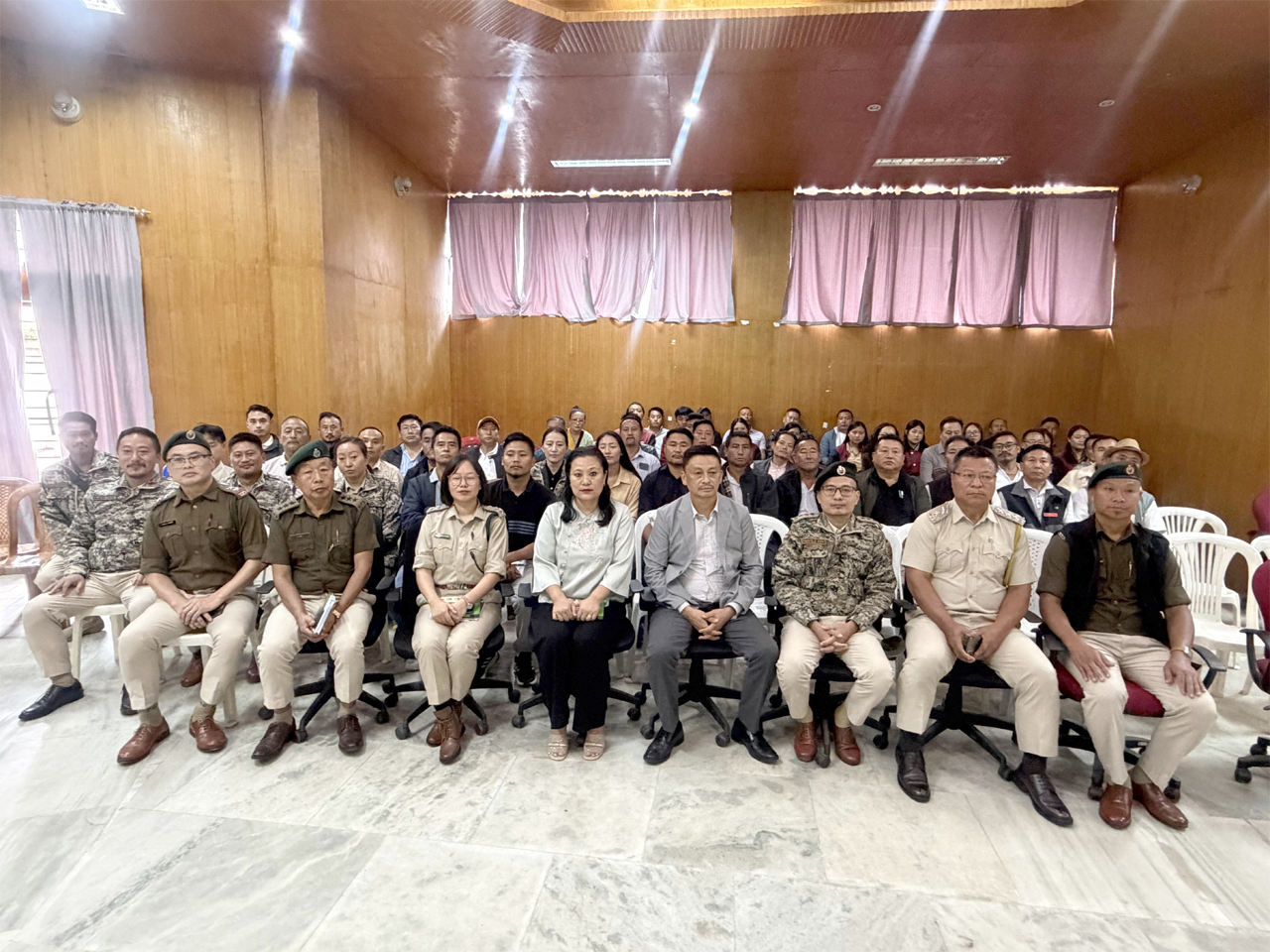
The Kohima Forest Division observed Wildlife Week 2026 at the Conference Hall of the Forest Office Complex on Thursday, calling for stronger community participation and collective responsibility to protect wildlife and natural habitats.
Observed on the theme “Connecting Habitats, Thriving Wildlife,” the programme brought together Forest Department officials, students, community representatives and other stakeholders to underline the importance of wildlife conservation and the need for people and institutions to work together for the protection of the environment.
Speaking at the programme, Conservator of Forests (STC) K Hukato Chishi, IFS, said wildlife conservation could not be left to the Forest Department alone, stressing that human beings and wildlife were inherently interconnected.
Chishi called for greater public awareness, particularly among students, media persons and citizens, observing that many disagreements and misconceptions stem from a lack of understanding of facts. He urged people to verify information and understand issues before forming opinions, saying greater awareness could help prevent assumptions, unnecessary arguments and miscommunication.
He also highlighted the importance of understanding Article 371(A) and using the constitutional safeguard responsibly. While acknowledging its significance to Nagaland, Chishi cautioned against its misuse and stressed the need for people to understand both the provisions and responsibilities associated with the constitutional framework.
According to him, Nagaland had come a long way under the protection provided by Article 371(A), making it important for people to continue educating one another about its scope and significance.
On the role of the Forest Department, Chishi acknowledged that the department may have shortcomings but maintained that it continues to discharge its responsibility as the caretaker of forests to the best of its ability. He also acknowledged the contribution of village councils, local communities and other stakeholders in supporting conservation initiatives.
Calling for greater humility in public discourse, Chishi said, “We should have the grace to admit” when we are wrong or lack knowledge about an issue.
He maintained that meaningful conservation ultimately depends on coexistence and shared responsibility. Appealing particularly to elders and community leaders, he urged them to carry the message of conservation to the younger generation and help build greater awareness about wildlife and the environment.
Earlier, Range Forest Officer, Chiephobozou Range, Kum. Savinuo Kikhi, made a presentation on wildlife conservation and key provisions of the Wild Life (Protection) Act, 1972. She highlighted legal provisions relating to hunting, including Section 9, which prohibits hunting of protected wildlife, along with limited exceptions under Section 11 and special-purpose permits under Section 12.
Kikhi stressed that effective forest and wildlife conservation requires active cooperation between local communities and government authorities. She highlighted community ownership as a crucial aspect of conservation, noting that village communities play an important role in managing forests, land and other natural resources.
She also underscored the importance of traditional conservation practices, observing that customary rules and traditional knowledge contribute to the sustainable use of natural resources and continue to guide communities in their interaction with forests and wildlife.
Download Nagaland Tribune app on Google Play


On wildlife protection, Kikhi said community participation could help prevent hunting, trapping and illegal collection of wildlife. Villagers, she added, are also well placed to monitor changes in wildlife, forests and water resources through local-level observation.
She further stressed the need for cooperation between communities and Forest authorities in addressing human-wildlife interactions and preventing conflicts. Greater awareness among village institutions, churches, youth and student organisations, she said, would further strengthen conservation efforts.
According to Kikhi, effective conservation ultimately depends on a strong government-community partnership, with Village Councils, local organisations and government agencies working together to protect forests, wildlife and natural resources.
A student of Sazolie College, Jotsoma, meanwhile, highlighted the important role of young people in wildlife conservation. She said conservation was often viewed as the responsibility of the Forest Department, scientists and conservation organisations, but young people and students also have a significant role to play.
She pointed to habitat loss, deforestation, pollution, illegal wildlife trade and climate change as some of the major threats facing wildlife. However, she said conservation did not always require large-scale interventions and could begin with simple actions such as avoiding littering, planting trees, protecting local water sources and educating others about the importance of wildlife.
The student also highlighted the potential of social media as a tool for conservation awareness, urging young people to use their platforms not only for entertainment but also to share conservation messages and encourage greater respect for nature.
Citing the conservation of the Amur Falcon at Doyang as an example, she said the success demonstrated what could be achieved when communities, young people, conservation groups and the Forest Department worked together.
“This teaches us something very important: Wildlife conservation works best when people become part of the solution,” she said.
She encouraged students across Nagaland to join nature clubs, participate in clean-up and plantation drives, document birds and wildlife in their surroundings, attend awareness programmes and learn to coexist with wildlife.
She also stressed the importance of learning from elders and local communities, who possess valuable traditional knowledge about forests and wildlife, while noting that young people could contribute through education, technology and social media.
The programme was chaired by Yhuntilo Kent, Range Forest Officer, Tseminyu, who in his welcome address said wildlife conservation could not be achieved by the Forest Department alone. He called for the support and cooperation of local communities, educational institutions, students, NGOs and individuals, noting that representatives from different sections of society had been invited to participate in the celebration.
The programme began with an invocation by Medolezo Kire, Range Forest Officer, Kohima, and concluded with a vote of thanks delivered by Dr Sevono Seletsu, Divisional Forest Officer, Kohima.