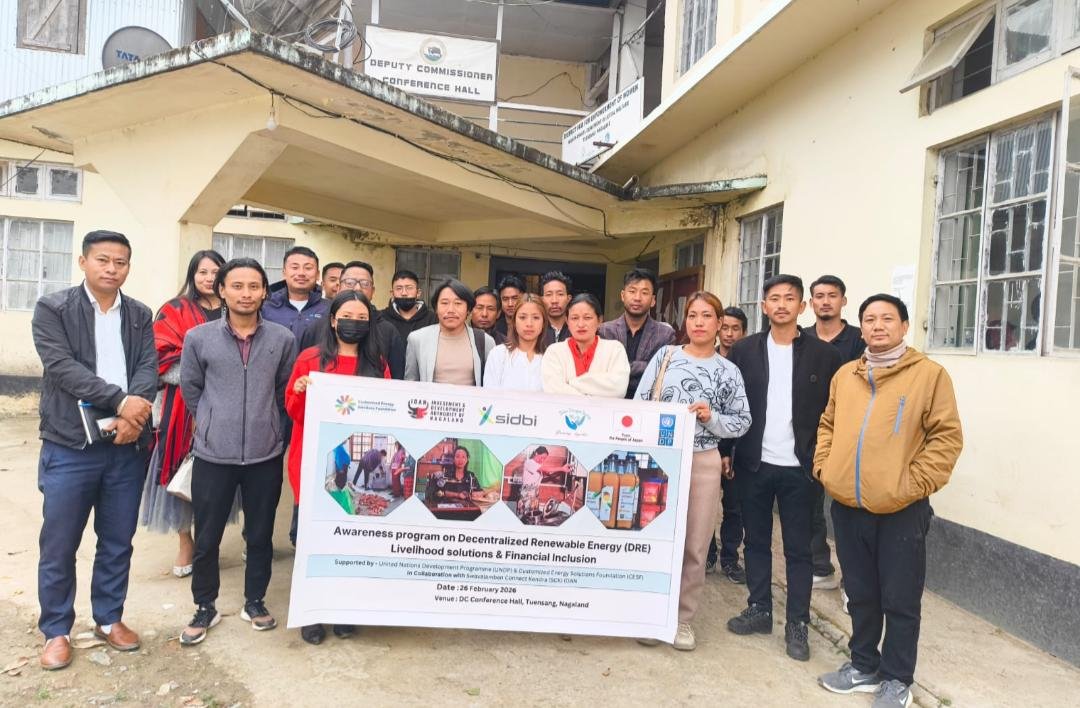
An awareness program on Decentralized Renewable Energy (DRE) livelihood solutions and financial Inclusion was conducted on February 26 at the DC Conference Hall. The program was organized by Customized Energy Solutions Foundation in collaboration with Swavalamban Connect Kendra (SCK), Investment and Development Association of Nagaland (IDAN), and Dolen Thangjam Society, with support from United Nations Development program UNDP aimed at strengthening lead generation and conversions.
The program began with a welcome note by Kihomong Yimkhiung, SDO (Civil), Government of Nagaland. In his address, he highlighted that the region is still lagging in development and emphasized the importance of staying informed about new technologies and opportunities such as DRE livelihood solutions. He encouraged participants to learn and explore how such solutions can help improve livelihoods and support regional development.
This was followed by a session on DRE livelihood solutions by Lakum C Chang, representing CES Foundation. The session focused on how CES Foundation is driving change in the region by promoting productive use of renewable energy Supported by UNDP. He shared examples of solar-powered sewing machines, solar-powered food processing machines, and solar-powered coffee processing machines. He emphasized that energy should not be used only for lighting but also as a tool for productivity and income generation.
Rev. Achu, Founder of Eden Resource Center, spoke about how their center operates using DRE systems. He explained that while DRE can support basic energy needs, its real value lies in powering livelihood machines such as coffee processing units and food processing equipment, helping communities become more self-reliant.
An inspiring testimony was shared by end user Yemkhong Chang, Center Manager of Leiyan Garments, a solar-powered stitching hub. He explained how the solar-powered system allows them to complete large stitching orders within weeks without interruption from power cuts. He also highlighted the positive impact on their income and productivity, also shared key learnings and implementation insights with the stakeholders to support better adoption and scalability.
Sonyasonla Chang, Founder of Maiya, spoke about the importance of food processing and value addition. She highlighted the need for the region to move beyond selling raw materials and instead focus on processing and value addition to increase income and economic growth. She also shared her personal experiences and the challenges faced while building her enterprise.
Nagaland Tribune app on Google Play

The endusers highlighted the positive impact on their income and productivity. They also shared our key learnings and implementation insights with the stakeholders to support better adoption and scalability.
Allen Chang from Redefine Solutions delivered a technical session on DRE systems and solutions. He explained the working principles of DRE technologies and emphasized that decentralized renewable energy is the future, especially for remote and underserved regions.
A briefing on financial linkage and credit access was provided by Langmai, Credit Coordinator from CMMFI, who explained the microfinance initiative and the process for accessing financial support. Topong Chang also spoke on the importance of financial literacy and entrepreneurship, encouraging participants to take initiative and explore livelihood opportunities.
An interactive open session was conducted where participants asked questions about microfinance, DRE solutions for households, and livelihood applications. The program concluded with a live interaction and demonstration of livelihood technologies, including a solar dryer and a solar-powered collapsible vegetable cooler, showcasing practical applications of DRE in supporting income-generating activities. With active participation from community members and government representatives. Such initiatives play a crucial role in empowering communities, promoting entrepreneurship, and supporting sustainable development.
