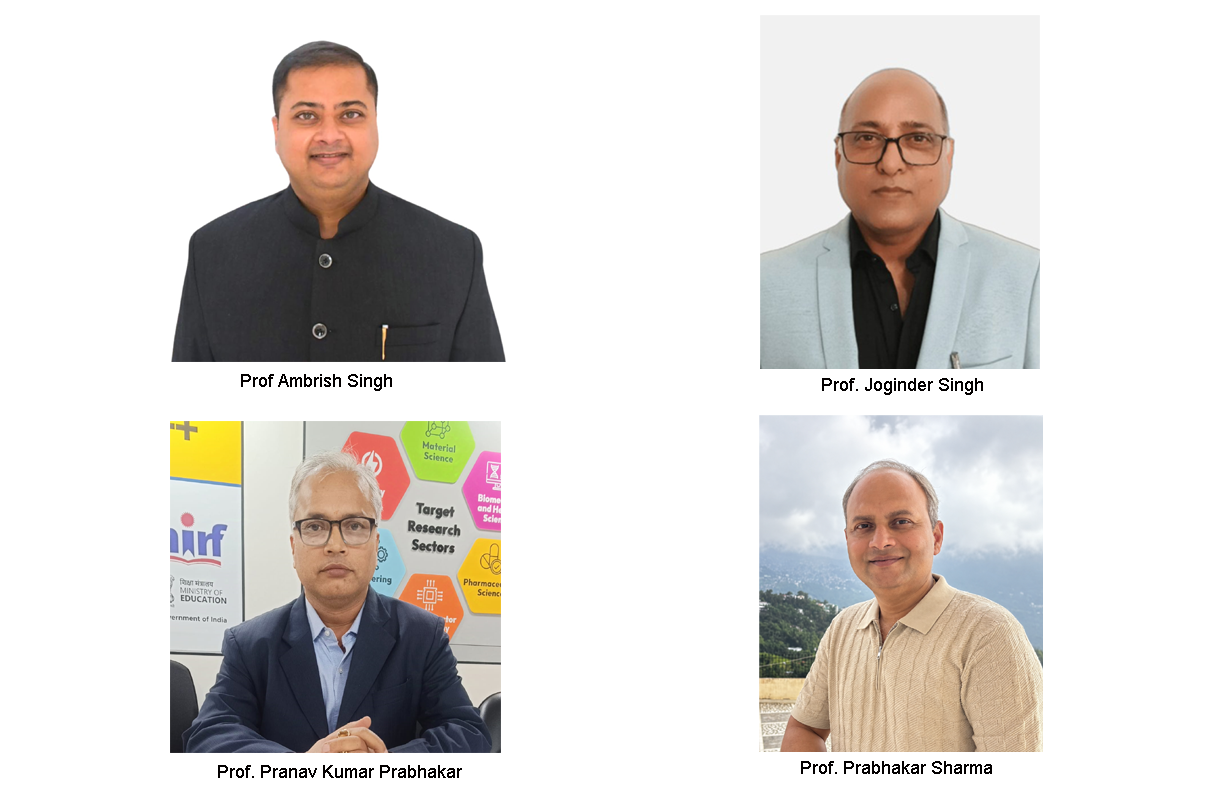
Four faculty members of Nagaland University have been recognised in the latest World’s Top 2% Scientists list, compiled by researchers associated with Stanford University using bibliometric data to assess research impact. Three of them have also earned recognition in the Career-Long Top 2% Scientists category, highlighting their sustained contributions to scientific research.
The faculty members featured in the latest list are Prof Prabhakar Sharma of the Department of Agricultural Engineering and Technology, Prof Ambrish Singh of the Department of Chemistry, Prof Joginder Singh of the Department of Botany and Prof Pranav Kumar Prabhakar, Head of the Department of Biotechnology.
Congratulating the faculty members, Vice Chancellor of Nagaland University, Prof Jagadish K. Patnaik, said the recognition was a matter of great pride for the university community and reflected the dedication, scholarly excellence and sustained research contributions of its faculty.
“I am delighted to note that four faculty members of Nagaland University have been featured in Stanford University’s World’s Top 2% Scientists list, with three of our faculty members also recognised in the Career-Long Top 2% Scientists category,” he said.
Patnaik added that the achievement demonstrated the growing quality, impact and global visibility of research undertaken at the university. He congratulated the researchers and appreciated the continued commitment of the university’s academic community to research excellence.
He expressed confidence that the recognition would inspire faculty members and scholars to pursue impactful research that contributes meaningfully to society and strengthens Nagaland University’s position in the global academic community.
The Career-Long Top 2% Scientists list features Prof Ambrish Singh, Prof Pranav Kumar Prabhakar and Prof Joginder Singh, recognising their sustained research impact over the course of their scientific careers.
Diverse research contributions
Prof Prabhakar Sharma, Head of the Department of Agricultural Engineering and Technology, works at the intersection of hydrology and environmental engineering. His research encompasses biochar applications for contaminant remediation, microplastic pollution, colloid fate and transport, aquifer characterisation, and groundwater management through aquifer storage and recovery.
He has published more than 119 peer-reviewed research articles, holds five patents and has received national and international research funding. His work also involves collaborations with institutions in India and abroad. He has an h-index of 47 and more than 8,200 citations.
Describing the recognition as a humbling acknowledgement of his efforts, Sharma said it motivated him to strengthen interdisciplinary research, expand collaborations and translate scientific knowledge into practical solutions for society and the environment. He thanked his colleagues, students, collaborators and Nagaland University for their continued support.
Prof Ambrish Singh of the Department of Chemistry specialises in electrochemistry, physical and materials chemistry, electroanalytical chemistry, corrosion and corrosion inhibitors, and polymers. His research includes the development of corrosion inhibitors for different corrosive environments.
A Fellow of the Royal Society of Chemistry, UK, Singh has an h-index of more than 55 and over 10,000 citations. He has also been associated with more than 56 intellectual property rights, including patents and other forms of intellectual property across multiple jurisdictions.
Download Nagaland Tribune app on Google Play


Reflecting on the recognition, Singh described science as a pursuit of the unknown that requires rigorous discipline and unwavering curiosity. He credited his collaborators, mentors and students for supporting his research over the years, adding that seven years of inclusion in the list represented sustained commitment to research and motivation for future work.
Prof Joginder Singh of the Department of Botany works across microbiology, plant sciences and environmental research. He has authored more than 120 research and review articles, edited 15 books published by leading international publishers and contributed to around 60 book chapters.
His academic work has led to collaborations and engagement with scientific societies and journals internationally. He also serves as a reviewer for journals covering environmental science, biotechnology, microbiology and allied disciplines.
Singh described research as a journey of uncovering nature’s biological intricacies, requiring patience, rigour and commitment. He said the recognition reflected a lifetime dedicated to advancing plant research and contributing to the scientific community, expressing hope that it would encourage young researchers to pursue science with curiosity, perseverance and purpose.
Prof Pranav Kumar Prabhakar, Head of the Department of Biotechnology, works in biotechnology and biomedical research, focusing on molecular mechanisms associated with metabolic disorders and strategies for oral insulin delivery.
His research also explores the use of natural products to mimic signalling pathways involved in diabetes, alongside combinations and alternative approaches to managing diabetes mellitus and its complications. An alumnus of IIT Madras, he has previously featured in the World’s Top 2% Scientists lists published in 2021, 2022, 2023 and 2024.
Prabhakar said being recognised among the World’s Top 2% Scientists for the sixth consecutive year was an honour that inspired him to continue pursuing research for better human health and society. Recalling his journey from Kachhubi in Madhubani district of Bihar to the global scientific community, he emphasised perseverance, curiosity and dedication.
His message to young researchers was to remain curious, uphold integrity and remember that scientific success ultimately lies in the impact research creates for humanity.
Research impact and bibliometric indicators
The World’s Top 2% Scientists database draws on Scopus data provided by Elsevier through ICSR Lab. It assesses researchers using a composite citation indicator, known as the c-score, with and without self-citations, alongside percentile-based measures of research impact.
Researchers are classified under the Science-Metrix system, which covers 22 broad scientific fields and 174 sub-fields. The database is intended to provide a standardised assessment of research influence based on bibliometric indicators, including citations and the h-index, rather than relying on a single measure of academic performance.