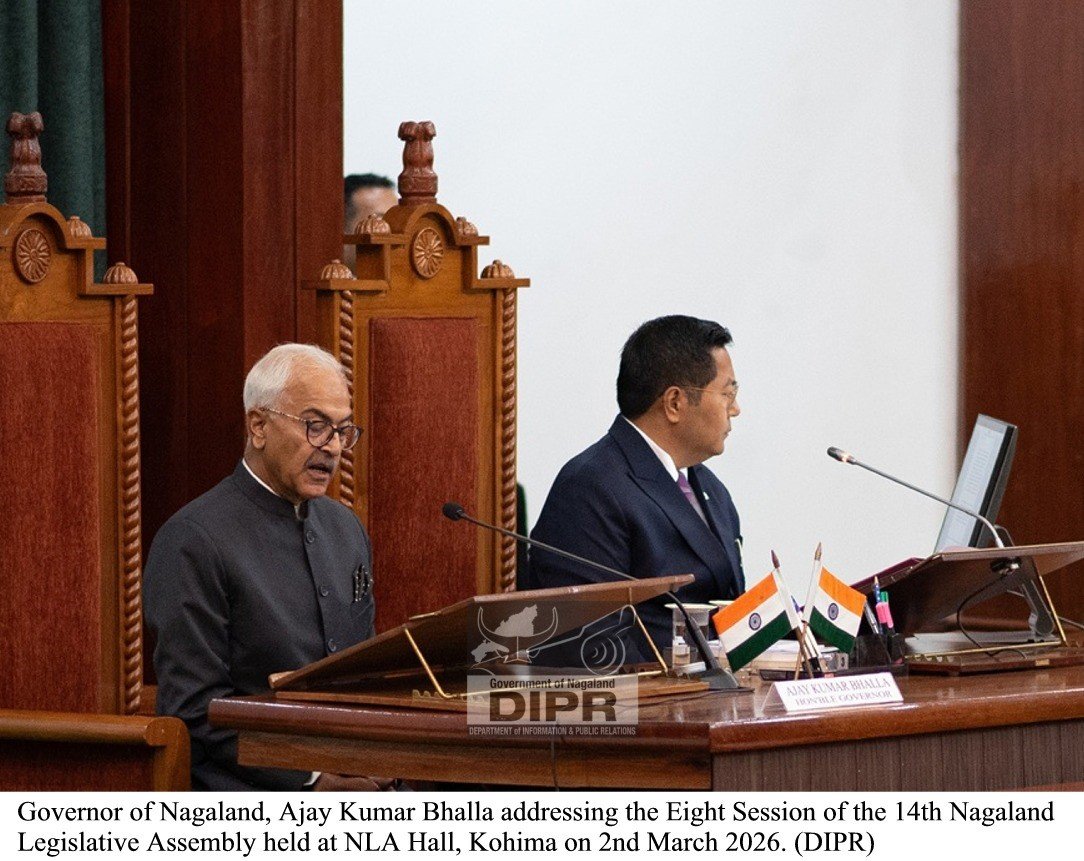
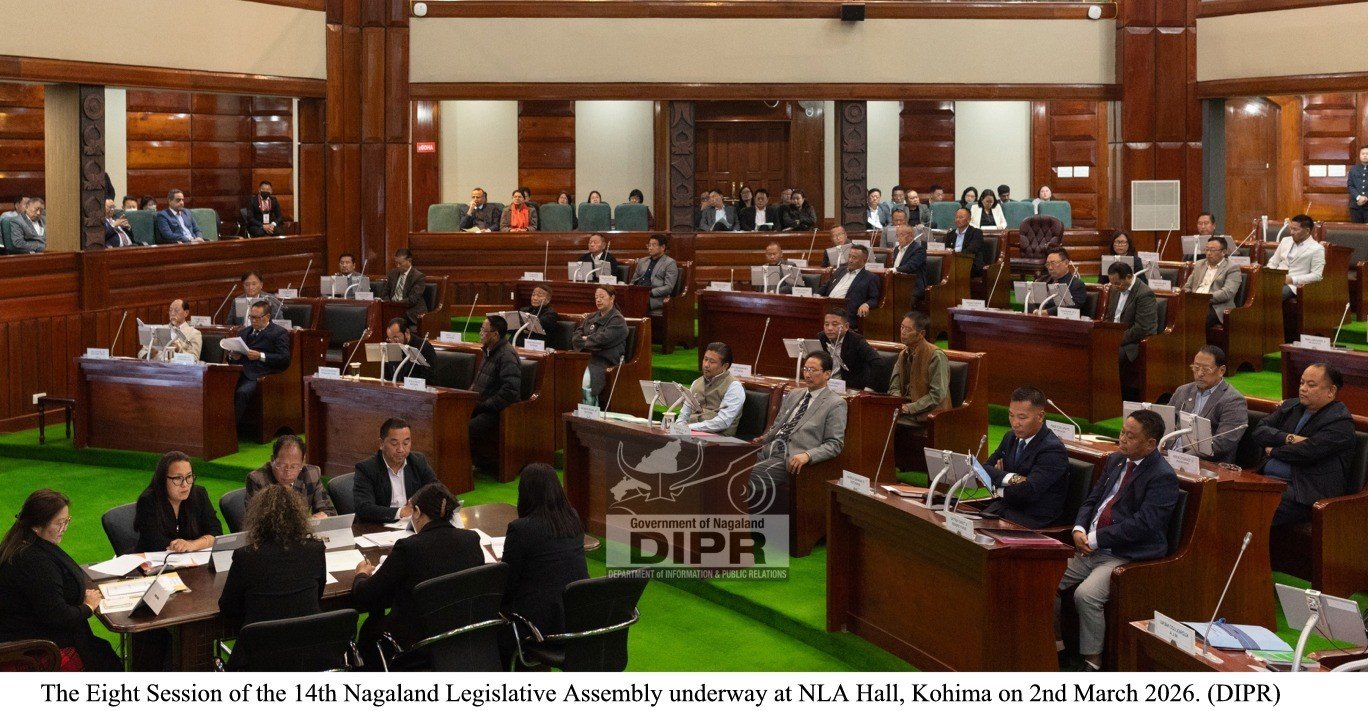
Governor of Nagaland Ajay Kumar Bhalla on Monday delivered his maiden address in the Nagaland Legislative Assembly (NLA) since assuming office in August 2025 as the first phase of the state budget session commenced.
Governor Bhalla highlighted the state government’s key policy priorities, achievements, and major developmental initiatives across various sectors.
Naga Political Issue: The governor reaffirmed the state government’s commitment to the peaceful settlement of the Naga political issue. He acknowledged the constitution of the Political Affairs Committee (PAC), comprising of ministers, elected representatives of all tribes, political parties and the two Members of Parliament from the state. The governor said a Sub-Committee has also been constituted to further streamline the PAC’s efforts, and Chief Minister Neiphiu Rio along with his cabinet colleagues and members of the PAC Sub-Committee had met the Union Home Minister Amit Shah, requesting the Government of India to elevate the ongoing peace dialogue through the appointment of an interlocutor at the political or ministerial level to expedite the talks towards an early and honourable solution.
FNTA: Highlighting the signing of a Memorandum of Agreement (MoA) on February 5, 2026 between the government of Nagaland, the Government of India and the Eastern Nagaland Peoples’ Organisation (ENPO) for the creation of the Frontier Nagaland Territorial Authority (FNTA) within the state, Governor Bhalla described the agreement as a significant step towards ensuring equitable and inclusive development in Eastern Nagaland.
He informed that the state government is working on constituting the Interim Council for FNTA in consultation with ENPO and the Tribal Hohos of Eastern Nagaland, and the government will also be moving soon for enactment of a special legislation for constitution of FNTA in consultation with MHA as provided in the MoA.
Download Nagaland Tribune app on Google Play

Congratulating the people of Eastern Nagaland on the momentous milestone, the governor assured of the government’s “fullest cooperation and support in our collective journey for attaining higher levels of progress and development for every section of our society”. He also expressed gratitude to the Government of India for its guidance and support leading to the signing of the historic agreement and called a continued assistance in helping the people chart together the path of moving forward.
Census 2027: The governor informed the House about the upcoming Census exercise which was announced by the Centre in June last year. For the state of Nagaland, he said the first phase of Census will be conducted from July 1 to July 30, 2026, and the option for self-enumeration shall be operational from June 16 to June 30, 2026. Towards this, the governor requested all the elected members to extend all necessary cooperation to the state administrative machinery and guide the stakeholders for proper and successful conduct of the Census exercise in the state.
Education: Stating that the government remains committed for human resource development which is the most crucial component for taking the state further to a higher growth trajectory, the governor highlighted that the Department of School Education has initiated the implementation of Standard Operating Procedure (SOP) for six core areas of the school transformation strategy for all the 17 Lighthouse School Complexes (LSCs). Under Nagaland Education Project-NECTAR, he mentioned that approximately 3,900 teachers comprising subject presidents/mentors and subject committee members have been trained through 133 Professional Learning Communities (PLCs) across 10 selected subjects as part of the efforts for the holistic implementation of the National Education Policy (NEP), 2020.
Under higher education, he stated that the department, under the Centrally Sponsored PM-USHA scheme, is undertaking infrastructure development in key government colleges across Nagaland. Governor Bhalla also expressed that the Nagaland Scholarship Nodal Cell, launched on December 1 last year will streamline scholarship governance and ensure timely delivery of benefits.
Sports: Expressing pride that Nagaland could host several regional and national sports events in 2025-26, the governor lauded athletes of various disciplines who have been bringing honours and laurels to the state.
Skill development: Highlighting efforts to improve employment opportunities and skill development, Governor Bhalla stated that the Department of Employment, Skill Development and Entrepreneurship has, in order to make employment services more inclusive, notified all Employment Exchanges as Special Employment Exchanges under the Rights of Persons with Disabilities (RPWD) Act, 2016, and is also launching the Providing Access to Core Employability Skills programme to enhance job readiness among the youth.
He mentioned that the Women Resource Department has also trained over 100 women in various vocational skills through Multi Training Centres.
Health: In the health sector, the governor highlighted the progress of the Chief Minister’s Health Insurance Scheme (CMHIS), which provides coverage for citizens not covered under Ayushman Bharat Pradhan Mantri Jan Arogya Yojana. He noted that under CMHIS for employees and pensioners which provides insurance coverage of Rs.20 lakhs per family, the total claim payout since inception stands at about Rs.171 crore, benefiting 29,500 individuals, while under general category scheme and the Pradhan Mantri Jan Arogya Yojana which provides Rs.5 lakhs insurance coverage per family, the combined claim payout has exceeded Rs.218 crore, benefiting over 81,000 individuals since inception.
“We have also taken a significant step towards strengthening of State drugs regulatory mechanism by operationalizing the Nagaland State Drugs Testing Laboratory (NSDTL) in Kohima. We have integrated Nagaland into the National Pharmacovigilance Programme of India (PvPI) and Materiovigilance Programme of India (MvPI) Network. Our healthcare professionals are being trained to report adverse events, making Nagaland an active contributor to India’s Drug and Medical devices safety landscape,” the governor said.
Social Welfare: The governor also highlighted that Social Welfare Department is implementing Mission Vatsalya scheme covering all 17 districts for the care and protection of children, and under Mission Shakti through Pradhan Mantri Matru Vandana Yojana (PMMVY) more than 6,800 beneficiaries have been paid cash incentives through DBT during FY 2025-2026.
PHED: He stated that PHE department under Jal Jeevan Mission (JJM), has been successful in providing more than 3.41 lakh Functional Household Tap Connections (FHTC) raising the coverage to about 94% in the state. Further, over 1100 villages/ habitations have been covered with 100 % FHTC, out of which 806 have been declared “Har Ghar Jal” villages, reflecting sustained efforts towards ensuring safe and adequate drinking water supply to every rural household.
Agriculture: The Agriculture department, he said, has consistently undertaken measures to enhance agricultural productivity, sustainability, market linkages, and farmers’ incomes through technology-driven and climate-resilient interventions. Under PM-KISAN, as of January 31 this year, 2,38,174 farmers have benefitted, with Rs.770.05 crore transferred directly to their bank accounts through DBT. The National Mission on Natural Farming is being implemented across 121 clusters covering 6,050 hectares, enrolling 15,125 farmers and promoting sustainable, chemical-free farming practices, he added. To promote jute and allied fibres, the governor stated that a 5-year MoU was signed with the Jute Corporation of India Limited (JCI), the National Jute Board (NJB), and ICAR–Central Research Institute for Jute and Allied Fibres. Additionally, during 2024–25 and 2025–26, under the National Food Security Mission, 2,217 quintals of quality seeds were distributed, benefitting 1,77,687 farmers.
Horticulture: This sector, the governor said, continues to play a key role in strengthening farmers’ income and promoting sustainable livelihoods in Nagaland, and under the Mission for Integrated Development of Horticulture (MIDH) 2025-26, an amount of Rs.38.88 crore has been allocated to the state for covering area expansion of various horticultural crops and other interventions. Moreover, an area of 125 hectares is proposed to be covered for Golden Kiwifruit cultivation in seven districts under Horticulture Model Village initiative.
Environment: The governor mentioned that the department of Environment, Forest and Climate Change to enhance the forest cover in the state has carried out plantations and protection works in an area of over 440 sq. km under the Nagaland Forest Management Project, and in order to harness the strong community conservation movement, the department has notified nearly 200 Community Reserves, which are Protected Areas on private lands leading to a significant increase in the state’s protected area network. Informing that the Nagaland Agar Policy has been drafted and will be soon submitted for notification, he said the policy will not only streamline the management and regulation of agar sector but also provide livelihood options to the people of Nagaland.
Rural Development: Governor Bhalla stated that under PMAY-G, more than 36,000 houses have been completed in the state, while under Deen Dayal Upadhyaya-Grameen Kaushalya Yojana (DDU-GKY), 510 rural youth have been trained and 412 placed in reputed companies within and outside the country during the current financial year. Further, 550 rural youth have been trained at Rural Self Employment Training Institute (RSETI) for the current financial year. Under MGNREGS, for the current financial year, more than 105 lakh person days have been achieved and employment has been provided to over 2.7 lakh households, he added.
DUDA: He acknowledged that DUDA is actively involved in elevating the livelihood of farmers and Minor Forest Produce gatherers and under the scheme of Van Dhan Vikas Yojana (VDVY) and development of value chain for Minor Forest Produce under TRIFED, Ministry of Tribal Affairs, Government of India; 180 SHGs under 38 VDVKs (Van Dhan Vikas Kendras) have been formed benefitting 11,400 households. Under the Prime Minister’s Development Initiative for North East (PM-DeVINE), he said 22 livelihood projects are being implemented across Eastern Nagaland.
Urban Development: Governor Bhalla said the Department of Urban Development and Municipal Affairs under SASCI Part V for the year 2024–25 is undertaking 12 infrastructure projects including construction of market complex-cum-ULB office buildings in various Urban Local Bodies. Moreover, under the 15th FC Untied Grants, various infrastructure works such as roads, drains, retaining walls and footpaths have been undertaken by the ULBs. The Pradhan Mantri Awas Yojana – Urban 2.0 Mission is proposed to be implemented in all 39 statutory towns in the state, he informed the House.
Natural Resources: Acknowledging that Nagaland is a resource-constrained state and pointing out the need for greater resources to translate the aspirations of the people of Nagaland into reality, the governor underscored that it is imperative to responsibly harness the state’s rich natural resources, particularly our petroleum and natural gas reserves, which have remained untapped for decades, to strengthen our resource base. “In this regard, my Government has taken up with the Government of India to evolve a State-specific policy for the exploration and production of petroleum and natural gas in Nagaland, while fully respecting the special constitutional provisions applicable to our State. We are hopeful of positive and early headway on this important matter,” Governor Bhalla stated.
He also maintained that the state is endowed with other substantial mineral resources, including coal, nickel cobalt-chromium bearing magnetite, and limestone deposits, and scientific and sustainable development of these resources would offer a significant opportunity to augment its revenues, promote industrial growth, create employment opportunities for our youth, and accelerate the pace of economic development. To this end, he sought the cooperation and support of all stakeholders in this collective endeavour so as to build sustainable and self-reliant sources of revenue.
Roads: During the current year, the governor remarked that the NPWD (Roads & Bridges) under the CRIF scheme completed two projects of length 26.5 km amounting to Rs.55.00 crore, and another two projects under NESIDS amounting to Rs.89.76 crore covering a total length of 27.85 km were completed. He said the state government has taken up critical stretches of the Foothill Road covering a distance of 139.85 km in Mon, Longleng, Mokokchung, Wokha, Niuland and Peren districts, which is also inclusive of 8 (eight) double lane bridges. Work is in decent progress at 70% completion as of February 2026. 35.
Meanwhile, he said in Dimapur the NPWD (NH) has completed development of 2-lane pavement from Tragopan junction towards Dillai gate on NH 29 for a distance of 6.68 km at a cost of Rs.12.94 crore, and widening of single lane to two lane from Longsa to New Wokha village on NH 2 for 10.44 km at a cost of Rs.65.00 crore, while a project for widening of existing single lane road to intermediate lane road from Mokokchung (Chuchuyimpang village) to Chare Town in Tuensang district for 23.06 km at a cost of Rs.115.1 crore was also completed along with repair & rehabilitation works of 3 (three) existing bridges in Kiphire district on NH 202 at a cost of Rs.1.75 crore.
Power: The governor also highlighted Power department is constructing a 220/132/33kv Substation with associated transmission lines at Tsitrongse (Diezephe) which will enhance the capacity for catering power supply to the four districts of Dimapur, Chumoukedima, Niuland and Peren. The project, sanctioned by Ministry of DoNER under PM-DeVINE at a cost of Rs.132.37 crore is scheduled for completion by September 2026. The transmission capacity of the existing 132/66/33kv, 200 MVA Nagarjan Substation, Dimapur has also been successfully upgraded to 350 MVA.
Reaffirming the state’s vision for long-term development, the governor stated that Nagaland is aligning its strategies with the national vision of Viksit Bharat 2047, with preparations underway for a comprehensive “Viksit Nagaland @2047” roadmap.
The Governor also commended the efforts of the administration, police, security forces, and civil society organisations in maintaining peace, law and order in the State. Initiatives such as cybercrime monitoring systems and AI-enabled surveillance infrastructure are being implemented to strengthen policing and public safety.
The governor concluded his address by expressing confidence that the deliberations during the session would further strengthen collective efforts towards building a peaceful, prosperous and developed Nagaland.