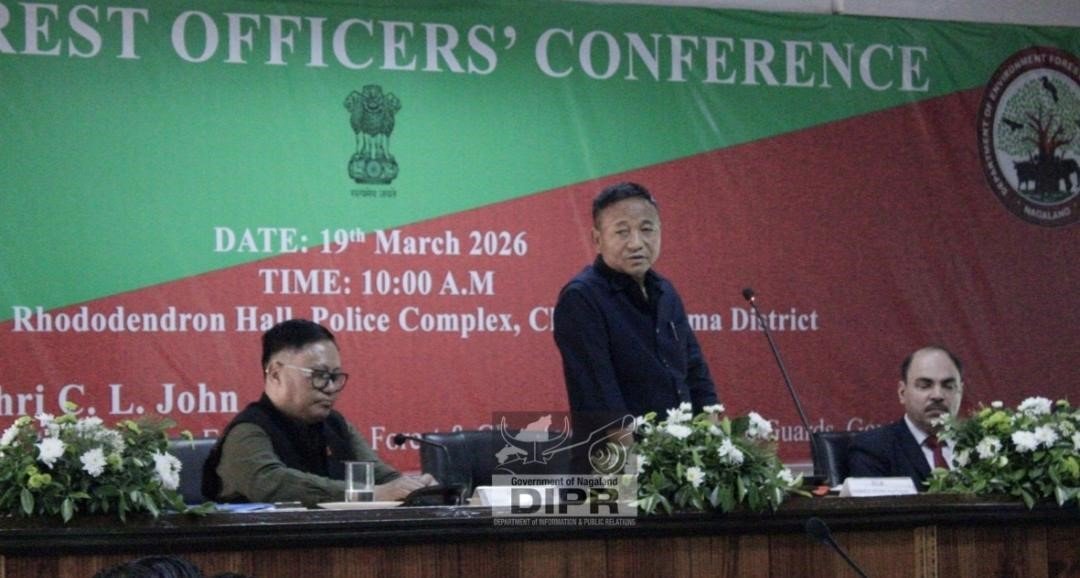
The Nagaland Forest Officers Conference was held on March 19 at Rhododendron Hall, Police Complex, Chümoukedima, bringing together forest officials from across the state to deliberate on key issues concerning forest management and environmental conservation.
The conference was graced by C. L. John, Minister for Environment, Forest & Climate Change and Village Guards, as the Special Guest and the programme was chaired by Vedpal Singh, Principal Chief Conservator of Forest & Head of Forest Force, who delivered the welcome address.
Speaking on the occasion, C. L. John highlighted the government’s commitment to environmental protection and the need for innovative approaches to tackle emerging challenges in forest conservation and climate change. He highlighted a range of pressing issues including human–elephant conflict, hunting, and forest conservation, while calling for urgent and coordinated action, John pointed to increasing human–elephant conflict in districts such as Longleng and areas like Bhandari, stressing the need for both awareness and preventive strategies. He emphasized community engagement, to educate people on how to safely deal with elephant encounters.
Highlighting hunting as a major threat to biodiversity, John termed it as one of the most dangerous issues facing the state and called for stricter enforcement and a complete ban. He also raised concerns over indiscriminate tree felling and urged the Forest Department to strengthen monitoring and regulation of forest resources.
In addition, John proposed proactive measures such as promoting plantation drives, suggesting that Anwar plantation be undertaken in lowland areas to enhance green cover and restore ecological balance.
Addressing environmental degradation, he strongly called for an end to forest burning practices, urging both the public and authorities to act responsibly. He stressed that the Forest Department must take greater accountability in preventing such activities and safeguarding forest ecosystems.
Further, He underscored the importance of public awareness and education, advocating for initiatives to teach communities how to protect and conserve forests effectively.
Concluding his remarks, John called for collective responsibility, emphasizing that only through joint efforts of the government, community bodies, and citizens can Nagaland’s forests and wildlife be preserved for future generations.
Y. Kikheto Sema, Principal Secretary, Environment, Forest & Climate Change, Fisheries & Aquatic Resources and Parliamentary Affairs, in his key note address, emphasized the importance of coordinated efforts, effective planning, and strengthening institutional mechanisms for sustainable forest governance in the state. In a landmark initiative, he said the first-ever Forest Officers’ Conference since the inception of the State’s Forest Department in 1963 was convened, bringing together senior officials, policymakers, and members of the media to deliberate on pressing environmental challenges and the future of forest governance.
Addressing the gathering, Y Kikheto Sema expressed gratitude to the Minister for Forests, Environment and Climate Change and the State leadership for supporting the initiative, describing the conference as a “historic and much-needed platform” for dialogue and coordination within the department. Highlighting the absence of such interactions in the past, it was noted that despite being one of the oldest departments, the Forest Department had functioned for decades without a unified forum for sharing ideas and strategies. Emphasizing unity, he remarked, “We must move from ‘I’ for illness to ‘We’ for wellness.”
The conference underscored the unique challenges faced by the State, particularly its complex landholding system, where the department directly controls less than 5% of the land. Despite this limitation, officers were urged to act as “custodians and soldiers” of the environment.
Key focus areas included forest management, biodiversity conservation, soil and water protection, and the urgent need to adopt modern tools such as GIS for data-driven decision-making. Officers were encouraged to engage directly with communities, promote awareness, and implement scientific practices in forestry.
A strong emphasis was placed on community participation through joint forest management. “The land may belong to the people, the forests may belong to the people, but the climate belongs to all,” he stated, stressing that sustainable livelihoods must be created to prevent forest degradation driven by economic necessity.
Download Nagaland Tribune app on Google Play

The issue of underutilization of the Compensatory Afforestation Fund Management and Planning Authority (CAMPA) funds was raised as a matter of serious concern. While over ₹58,000 crore has been released nationwide and significant amounts accessed by other northeastern states, Nagaland has reportedly failed to avail any funds. This, it was pointed out, may have resulted in the loss of opportunities worth thousands of crores.
The conference also highlighted the untapped potential of agarwood cultivation. Despite favourable conditions, the State lacks a clear policy, resulting in farmers receiving minimal benefits while neighbouring states capitalize on the resource. Plans are underway to collaborate with the Rain Forest Research Institute to promote scientific cultivation techniques and sustainable income generation.
On administrative reforms, a proposal was discussed to introduce a zonal posting system to ensure equitable distribution of responsibilities, particularly in remote areas. It was suggested that field service in difficult terrains be made mandatory for career progression.
The importance of strengthening revenue systems was also emphasized, with plans to enhance royalty collection and improve financial accountability within the department.
Sema further stressed the need for capacity building, including physical endurance, crisis management skills, and effective communication – not only with communities but also with wildlife and nature. Encouraging eco-tourism and the promotion of the State’s rich biodiversity, the conference called for proactive efforts to showcase its ecological assets to the wider world.
Concluding the address, participants were urged to actively engage in the day-long sessions and contribute towards building a more responsive, efficient, and sustainable Forest Department.
The conference is expected to pave the way for policy reforms, improved coordination, and a renewed commitment to environmental conservation in the State.