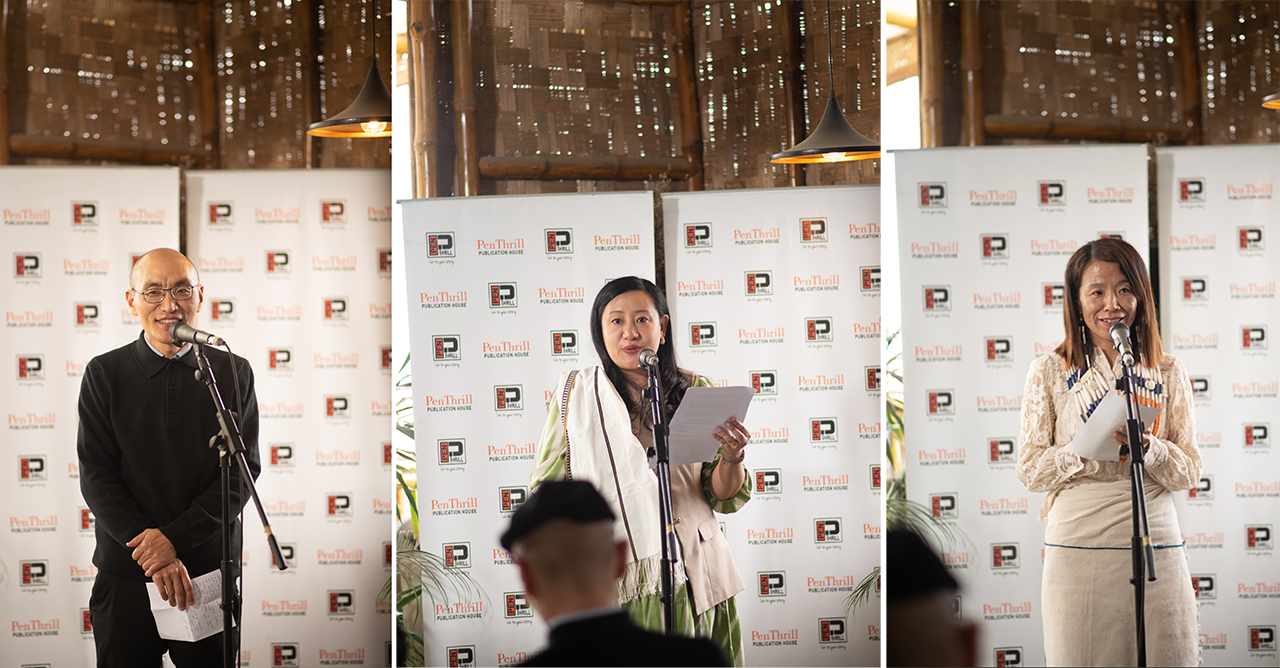
A book titled, “A bowl of Khaudzii”, written by Vishii Rita Krocha and illustrated by Adenuo Shirat Luikham was released at The Local Harvest Kohima on April 18.
The book was launched by Deputy Secretary, Government of Nagaland, Asalie Lese. In his speech he stated that the book talks about a particular food item, but that is not an end in itself. Through it, the author presents relationships within the family, as well as the social and economic life of a community. It shows why people in certain cultures do things in particular ways and for specific reasons.
He said the book captures all these aspects. “Our culture and traditions will not endure unless they are documented and carried forward. I sincerely congratulate everyone involved,” he added.
“Similarly, our culture is not limited to symbols like the spear or war cry. It includes our language, food, and the way we interact with one another. One beautiful cultural practice I’ve observed is how people protect others’ dignity. Instead of pointing out someone’s flaws directly, they include themselves in the description, softening the statement and sharing the burden. To me, this reflects a deep sense of respect and empathy,” he further stated.
Lese further said in literature, especially for children, one has access to global works like DC Comics and Marvel Comics etc . “While these are valuable, we also need more local stories—stories we can immediately relate to. Narratives about our towns, villages, daily life, and shared experiences can help preserve our identity and pass it on to future generations,” he said.
Publisher and author, Rita Krocha, in her address, shared that her journey to capture the essence of khaudzü—a native dish she grew up loving—began several years ago. Over time, her appreciation deepened, not only for its taste but for the realization that traditional foods carry stories and offer comfort.
This journey has taken shape in her book “A Bowl of Khaudzü”.
Download Nagaland Tribune app on Google Play

She expressed gratitude to her collaborator, Adenuo—an academic, poet, writer, and artist—who brought the story to life through her illustrations, transforming it into something vivid and meaningful.
Recalling simple days, often Sundays or rainy afternoons in Kohima, she spoke of gathering with family and friends to cook and share khaudzü—moments filled with belonging, nostalgia, and connection to their roots.
One of the key reasons for writing the book, she noted, was the gradual disappearance of traditional foods from both tables and memory. Many children today have neither tasted nor recognized such dishes, which embody cultural values and history, she said and emphasized that “our connection to food shapes our lives, and ancestral dishes must be preserved as part of our heritage”.
Describing the book as a labour of love, she said it reflects years of cooking, experimenting, and sharing meals with loved ones. It also acknowledges the efforts of farmers whose hard work brings food to our tables.
Beyond sharing a recipe, the book aims to preserve childhood memories and inspire younger generations to reconnect with their roots. Culture, she said, exists not only in traditional attire but also in everyday practices, especially the food we eat.
She also recalled her mother’s words that khaudzü is more than just a dish—it holds cultural significance. It was a source of comfort during illness and, in earlier times, was offered to grieving families as nourishment and healing. It represents connection within the community and serves as a reminder to listen to the wisdom of ancestors.

She expressed thanks to her family, friends, and all who supported her in bringing the book to life. Special appreciation was extended to Asalie Lese for releasing the book, Dr Vizovono Elizabeth for her thoughtful reflections, and Adenuo for her creative contribution.
She also acknowledged others who contributed to the event and thanked the media for amplifying such stories. Above all, she expressed gratitude to God for the gift of creativity.
She concluded with the hope that “A Bowl of Khaudzü”, marking PenThrill’s 120th publication, will encourage people to rediscover traditional dishes and bring warmth and joy back into their kitchens.
The book, marks PenThrill’s 120th publication .
Independent editor and researcher, Dr Vizovono Elizabeth expressed that when love cannot be expressed in words, it is shown through food/ it manifests in food. “I think this is so true for us Nagas because culturally we are not too expressive with words when it comes to love. But often, we find that food is shown as love,” he added.
“It is the ultimate expression of love and care. It is through the act of cooking and sharing meals that we show our affection for one another. So if you have someone in your life who loves to cook for you, or pampers you with food, take note – they love and care for you. Do not expect verbal love you’s. It is there, in the food. Food is our love language,” he stated.
The program was chaired by Runshito Lims, Author, Poet & Assistant Professor, Alder College Kohima. Senjano N Murry blessed the program with prayer. Illustrator Adenuo Shirat Luikham also shared her journey.