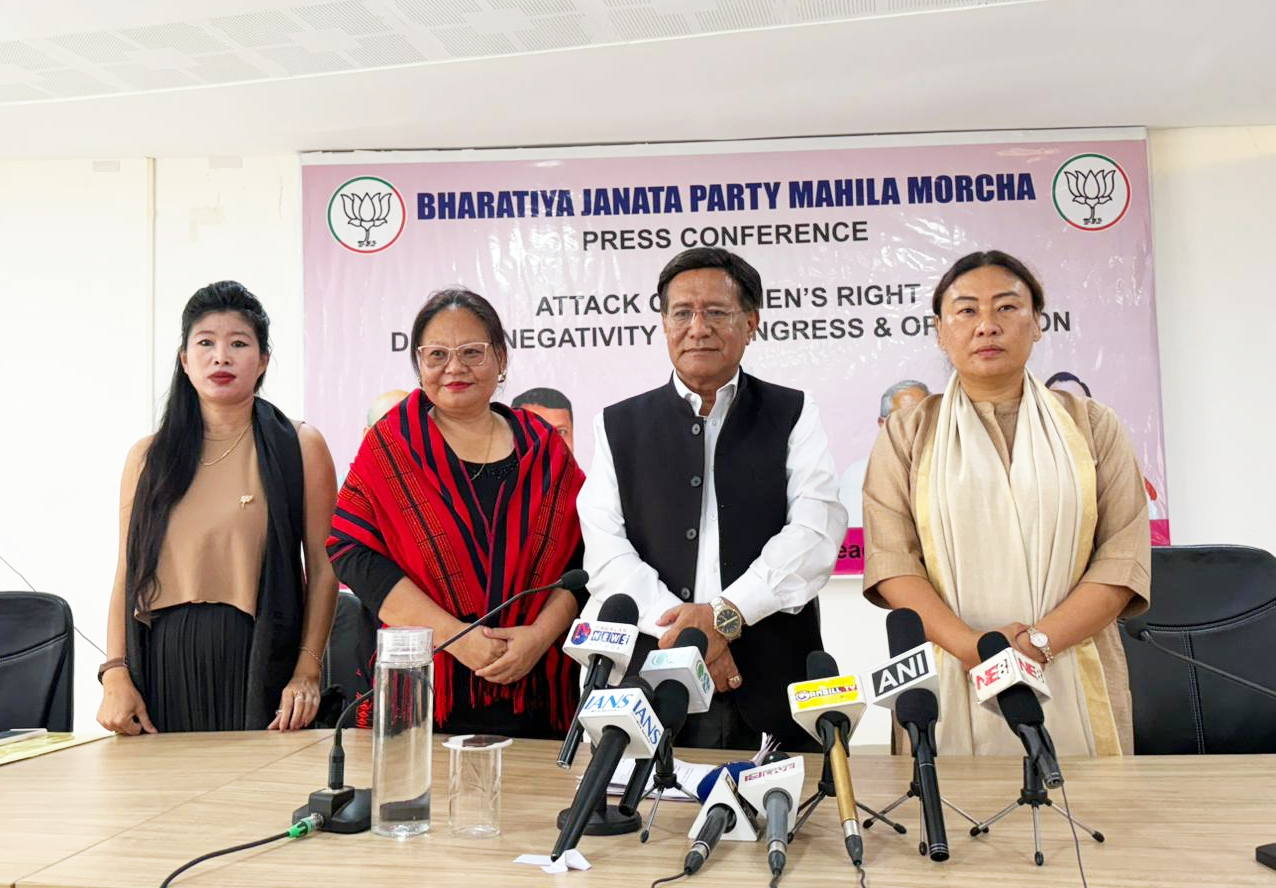
The Bharatiya Janata Party (BJP) Mahila Morcha on Monday accused the Congress and Opposition parties of obstructing key legislations aimed at ensuring 33% reservation for women in Parliament and State Assemblies.
Addressing the media at the BJP Head Office, Member of Parliament (Rajya Sabha), Phangnon Konyak, said that on April 16, 2026, the Central Government introduced three crucial Bills in the Lok Sabha — the Constitution (One Hundred and Thirty-First Amendment) Bill, 2026; the Delimitation Bill, 2026; and the Union Territories Laws (Amendment) Bill, 2026 — with the objective of expediting the implementation of the Nari Shakti Vandan Adhiniyam.
“To ensure timely benefits for women, who constitute nearly half of the country’s population, the government proposed to delink the implementation from the constitutional requirement tied to delimitation,” Konyak stated. However, she expressed regret that the Bills could not be passed.
She clarified that the proposal included a proportional expansion of Lok Sabha seats by 50% across all States and Union Territories, rather than altering representation based purely on population. Currently capped at 543 elected members (with the constitutional limit fixed at 550 since 1976), she noted that the expansion would have increased the strength to around 815–850 seats, maintaining proportional representation for all States.
“In 1971, India’s population was about 54 crore. Today it stands at over 1.4 billion. Representation has effectively reduced over time due to population growth. Increasing seats in Parliament is essential for fair representation,” she said.
Addressing concerns that the proposal aimed to modify the Delimitation Commission, Konyak asserted that there were no changes to the existing legal framework governing the Commission. Any recommendations would still require parliamentary approval and the President’s assent, she added.
She also dismissed fears that smaller States would lose representation, stating that the proposed 50% uniform increase would have benefitted all States equally. “Nagaland, which currently has one Lok Sabha seat, would not have lost out. In fact, representation would have improved,” she added.
On the issue of Scheduled Caste and Scheduled Tribe representation, she said the delimitation process ensures proportionate reservation, and with an expanded House, the number of reserved seats would correspondingly increase.
Responding to allegations that the Bill was intended to delay the caste census, Konyak said the government has already initiated a time-bound Census programme, including the enumeration of caste data during the population phase.
She further clarified that reservation in India is not granted on the basis of religion, responding to questions about separate quotas for Muslim women. “Reservation has always been structured around constitutional provisions, not religion,” she stated.
Konyak emphasized that the Women’s Reservation Bill was first introduced and passed in 2023 to establish a constitutional framework, reflecting broad political support at the time. The recent move, she said, was aimed at expediting its implementation ahead of the 2029 elections.
Download Nagaland Tribune app on Google Play


Calling the failure to pass the Bills “unfortunate,” she remarked that women in Nagaland had to wait more than five decades after statehood to see representation in the State Assembly, with only two women elected in the last Assembly elections. “For good governance and true progress, voices from all sections of society are essential,” she said, adding that Prime Minister Narendra Modi envisions women-led development as a cornerstone of governance.
Also addressing the media, National Vice President of the BJP and Chairman of MarCoFed, Government of Nagaland, Dr M Chuba Ao alleged that the failure of the 131st Constitutional Amendment Bill and the Delimitation Bill was due to the opposition INDI Alliance withholding the required two-thirds majority for a constitutional amendment.
“The failure was not accidental. It was a calculated move,” he claimed, asserting that the NDA government remains committed to securing 33% reservation for women.
He said the BJP would continue to pursue the issue “in Parliament, on the streets, and in every election” until women receive their due share of representation. “Nari Shakti is not a political slogan for us — it is a national resolve. The women of India are watching,” he added.