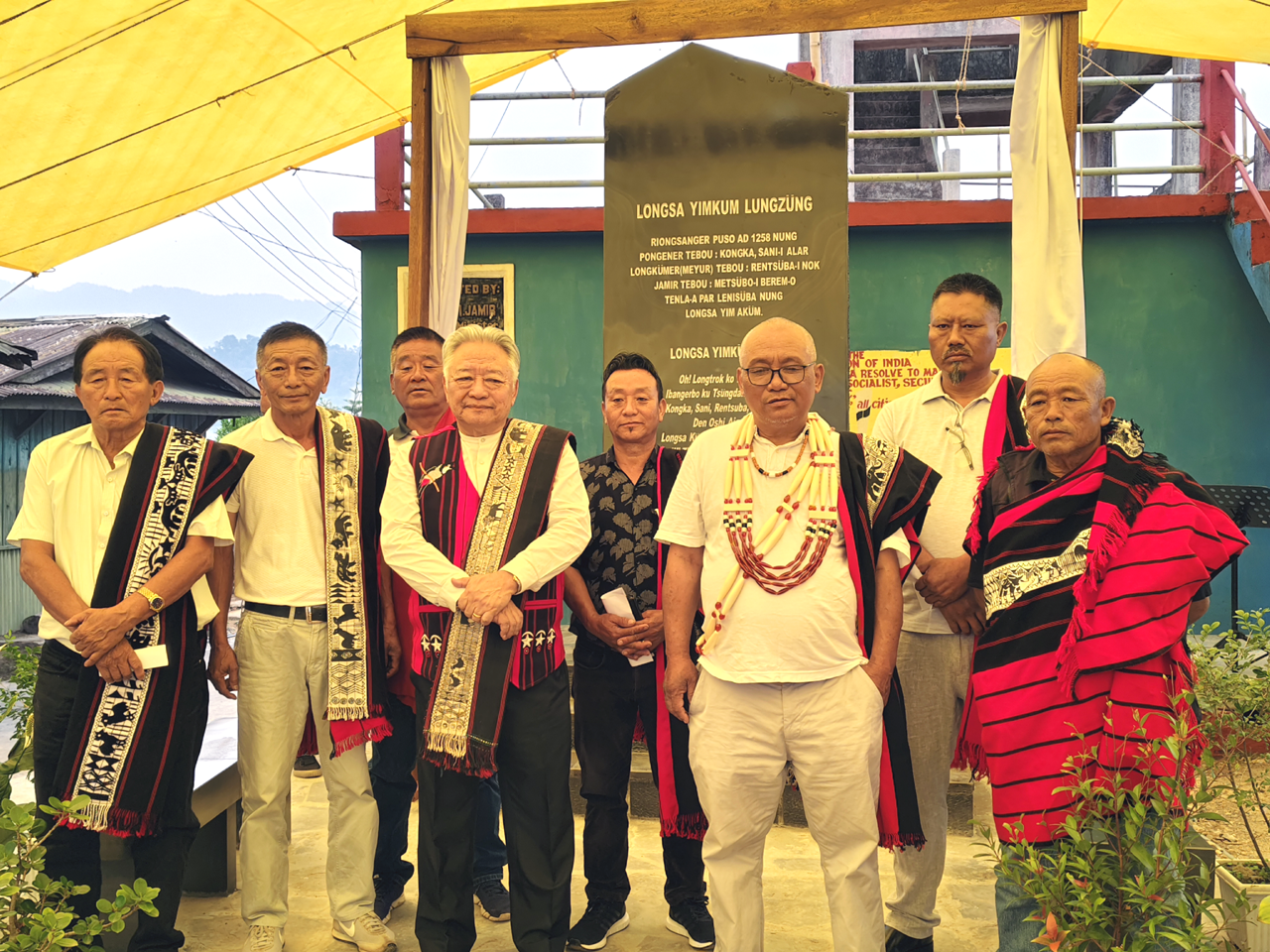
A monolith foundation stone was erected at Longsa Imrongtama on April 25, documenting the historical foundation and continuity of Longsa Village, whose origin is traced to AD 1258.
The stone stands as a recorded legacy of the Riongsanger puso (generation) and the three founding clans of the village: Kongka, Sani (Pongener clan), Rentsüba (Longkumer/Meyur clan) and Metsübo (Jamir clan).
The monolith was inaugurated by Alemtemshi Jamir, IAS (Retd). In his address, he placed emphasis on history as a defining discipline that situates individuals and communities within a continuum of identity and belonging.
Drawing from his academic grounding in history, he stated that the understanding of the origin of one’s lineage, land and people remains central to recognition, both within and beyond one’s immediate environment.
Referring to the occasion, he described the erection of the monolith as a formal acknowledgement of Longsa’s historical consciousness which is an effort not limited to recording the point of origin, but extending to the lived experiences of the people across centuries. He noted that the village’s existence for over 768 years reflects continuity shaped by endurance, adaptation and collective identity.
He further recalled the words of his father, N I Jamir, who had expressed the desire to document the history of Longsa “in alphabets of gold,” and said such initiatives contribute to that larger aspiration of preserving memory in tangible form.
Reflecting on the past, Jamir observed that the forefathers of Longsa sustained life through agrarian practices and undertook inter village movement on foot during a period marked by hardship and headhunting traditions. Despite limitations of mobility and resources, he noted that they upheld systems of social honour, responsibilities, feasts and community living with dignity. He noted that such experiences form an integral part of the village’s historical narrative. He also stated that Longsa village has existed for over seven centuries, built on dignity and added that, as per oral accounts, the village was not subjected to attacks from other Ao villages during earlier times.
He described the monolith as not merely symbolic, but as a record of history representing the land, people and legacy of the village. He further stated that the present status of the village is rooted in the contributions of its forefathers and urged that this foundation be remembered.
He also highlighted that members of Longsa village have been associated with governance and administration over a prolonged period, including during the British era and also after the formation of the state. He cited names such as N I Jamir, Imtimeren, Takomeren, Aolepden, Merentoshi and presently Minister Metsubo, MP Supongmeren and noted that the village has produced three Chief Secretaries, including himself.
Nagaland Tribune app on Google Play


Stressing on responsibility, he stated that while such achievements reflect progress, they should not lead to complacency, and called upon the present generation to continue contributing while remaining mindful of their roots. He added that irrespective of their place of residence, members of the village should retain their connection to their land and identity.
He also expressed concern over the declining use of their native Longsa language among sections of the community settled in towns and cities, and stressed the need for its preservation through regular speaking and communication, stating that language forms an essential component of historical and cultural identity.
Earlier, Limaakum Tatar spoke on the significance of the monolith. Welcome addresses were delivered by Akangjungshi Tatar of Tepo Asem Chir Yimsüsür, Longdi Yimsen Yimsüsür, and Temjensosang Tatar of Lemtu Ongerna Yimsüsür.
The programme was chaired by Bendangwati Tatar. Rev. Supongchiten, Pastor of Longsa Baptist Church, read from the Bible and offered the invocation. Alemwati Tatar delivered the vote of thanks, while the closing prayer was pronounced by Temsiiyanger, Secretary, LBA.