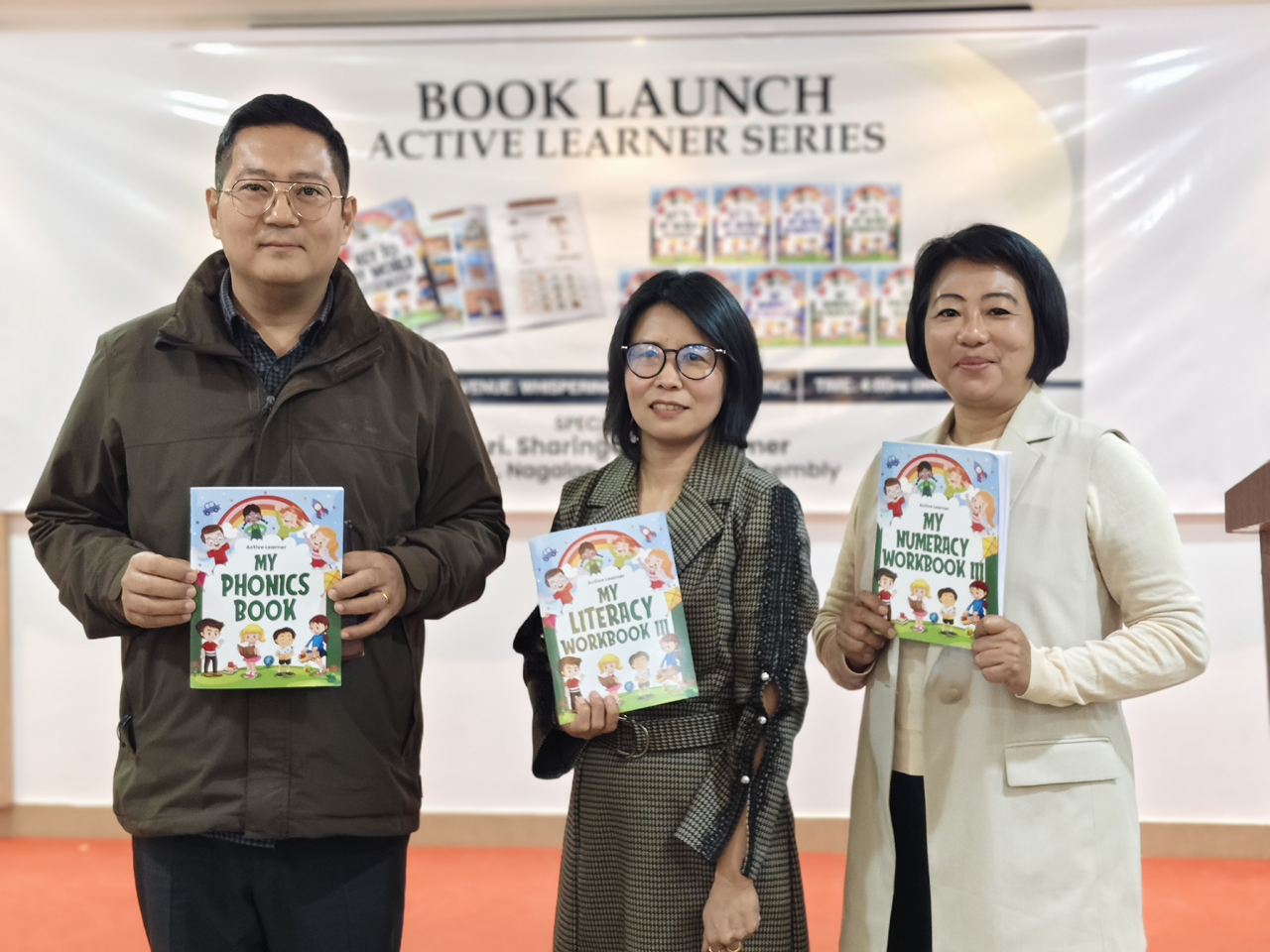
An 11-book Active Learner Series authored by Dr Ajungla Lipok for early childhood education was officially launched at Whispering Winds, Mokokchung, on April 30, with Speaker of the Nagaland Legislative Assembly, Sharingain Longkumer, attending the programme as the special guest. During the launch, Longkumer stressed the importance of preserving childhood innocence, encouraging reading habits among children, and described education as “a very serious social business” where “the moral responsibility outweighs the profit motive.”
In his address, Sharingain Longkumer described the creation as “historic and significant” not only for Mokokchung but for the wider community as well.
“We are living today in a world where we don’t seem to recognize the very significant things that we witness,” he said while appreciating Dr. Ajungla and her team for creating the series. Referring to his own experience as a father, he stressed the need to introduce reading habits during the earliest stages of childhood.
Longkumer remarked that society increasingly views schools from a business perspective.
“Why I say school is a social business is because yes, there has to be some profit motive behind running an institution because you have to pay salaries, maintenance and many other things. But you are playing with people’s lives. You cannot go wrong,” he stated.
He said the moral responsibility attached to education outweighs the profit motive and added that everyone involved in an educational institution, the owners, teachers, and even administrative staff carries responsibility toward children and society.
Longkumer further stated that institutions such as schools and the print media, which he referred to as the “fourth pillar of democracy,” must uphold social responsibility above commercial interests.
“Every child is a blessing from God,” he said, adding that society must ensure children grow into “beautiful human beings.”
A major portion of his address focused on the increasing use of mobile phones among children. Stressing that “We must encourage the habit of reading to our children,” he expressed concern over parents handing mobile phones to children at a very young age in order to keep them occupied.
“I’m very against that,” he said while referring to the practice of giving mobile phones to children during busy schedules and household work. He noted that children become fully absorbed in digital platforms while parents finish their chores without fully understanding the long-term implications.
“Digital literacy is important for the parents, digital literacy is important for you and me,” he said, adding that society is often handing technology to children without fully understanding the technology themselves.
Calling for collective awareness, Longkumer said people must “collectively voice out in protest of mobile phones being handed to minors,” stating that the issue may appear insignificant but directly affects the future and well-being of children.
He repeatedly stressed the need to “preserve the innocence of the child.” Reflecting on his own childhood, he recalled “We grew up hanging from trees. We grew up with torn, bruised elbows and knees. That was childhood. That was innocence,” he said, while expressing concern that children today may never experience such freedom because of growing dependence on digital devices.
“As much as I can as a father, I try to give that time to my daughters. I let them play. I play along with them,” he added.
Referring specifically to the Active Learner Series, Longkumer urged the author not to shift the books into digital formats.
“The beautiful thing about reading books is that a child should be given that opportunity to imagine,” he said. “She or he should imagine. Give the child the opportunity to protect her or his innocence.”
He also suggested including a pledge page at the beginning of every book, where parents would commit not to introduce mobile phones to their children until they reach an appropriate age.
Longkumer described Dr. Ajungla Lipok as “one of our very own daughters of the soil” and termed the initiative “a history happening in Mokokchung.” Calling it a milestone for the community, he encouraged people to support and propagate the books further.
“Many of us are focusing on developmental infrastructure and this and that, but this is a history happening in Mokokchung,” he said. “This is something we should all be proud of.”
He further offered support through his trust foundation if assistance was required regarding future collaboration.
Speaking on publishing standards, Longkumer also highlighted the importance of environmentally friendly printing materials, especially for books meant for infants and children. He said inks used in children’s books should preferably be natural, less toxic, and environmentally safe.
Dr. Ajungla Lipok, during her author’s address, shared that the ‘Active Learner Series’ emerged from years of engagement with early childhood education and from observing gaps in existing learning materials available in the market.
According to her, while many educational resources were available, many relied heavily on repetition and rote methods with limited emphasis on engagement, exploration, and understanding. She also observed that literacy development materials were often disappointing.
She stated that the series evolved from worksheets and classroom learning materials originally created out of necessity to make learning “more meaningful and engaging” for children.
Dr. Ajungla said the materials gradually developed into a more systematic, child-centric approach rich in experiential learning opportunities, which eventually became the foundation of the Active Learner Series.
The series consists of 11 books structured across three progressive levels designed to support three years of early childhood education.
Level 1 consists of four books introducing children to literacy, numeracy, and their environment through activity-based exercises focused on familiarisation, comfort, curiosity, confidence, and independence rather than performance.
Level 2, consisting of three books, focuses on more intentional and skill-oriented learning, including phonetic awareness through sounds, blending sounds into words, and helping children transition from letter recognition to actual reading.
Level 3, which includes four books, focuses on consolidation, application, and deeper understanding. At this stage, children are guided toward building words and sentences, comprehension, independent reading, and understanding phonics rules and patterns.
Dr. Ajungla further stated that the series is guided by the philosophy that “children learn best when they are actively engaged.” She added that the books are designed to encourage exploration, participation, independent thinking, and meaningful learning experiences.
Download Nagaland Tribune app on Google Play


She also highlighted the importance of visual illustration and design in the books, stating that the illustrations effectively capture the essence of the content and help sustain curiosity, engagement, and deeper understanding among young learners.
The design and illustration for the series were done by Bendangonen Atsongchanger.
The programme was chaired by Arenla Tzudir. Invocation prayer was pronounced by Yanglo Pongen, Pastor, MTBA, while a book review was presented by A Ayimsungla Amer, Lecturer, DIET Mokokchung. The publisher’s note was delivered by Bendangtula of TDCC Printing & Publishing. The programme also included a song from the Active Learner series and formal release of the books.
*Know the Author Behind the Active Learner Series: Dr. Ajungla Lipok*
Dr. Ajungla Lipok is an educator, researcher, and social entrepreneur based in Arkong Ward, Mokokchung, who has professional involvement in early childhood education, Montessori training, academic resource development, and community-based educational initiatives.
She is the proprietor and administrator of Greenfield Star Preschool, Mokokchung, established in 2017, where she oversees child-centric and activity-based learning programmes, curriculum implementation, staff management, and institutional development. Since 2015, she has also been serving as proprietor of the International Montessori Teachers Training Centre, Mokokchung Branch, training educators in Montessori philosophy and methodology.
Dr. Ajungla is the founder of Active Learner, an initiative under Shisa-Ren-Lok, through which she conceptualised and developed early childhood academic resources focused on experiential and child-centred learning. She currently serves as the Chairperson and Permanent Trustee of the Shisa-Ren-Lok Trust, leading initiatives related to early childhood education, teacher training, and community development.
She is also a founding member of TREsT, an organisation working towards empowering rural youth, women, ex-servicemen, and their dependents through sustainable livelihood and rural development initiatives across Nagaland.
Her academic background includes a Ph.D. in Botany from the University of Pune in 2008, with research focused on tissue culture studies in Datura metel L. for secondary metabolite production. She completed her M.Sc. in 2000 and B.Sc. in 1998 from the University of Pune, and later obtained an Advanced Diploma in Montessori Teacher Training from the International Montessori Teacher’s Training Institute, Dimapur, in 2014.
Dr. Ajungla previously served as a Research Associate at Nagaland University, SASRD, from 2009 to 2010, and later under the Department of Biotechnology, Government of India at Nagaland University from 2011 to 2012.
Her research works have been published in scientific journals including Plant Cell Biotechnology and Molecular Biology and the Indian Journal of Biotechnology. She also co-authored Medicinal and Aromatic Flora of Nagaland, published by the Medicinal Plant Development Agency, Government of Nagaland, in 2010.
Apart from education, she has been involved in promoting eco-friendly and sustainable rural enterprises. Under TREsT, she initiated and facilitated the installation of an Areca Leaf Plate Manufacturing Machine at Tuli to support rural livelihood generation, sustainable use of local resources, and skill training for women and youth in eco-friendly production practices.