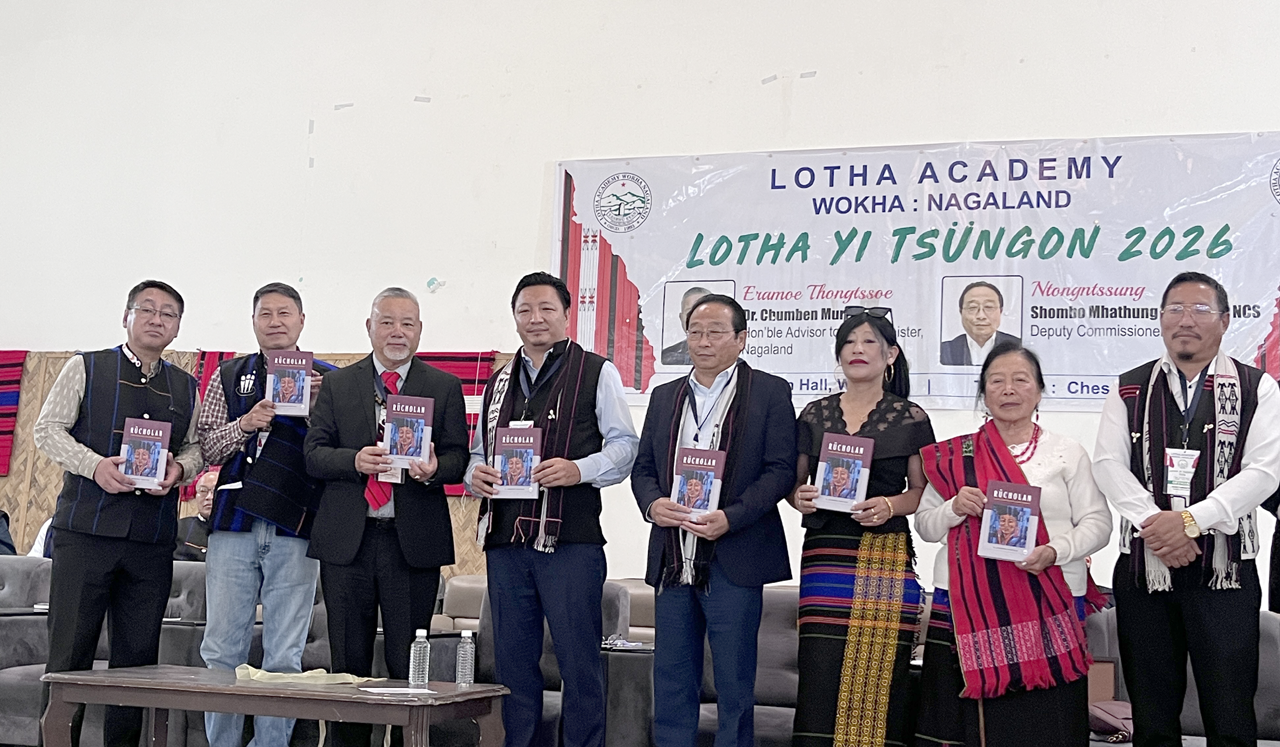
The Lotha Academy observed Lotha Language Day on May 1, 2026 at the Town Hall, Wokha, with Dr Chumben Murry, Advisor to the Chief Minister, as the special guest.
Delivering the address Dr Chumben Murry stated that it is not only about refining the Lotha language, but about preserving our identity. He stated that language is closely tied to cultural heritage. Reflecting on his own life, he admitted that he had not given much importance to language and cultural heritage in the past, but has now realized their significance, describing it as a mistake he made and urging others not to repeat it.
He stressed the importance of unity, stating that language has the power to bring people together, and that unity, resilience, and hospitality are all interconnected through language. He added that the better one speaks a language, the stronger the relationships one can build.
He said that the wisdom of the ancestors, along with the rhythm of folk songs and folklore, is deeply rooted in language. He emphasized that preserving language and heritage should become a movement, where people do not merely attend programmes but take personal responsibility.
He encouraged everyone to write more books in Lotha language, not only to preserve the language but also to innovate, while taking pride in both their language and culture.
In his exhortation, Mhathung Tsanglao, NCS, Deputy Commissioner of Wokha, lauded the Lotha Academy for its efforts to promote and preserve the Lotha language, particularly among the younger generation. He underscored that language is a core element of identity and stressed the responsibility of elders parents and ancestors in passing it on.
Tsanglao encouraged educating children in basic Lotha vocabulary, including names of trees, birds and everyday objects. He also urged the youth to value their language, noting that people are recognised by their culture, tradition and language when they go beyond their home district for studies or work. He further highlighted the role of social media, churches and Sunday schools in promoting and preserving the language.
He also advocated for conducting such programmes entirely in the Lotha language and suggested initiatives such as storytelling sessions, prayers and writing exercises in Lotha to strengthen linguistic skills. He reminded the gathering that the lessons from such programmes should be carried forward beyond the event itself.
Download Nagaland Tribune app on Google Play


In her greetings, Lolano Patton, DPRO and representative of the Lotha Officers’ Association, Wokha Unit, described the programme as an eye-opener and a meaningful step towards strengthening the language. She noted that despite being blessed with a rich linguistic heritage, many people tend to rely more on Nagamese and English, and urged the community to take full advantage of such initiatives by the Lotha Academy.
During the programme, a book titled “Rücholan: Lotha Folktale and Short Stories” authored by N. Janbemo Humtsoe was officially launched by Dr Chumben Murry.
The programme was chaired by Dr Bijano Murry Odyuo, Member of the Lotha Literature Committee. The invocation was pronounced by Limathung Patton, Catechist of St Paul’s Church, Wokha, while the welcome address was delivered by Fr Abraham Yanthan, Ph.D, President of the Lotha Academy. Highlights of the event included an oral storytelling session by Jenibemo Ezung, BA 2nd Semester, Bailey Baptist College, Wokha, and a folk song presentation by Fernbrook School, Wokha. The programme concluded with a closing prayer by Rev L Renathung Yanthan, Pastor of Niroyo Baptist Church.
