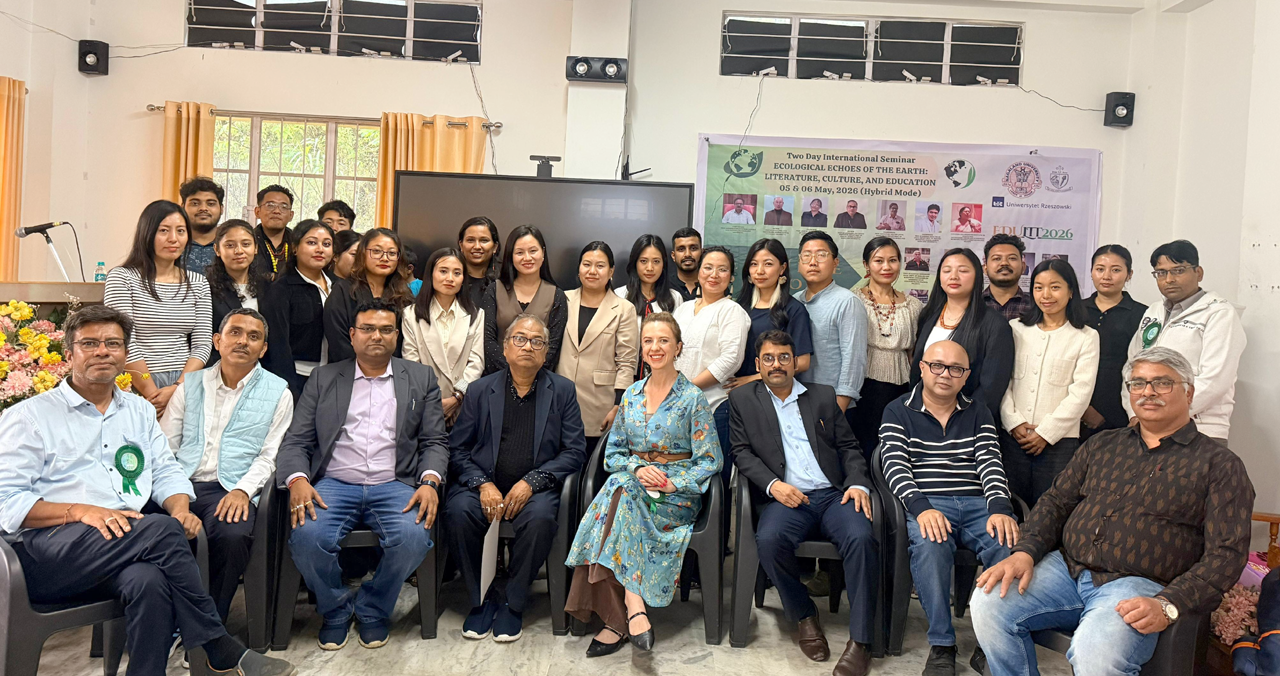
The Department of English, Nagaland University in collaboration with the Department of Teacher Education, Nagaland University, successfully organised a two-Day International Seminar titled “Ecological Echoes of the Earth: Literature, Culture and Education” on May 5 and 6 at the Conference Hall of the Department of English, Kohima Campus. The seminar emerged as a vibrant interdisciplinary academic platform devoted to ecological humanities, environmental ethics, sustainability studies, Indigenous epistemologies, literary ecology, and pedagogical transformations in the age of environmental crisis.
The seminar witnessed an overwhelming academic response with approximately 125 research papers received from scholars, faculty members, and students from universities and institutions across India and abroad. Owing to the large number of quality submissions, the organisers conducted twelve parallel technical sessions in both online and offline modes, thereby ensuring meaningful academic engagement and wider participation.
The programme was organized under the guidance and patronage of the Vice-Chancellor of Nagaland University Prof JK Patnaik, and received constant support from the Pro Vice-Chancellor, Kohima Campus. The seminar also reflected the collaborative academic spirit of the two departments.
The inaugural session began with a warm welcome address by Dr Subhashis Banerjee, Convener of the seminar, who highlighted the urgency of ecological consciousness in contemporary literary, cultural, and educational discourses. He emphasised that the seminar sought to create a dialogue between literature and environmental ethics while foregrounding Indigenous ecological knowledge systems and sustainable pedagogical practices.
Dr Prasenjit Pal, Convener of the Dept. of Teacher Education, was specially acknowledged for his meticulous coordination throughout the seminar. The organisers expressed their heartfelt gratitude to Prof. Nigamananda Das for his scholarly guidance and advisory support.
Nagaland Tribune app on Google Play


The seminar brought together an illustrious panel of internationally and nationally acclaimed scholars and academicians. The resource persons and plenary speakers included Pramod K Nayar, whose insightful deliberation explored environmental humanities and the ethics of ecological representation; Saugata Bhaduri, who discussed the intersections between literature, environment, and global modernity; and Bhavatosh Indraguru, whose lecture foregrounded cultural ecology and literary ethics. Prof Bhavatosh Indraguru also graced the valedictory session as the Guest of Honour and delivered an insightful address on the ethical responsibilities of literature and education in confronting contemporary ecological crises.
The international dimension of the seminar was further strengthened by the scholarly presence of Patrycja Austin, whose presentation highlighted ecological memory and transnational literary discourse. Dhananjay Tripathi delivered an engaging lecture connecting myth, gender, and ecological consciousness in South Asian narratives. Abhinandan Saikia illuminated the socio-cultural dimensions of sustainability and community ecology. Ajanta Paul reflected on ecological pedagogy and literary sensitivity in higher education.
The seminar also benefited from the academic interventions of Jyoti Narayan Baliya, Amina Kirbes, Tanmoy Bhattacharjee, Ashim Chakraborty, and Goutam Karmakar, whose scholarly deliberations enriched the interdisciplinary framework of the seminar.
The organisers also expressed gratitude to the distinguished session chairs who conducted the technical sessions with academic rigour and intellectual generosity, ranging from ecocriticism, Indigenous environmental knowledge, sustainability, environmental justice, ecofeminism, climate narratives, pedagogical ecology, translation studies, folklore to cultural memory. Their constructive observations and scholarly moderation elevated the quality of the deliberations and encouraged young researchers to engage critically with emerging ecological discourses.
Special acknowledgement was extended to Prof MAJ Khan, Head, Department of English, for his encouragement and administrative support. Gratitude was also conveyed to GN Tiwari for strengthening the collaborative spirit of the Department of Teacher Education. The organisers also recognised the contribution of faculty members, research scholars, volunteers, technical coordinators, and students whose collective efforts ensured the smooth conduct of the seminar.
One of the most significant aspects of the seminar was its emphasis on ecological interconnectedness through literature, culture, education, and Indigenous knowledge systems. The discussions repeatedly underscored that environmental crises cannot be addressed solely through scientific intervention; rather, they require ethical imagination, cultural sensitivity, literary consciousness, and educational transformation. The seminar therefore became a meaningful intellectual space where ecological thought was explored not merely as an academic discourse but as a moral and civilisational necessity.
The valedictory session concluded on a reflective note with expressions of gratitude to the participants, presenters, resource persons, session chairs, organisers, and collaborating departments. The seminar had successfully fostered interdisciplinary dialogue and opened new pathways for future research in environmental humanities and ecological studies.