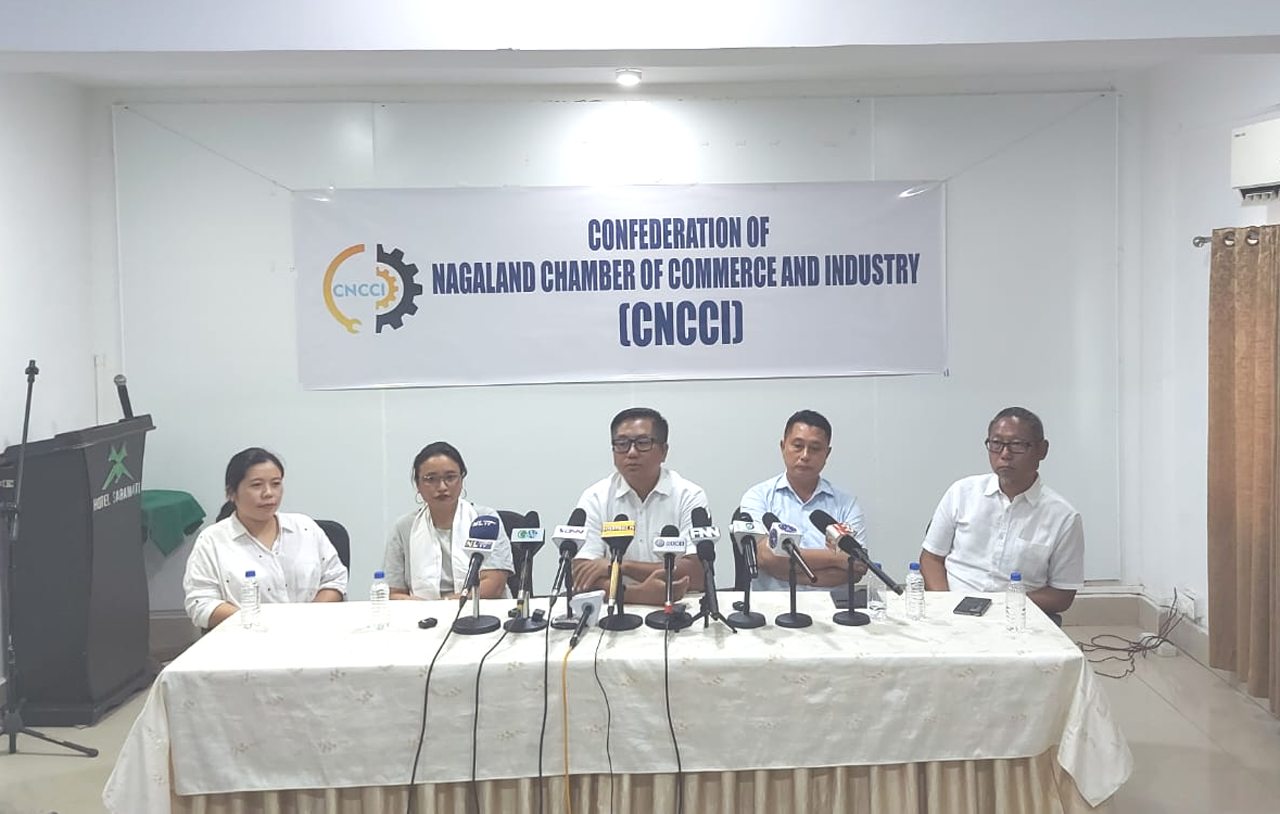
The Confederation of Nagaland Chamber of Commerce and Industry (CNCCI) has sought to dispel widespread confusion surrounding the recent notification issued by the Department of Health and Family Welfare on the prohibition of food products containing tobacco and nicotine, asserting that there is no blanket ban on tobacco products in Nagaland and cautioning against unauthorized enforcement actions by individuals and organizations.
Addressing a press conference at Hotel Saramati here, CNCCI Chairman Dr Khekugha Muru said the Chamber felt compelled to intervene following reports of confusion, panic buying, raids, destruction of products and alleged harassment of traders across several districts of the state.
At the outset, Dr Muru clarified that CNCCI does not endorse, encourage or promote the consumption of tobacco, pan masala or gutkha and remains concerned about their harmful impact on public health. However, he said it was equally important that government notifications are interpreted correctly and implemented in accordance with the law.
According to the CNCCI chairman, the past two weeks have witnessed considerable uncertainty in the market, with reports emerging from different parts of Nagaland regarding raids, seizures and destruction of products amid varying interpretations of the notification.
He noted that district chambers in Kohima, Mokokchung, Chümoukedima and Dimapur had already issued statements seeking clarification, prompting CNCCI to engage directly with the authorities.
Dr Muru informed that CNCCI representatives met the State Food Safety Authority and held discussions with senior officials to obtain a clear understanding of the notification and its intended scope.
“The meeting was very cordial and positive, and we have requested them to come up with more clarification in the next one or two days, and they have assured us that they will bring it out,” he said.
A major point of confusion, according to CNCCI, lies in the distinction between the Food Safety and Standards Act (FSSAI) and the Cigarettes and Other Tobacco Products Act (COTPA).
Dr Muru explained that the June 4 notification specifically targets food products that contain tobacco or nicotine and does not amount to a blanket prohibition on all tobacco-related products.
“The Food Safety Act and COTPA Act are a separate thing. So the confusion we have right now is that any food product that contains nicotine and tobacco is banned. Clear cut, it’s just that,” he said.
He stated that several popular pan masala brands available in Nagaland are licensed by FSSAI and are marketed as tobacco-free and nicotine-free products.
Referring to brands commonly sold in the state, he said that many manufacturers shifted to tobacco-free formulations following legal developments and directives issued by the Supreme Court and FSSAI in previous years.
“If a product is licensed under FSSAI and does not contain tobacco or nicotine, then it falls under a different category. However, if any product contains tobacco or nicotine mixed with food products, then it comes under the purview of the notification and cannot be sold,” he explained.
Dr Muru further clarified that tobacco products themselves continue to be regulated under COTPA and are not covered by the food safety notification.
He pointed out that the Nagaland Government had previously directed Urban Local Bodies to regulate the sale of tobacco products through licensing mechanisms and that such sales remain legal provided vendors comply with the prescribed rules and conditions.
“So the confusion is, tobacco is also not banned. Only mixing it is banned. Otherwise, if one has a ULB license, they can sell tobacco as well,” he clarified.
The CNCCI chairman stressed that traders should not be subjected to harassment due to misinterpretation of the law and urged authorities to ensure uniform enforcement across the state.
At the same time, he appealed to civil society organizations, student bodies, NGOs and community groups not to take enforcement matters into their own hands.
While appreciating the efforts of various organizations in raising awareness about the harmful effects of tobacco and other addictive substances, Dr. Muru emphasized that enforcement powers rest exclusively with authorized government agencies.
“…be it our mothers, our student leaders, or our GBs—whoever it is, if you catch such things, we will appreciate it if you don’t take the law into your own hands. Go and inform the competent authority, the police, the district administration, and food safety officers. If at all it has to be seized or destroyed, it is much better if it is done like this,” he said.
He warned that unauthorized confiscation or destruction of goods could expose individuals and organizations to legal consequences.
He said if products worth two or three lakh rupees are seized from someone’s shop and burnt without due process, and the owner subsequently files a police complaint or seeks compensation, who would take the responsibility. “We have to think about this properly too,” he said.
Download Nagaland Tribune app on Google Play


Echoing similar concerns, CNCCI Treasurer Kevin Yepthomi said misinformation circulating on social media platforms had significantly contributed to public confusion and panic.
According to Yepthomi, unverified messages and misinterpretations of government notifications created an atmosphere of uncertainty, leading to panic buying and artificial shortages of certain products.
“The government directive may not have been clearly understood by everyone, and social media amplified the confusion. Even businesses were unsure about the exact implications. That is why further clarification is necessary,” he said.
He maintained that while public vigilance is important, enforcement actions should remain within the framework of the law.
“People should remain alert and aware, but enforcement must be left to the administration, police and other competent authorities,” he added.
Replying to queries on syndicates being run by individuals, Dr Muru claimed that a handful of individuals control the distribution and dealership of major brands of pan masalas in the state, resulting in artificial scarcity and inflated market prices.
He described the situation as embarrassing and unprecedented, alleging that consumers in Nagaland are often forced to queue for products that are readily available elsewhere.
“It is so embarrassing, nowhere else in all of India have I seen people standing in queues for pan masala. Keeping people inside or sometimes keeping bouncers… it is the truth, bouncers are kept. Or police regulating and maintaining lines to buy pan masala, “ he said adding, “This hasn’t happened anywhere in India, but it’s happening in Nagaland.”
“This is because of a syndicate. This is because of a monopoly. And we are not happy with this. Even as much as we talk in favor of pan masala not being banned, we also at the same time would like to make it very clear to the syndicates and monopolies. This is not tolerable,” he asserted.
According to him, the monopoly over certain brands has enabled products with relatively low MRPs to be sold at significantly inflated prices.
“A product with an MRP of Rs. 20 is sometimes sold at Rs. 80 in Nagaland. Such artificial price inflation is a direct consequence of syndicates and monopolies,” he alleged.
The CNCCI chairman warned that the chamber would not remain silent on such practices and would take steps to promote fair competition and market accessibility.
He also issued a caution to companies supplying products to Nagaland, alleging that some local agents and distributors may be colluding to restrict market access and maintain monopolistic control.
He said local entrepreneurs should be given a fair opportunity to obtain dealerships and distributorships. A few individual should not be allowed to dominate the market indefinitely, he added.
Dr Muru further stated that CNCCI would be willing to assist aspiring Naga entrepreneurs seeking entry into such businesses if they face obstacles due to monopolistic practices.
Responding to questions regarding syndicates in other sectors, he reiterated CNCCI’s commitment to combating anti-competitive practices across industries.
Stating that syndicates and monopolies are illegal, Dr Muru said if they receive complaints and supporting evidence, they will pursue the matter through appropriate legal channels. “We have intervened in similar situations before and will continue to do so whenever necessary,” he said.
When queried about products being sold above MRP, the Chamber acknowledged complaints regarding the sale of products above the maximum retail price and urged consumers to formally report such cases.
Kevin Yepthomi observed that while complaints about overpricing are common on social media, many consumers do not file official complaints with the relevant authorities.
“If people want action, they must come forward and submit formal complaints. Without evidence and proper reporting, it becomes difficult to initiate action,” he said.